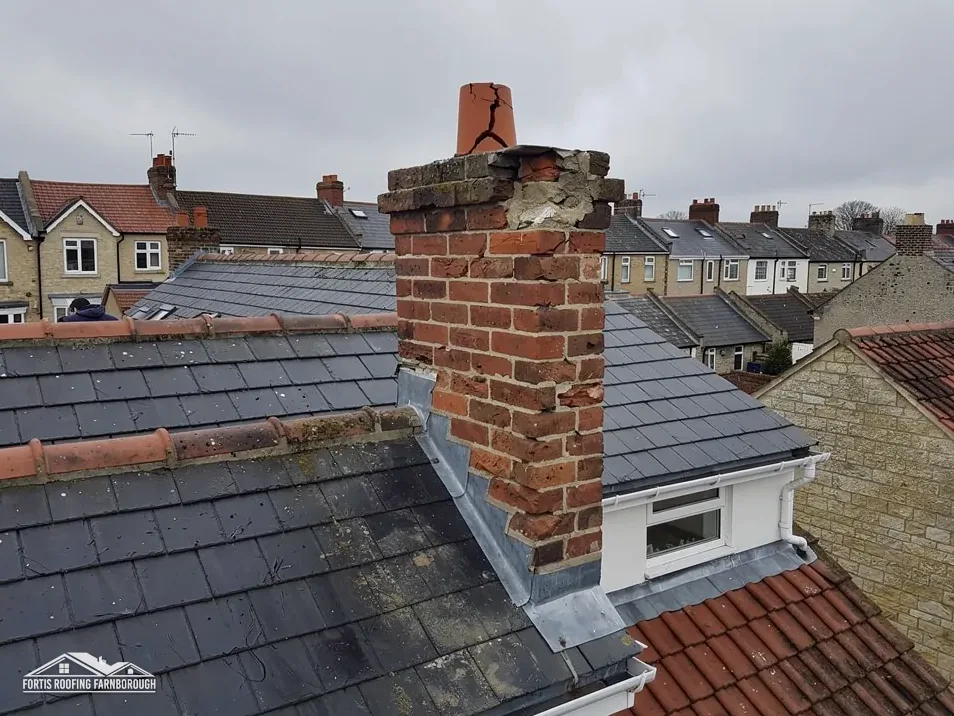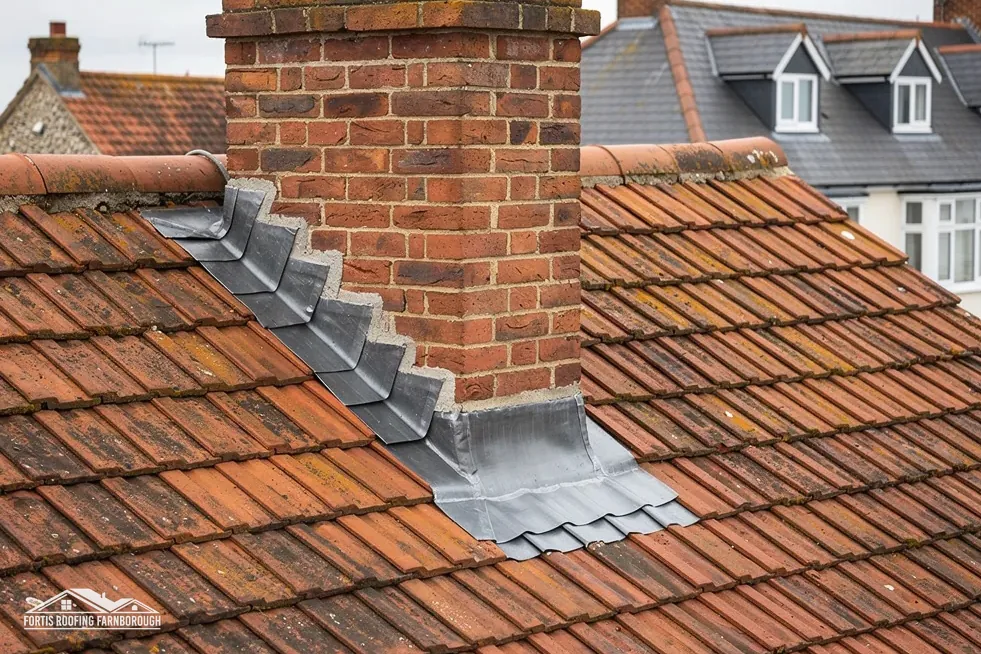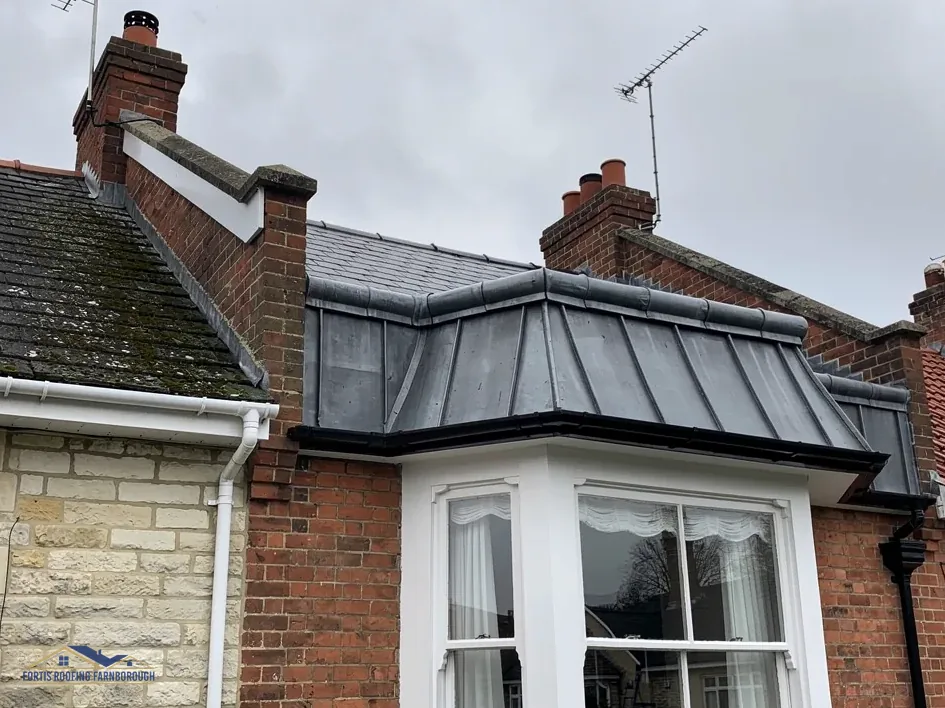
A valley forms wherever two roof slopes join at an inside corner. Rain from both slopes runs into it, so it takes more run-off than any other line on the roof, and it fails in a particular way: the lining cracks or the tile edges beside it slip, and water reaches the timber below. When a ceiling stain lines up under an inside corner, the valley is the first place we look.
People ask what a replacement should cost because the figures they hear are far apart. Some of that gap is real, since valleys differ in length, in lining and in how awkward they are to reach. Some of it comes from comparing a patch with a full replacement. This post sets out the national figure for a valley, names its source and date, and then explains what moves a valley price on a house around Farnborough.
The number below comes from a national cost guide, and it is no quote from us. It gives the scale of the job and nothing more.
The published figure for a lead valley
MyJobQuote's cost guide, dated September 2026, puts a full roof valley replacement at around £540 for most jobs. It is a single national average, and it needs three cautions before you use it.
It is a full replacement
The guide is describing taking a valley back to the timber and relining it. A repair to one split section, or a re-dress of a lifted edge, is a smaller job. A valley that has failed along its whole length is the case the figure describes, and a quote far above it is not necessarily wrong: a long valley on a steep roof costs more than a short one on a porch.
It does not know your roof
The figure carries no length, no roof height and no lead code. Two valleys on the same street can be quite different jobs, because one meets a hip at the top and the other runs down to a flat-roofed extension. The only way to turn a national marker into a price for your house is to measure the valley, so the written price follows the survey.
It says nothing about the tiles around it
A valley is lapped by the tiles or slates on both sides, and those have to be lifted and re-laid. If the roof covering is old and brittle, lifting it can break it. So when you set a valley quote beside the figure above, take a look at the surrounding tiles too. Our guide on lead valleys and dry valleys covers how the two types are built.
How a lead valley is built
Before reading a price it helps to know what the money buys. A lead valley is a gutter formed in the angle of the roof. It is a strip of milled lead sheet laid in the valley on a timber board, with the tiles or slates of each slope lapped over the edges.
The base
Under the lead sits a boarded or battened bed, covered with an underlay so the lead does not sit on rough timber. If the old boards are damp or soft, they are replaced first. That is one of the few things that cannot be judged until the lining comes off, and it is the usual reason a valley job grows once work starts.
The lead
Lead is a soft metal, so it is laid so that it can move. It expands in sun and contracts at night, and a sheet that is too long or fixed too tightly will tear along the fold lines over the years. The sheet is dressed into the shape of the valley and held by its overlaps, with the tile edges holding the sides down.
The edges and the top
Where the valley meets the ridge and where it empties into the gutter or a lower roof, the lead is dressed so that water runs on and is not pushed back. Those ends are where most failures show first, which is why we photograph them. A flashing is a related lead strip at a wall or chimney; if you want its price range as well, our post on lead flashing cost sets it out.
Choosing the lead code for a valley
Lead sheet is sold by "code", a number that gives its thickness and weight per square metre. A higher code is thicker, heavier and dearer, and each code has jobs it suits. Royston Lead, a sheet maker, publishes the codes and their uses in a brochure.
| Code | Thickness | Weight per m² | Royston lists it for |
|---|---|---|---|
| Code 3 | 1.32 mm | 14.97 kg | Soakers only |
| Code 4 | 1.80 mm | 20.41 kg | Soakers, flashings, pitched valley gutters, dormers |
| Code 5 | 2.24 mm | 25.40 kg | Flashings, pitched valley gutters, parapet and box gutters, tapered valley gutters, dormers |
What the table tells you
Code 3 is listed for soakers only, so a valley lined in Code 3 would be a thin choice. Code 4 and Code 5 both appear for a pitched valley gutter. Code 5 is the thicker and heavier of the two, and it is the one listed for the larger tapered and box valleys. For a normal pitched valley the choice is between 4 and 5, and the length of the valley and the roof it drains decide it.
The code is one of the few levers on price that sits in your hands. Our answer on Code 4 against Code 5 covers the choice in more depth. We would not drop a code just to match a lower quote on a valley that carries a lot of water.
What moves the price of a valley job
Beyond the lead itself, a handful of site facts push a valley price up or down. Knowing them lets you read two quotes that seem far apart and see why.
Length and number of valleys
A roof with one short valley over a porch is a small job. A house with an L-shaped plan has a long valley, and a house with an extension may have two or three. The cost grows with every metre of valley and every junction where a valley meets a hip, a ridge or a wall.
Height and access
A valley on a single-storey roof can be reached with a ladder and a roof ladder. A valley three storeys up needs scaffold, and the scaffold, with the days it stands, is part of the figure. MyJobQuote makes the same point about chimney leadwork, whose range of £350 to £920 depends on scaffold. If the scaffold would be on the highway, it needs a licence under the Highways Act 1980 s169 from the highway authority. Ask who applies for it, because the licence adds time before work can start.
The roof covering
Slate valleys and clay tile valleys are fiddlier than plain concrete tile ones, because the edge pieces must be cut and the old material may be fragile. Tiles that have to be replaced as well add to the figure.
What is under the old lead
A valley board that has rotted, or rafters that have been damp for years, need repair before relining. A survey with photographs from the roof can often show this ahead of time, and it avoids a surprise mid-job.
Lead against a dry valley
A dry valley is the alternative. Instead of an open lead channel, it uses a preformed plastic or GRP trough laid in the angle, with the tiles of both slopes cut to meet over it. The tiles come close to the centre line and the trough shows only a narrow gap or none at all.
Where a dry valley suits
It is quicker to fit and gives a neat, uniform edge on a modern tiled roof. On a roof that never had a lead valley in the first place, such as a newer concrete-tiled house, a dry valley is often the way it was built, and replacing it like for like makes sense.
Where lead is the better choice
On a slate roof, on an older house or on a listed or conservation home, a lead valley may be the correct detail. It is the form the original builders used, and it lasts well; MyJobQuote words the flashing figure as "over 80 years", a lower bound for flashing and no promise for one valley. If you are in a conservation area or a listed building, tell the surveyor, because changing the valley type can change the look and may need consent.
Reading the price
A lead valley costs more to fit than a dry valley because the metal costs more and it takes longer to dress. That said, the cheaper detail is not automatically the right one, and a quote that swaps a lead valley for a dry one without telling you has changed the job. If the choice is open, ask the surveyor to say why one detail suits your roof better than the other.
Rules, checks and a valley that is not leaking
Replacing a valley lining is repair work, and it does not usually raise a Building Regulations question on its own. Approved Document C, the Building Regulations guidance on moisture, asks for a roof that excludes rain and for each sheet and tile to be properly fixed, and for lead it refers to BS 6915:2001. A valley that sheds water and stays put is doing what that guidance asks. If a larger re-roof is planned at the same time, the Planning Portal test applies to the whole job, and we check the building control position before work starts.
Signs a valley is failing
Look for a brown stain on a ceiling under an inside corner, moss or debris packed along the valley, lifted or cracked tile edges beside it, and light or daylight in the loft along the line of the angle. Lead that has split along a fold, or been patched with sealant, is a warning. Sealant smeared over a split in lead fails again quickly.
Before you accept a price
Ask for the valley length, the code and the covering to be named on the quote. Ask whether the boards are included if they turn out to be rotten, and whether VAT and scaffold are in. Citizens Advice recommends at least 3 written quotes before you decide. Our lead roofing and leadwork page covers the wider range of lead jobs we carry out around Farnborough.