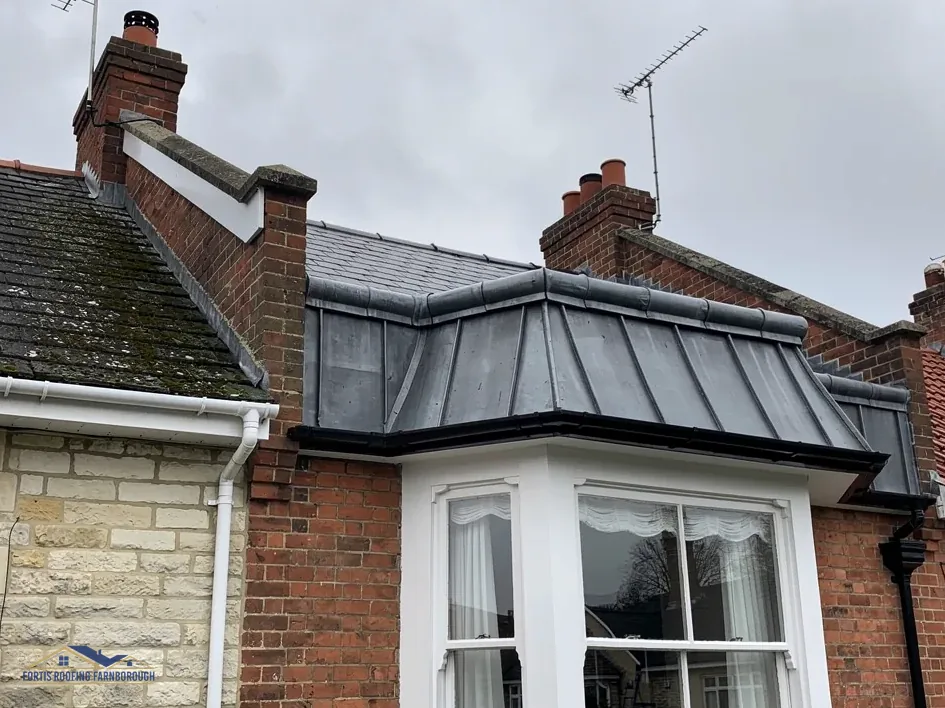
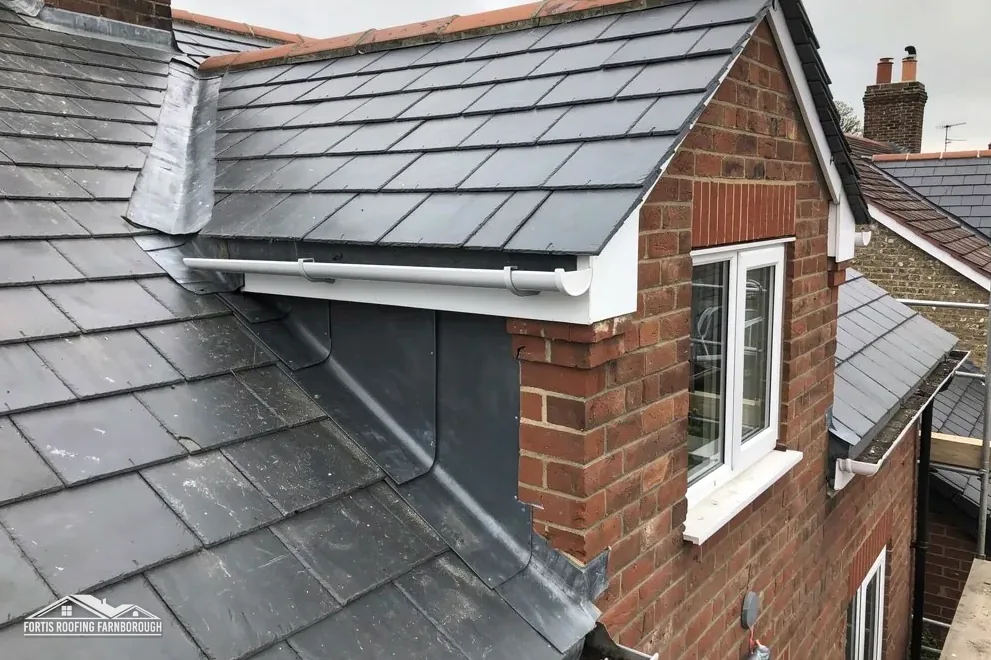
Lead has covered roofs for centuries, and a sound lead roof can outlast the walls beneath it. Because it is soft, malleable and easy to dress into awkward corners, it remains the usual answer wherever a roof butts against a chimney, a wall or a dormer. That long record can make it seem trouble-free, so it comes as a shock when a lead flashing splits after fifteen years.
The truth is that lead has a short list of problems and nearly all of them trace back to how it was designed and laid, not to the metal. It moves with temperature, so it needs room to move. It has value as scrap, so it gets stolen. It is soft, so it is easily patched in ways that look cheap and fail soon after. And it comes in different thicknesses, so a sheet that is too light for its position will crack.
This post goes through each of those problems in turn, explains what causes it and what a proper repair looks like, and then looks honestly at the alternatives. We write it for owners of older houses across Farnborough, Aldershot and the villages around, where lead shows up at chimneys, bays and dormers.
Splitting from movement and oversize sheets
Splitting is the problem we are asked about most. A lead sheet that has cracked along a line, usually at a fold or across the middle of a long run, lets water through, and the crack is hard to spot until it stains a ceiling.
Why lead moves
Lead expands when it warms and contracts when it cools. On a sunny roof the metal can be far warmer than the air, so a sheet that is fixed rigidly gets pulled in two directions every day. Over years the metal work-hardens along the stress line and cracks. This is called thermal movement, and it is the main reason lead fails.
Oversized pieces
The longer the piece, the more it moves at its ends, and the more strain it puts on the fixings. A roofer who lays one long sheet to save joints is storing up a split. Shorter pieces with proper laps give each sheet room to slide, and they are the correct detail.
Fixings that grip too hard
Lead is meant to be anchored along its upper edge, with the rest of the sheet free to slide. Fixings driven through the face of a sheet pin it in place and tear it. If a split follows a line of nail heads, that is the cause.
What a fix involves
A split that is small and local can sometimes be removed and a fresh piece worked in with a welted or lapped joint. A split that runs across a long piece needs the piece replacing, with the laps corrected. Our answer on why lead splits sets the causes out in more detail.
Theft, and what it leaves behind
Lead has scrap value, so exposed lead on a roof is a target. Churches, empty buildings, extensions with flat lead roofs and roofs that can be reached from a garage or wall are all at risk, and a stripped roof leaves the building open to the weather.
What theft does
Water enters straight away, and the damage inside is out of proportion to the value of the metal taken. Ceilings come down, timbers get wet and the contents of a room are ruined, which is why a theft is usually found inside the house before it is seen on the roof.
First steps
Tell the police, as you would with any theft. Tell your home insurer next and follow its guidance on temporary repairs. Photograph the scene, keep receipts for any emergency cover and make the roof safe so that no more water gets in. A roofer can sheet the opening or lay a temporary covering, and stopping the water comes ahead of everything else. Your policy wording decides what is paid, so read it before you rely on cover.
Reducing the risk
Where theft is a worry, the choice of material matters. Lead-free flashings in flexible strip or zinc look similar from the ground and have far less scrap value. Securing access, such as the low roofs a thief climbs from, helps as well. If the roof is a listed or conservation one, ask what consent is needed before a lead covering is replaced with another material.
Sealant patches and quick fixes
Sealant is the commonest wrong answer to a lead problem. A bead of mastic along a flashing, or a smear over a split, looks like a repair and keeps water out for a season. It is not a repair, and it often makes the next fix harder.
Why it fails
Lead moves and sealant does not move with it in the same way. As the metal expands and contracts, the sealant parts from the lead, or cracks, and the gap reopens. In frost the water that has got behind it expands and opens it further. Meanwhile the sealant hides the original fault, so the lead underneath can go on deteriorating where nobody can see it.
What it does to the next repair
Mastic leaves a residue on lead and on masonry. A roofer who comes to fix the flashing properly has to clean it off first, and a surface with sealant on it does not take a new joint cleanly. That adds work, and on a quote it adds cost. It also means a patched flashing can be dearer to put right than one that was left alone, which is the opposite of what the patch was meant to achieve.
What is right instead
A proper repair either re-fixes sound lead into a clean chase with lead wedges and repointing, or replaces the damaged piece. Our guide to sealant on lead flashing covers when a sealant is acceptable as a finishing touch, and the cases where the mortar joint has failed are better handled by re-fixing the lead. If a roofer proposes sealant as the whole answer, ask what the lead will do when it moves, because the answer is usually nothing good.
A code too thin for the job
Sheet lead is graded by code, which is a number for its thickness. Royston Lead's brochure lists Code 3, the thinnest in the range at 1.32 mm, for soakers only. Code 4 at 1.80 mm and Code 5 at 2.24 mm do the flashings and valleys, and the heavier codes from 6 to 8 are listed for the larger gutters and dormers.
How a thin code shows itself
A sheet too thin for its job fatigues sooner. The cracks appear along folds and at the corners of a gutter, and the lead may buckle or dent underfoot. The pattern looks like movement damage, because that is what it is, but the thinner metal gives way earlier than a heavier code would.
Why it happens
A lighter code is cheaper. A quote that is low and says nothing about the code may be low for that reason. When lead is quoted without a code the figure cannot be compared with one that names it, and the lighter roof can look like a bargain.
Checking
Have the code for every piece written on the quote, and ask for the work to follow BS 6915, the standard that Approved Document C names for lead sheet. The thicker sheet costs more, so ask where it matters and where a lighter code is perfectly proper.
A sound lead roof is one where the code, the length of each sheet and the fixing all suit each other. Fixing one without the others only moves the weak point along.
Alternatives to lead and what they give up
If lead has failed on your roof, or if its cost or its theft risk puts you off, there are other materials. None is a straight swap, and each has a trade-off. The table gives the published lives and supply-only prices for the flat-roof options; flashing choices follow below.
| Covering | Typical life | Supply only |
|---|---|---|
| Lead | 60 to 100 years (HomeBuilding) | £170 |
| EPDM | 25 to 30 years (HomeBuilding); 30 to 50 (Less) | £105 |
| GRP | 25 to 30 years (HomeBuilding); 25 to 40 (Less) | £110 |
| Felt | 10 to 15 years (HomeBuilding); 10 to 20 (Less) | £65 |
Reading the table
Lead costs the most to supply and lasts the longest by a wide margin, so the cost over its life can be lower than the first price suggests. The supply-only column is the material alone, laid out here to show relative cost, and it is not a fitted price. Fitting, access and the deck underneath change the total on any roof. EPDM, GRP and felt follow BS 6229:2025, which covers flexible membranes and not lead.
For flashings
Zinc is a metal alternative; VMZinc cites a BRE Environmental Product Declaration that "states 100 years". Flexible lead-free strips suit some modern roofs and quick fixes, but they suit period detail less well. Our guide to lead flashing alternatives sets out the choices, and on a listed or conservation house the original material is often the right one.
Looking after lead that is already up
Most lead problems can be caught early. A short check, made at ground level and again from inside the loft, will find the signs before they turn into a stain on a ceiling.
From the ground
Look at flashings at the chimney, at walls and around dormers. Lead that has lifted from the wall, hangs in a curve or shows a pale crack is worth a closer look, and so is any flashing with a bead of sealant along it. A white powdery crust on the surface is normal weathering and is not a fault; the grey patina protects the metal.
From the loft
Check the timbers beneath the chimney and valleys for damp wood, dark marks or chinks of daylight. Mark the edge of any stain on the ceiling below in pencil with the date, so that you can tell whether it is spreading from one week to the next.
After storms and heavy rain
Water that runs through a failed flashing often appears days after the rain, as it works its way down through the timbers. A stain after a wet spell is a reason to look, even if the roof seemed sound from the garden.
When to call a roofer
Please stay off the roof itself when checking. A ladder at the eaves and a pair of binoculars are enough for a first look, and roof ladders and edge protection are for the roofer. A survey photographs each joint and tells you which parts are in good order. Our lead roofing and leadwork page describes the repairs and renewals we take on, and one written price follows each survey.