A roofer is not the obvious person to ask what a town is like to live in, but we look at the same streets every week and we read the council's own history of them. From up a ladder the town reads as layers built in different decades, and the age of each layer tells you a fair amount about the houses in it and the faults they tend to develop.
Farnborough sits in Rushmoor borough, on the Hampshire side of the line with Surrey. It is not one centre with suburbs hung off it. Rushmoor's overview describes a borough made of Aldershot, Farnborough and North Camp, with Farnborough Airport, a good deal of military land, woodland and open green space in between.
This post sticks to what the council and the Met Office publish, and leaves out house prices, school results and population counts, which change faster than a guide can follow. We cover the neighbourhoods one by one, the aviation story the town is known for, the climate averages, and a short section for anyone buying a home here. For a roof on any of those homes, the Fortis Roofing Farnborough homepage is where a survey begins.
Where Farnborough sits and how it is linked
Rushmoor was formed in 1974, when the two towns of Aldershot and Farnborough were brought together as one borough. Rushmoor takes its name from old heathland that lies in the borough's western part, while Aldershot has housed the British Army's Home since the 1850s.
Road, rail and water
Rushmoor says the M3 motorway and the Basingstoke Canal pass through the borough, and that so do three railway lines. The railway reached Farnborough in 1838, so the town has been a place people travel from for generations.
Green space and military land
The overview points out that the borough has significant amounts of military land, woodland and green open space. Those spaces shape the map, and they are part of why neighbourhoods here can differ so much in age and layout.
Councils, borders and the address you choose
For someone moving here, "Farnborough" really means a collection of areas with different ages and characters. Asking which part of town matters more than asking about the town as a whole, and the age of the housing varies from one to the next in the ways described below. Council services also change as you cross borders, which is worth knowing if you commute or look at homes in the next town: Rushmoor and Hart share a building control service, for example, while Surrey and Hampshire are different counties with different highway authorities. If you are comparing Farnborough with Fleet, Camberley or Guildford, the council tax bill, the planning team and the people who license scaffolding on the pavement are all different bodies, and it is worth asking which applies to the address you are looking at.
Neighbourhood by neighbourhood
Rushmoor's account of how the settlement grew is the best guide to what each neighbourhood is like, because it dates each part.
Farnborough Street
In the council's history this is where Farnborough began. The conservation area here was designated in 2025, alongside a separate one for Farnborough Hill.
North Camp
North Camp is the southern district of the town. The council links it to the army's arrival in Aldershot in 1854, adds that it was the commercial hub of Farnborough for many years, and notes that this role faded from around the 1960s. These days it is mainly housing with a district centre at its heart.
South Farnborough
On the council's dating, North Camp and South Farnborough took shape from the 1860s, and the main roads were all in place by 1874. South Farnborough is a conservation area, designated in 1987 and revised in 2025.
Cove
Cove saw new housing developments in the 1950s and 1960s. Rushmoor also records many early pottery sites there.
Southwood
Southwood's housing came in the 1980s, which makes it the youngest of the districts in the council's account.
The early suburbs
Between the older centre and the later estates came suburban commuter housing in the early twentieth century, spreading out from the Farnborough Street crossroads.
We cannot tell you what any of these areas feels like on a weekday evening, and we do not rank them. What we can say is that the age of a street is a good first guide to what its roofs have been through.
The aviation story behind the name
Farnborough calls itself the birthplace of aviation, and the council's overview gives the reasons. The field began as His Majesty's Balloon Factory, set up for the Royal Engineers in 1905, and Rushmoor calls it the first operational airfield in the UK. Samuel Cody made the country's first powered flight from the site in 1908, covering some 1,400 feet in 27 seconds, according to the airport.
The Royal Aircraft Establishment
What later became the Royal Aircraft Establishment, or RAE, is described as the hub of the town's aviation history. Seven buildings from the site carry statutory listing for their architectural or historic interest, with grades running up to Grade I for a pair of wind tunnels. One of them, the former battalion headquarters, now holds a museum run by the Farnborough Air Sciences Trust.
The airport today
Farnborough Airport's own website dates the first civil flying at the airport to 1989, and says the Airshow goes back to 1948 and takes place every two years. If you move here, the Airshow years are the ones when the town is at its most visited.
The airport also safeguards the area around the aerodrome for cranes and tall plant, which matters to anyone planning building work: it is a reason to talk to the airport early if a job involves a crane. Our post on roof work near Farnborough Airport covers that side.
For people living here, the aviation history has a practical side as well: the borough has a good many protected buildings, and a planning team used to dealing with them.
Landmarks and the nine conservation areas
Across the borough Rushmoor has designated nine conservation areas, covering Aldershot Military and Aldershot West, the Basingstoke Canal, Cargate, Manor Park, and the Farnborough ones: Farnborough Hill, Farnborough Street, St Michael's Abbey and South Farnborough. Several of them lie in and around Farnborough itself.
Farnborough Hill
The mansion at Farnborough Hill was built for Thomas Longman and finished in 1863. Empress Eugénie, the widow of Napoleon III of France, bought the estate after Longman died in 1879, and she lived there in exile until 1920. A school took over the house in 1927, and in 1994 the school passed to the Farnborough Hill Trust.
St Michael's Abbey
Eugénie built a mausoleum for her husband and her son, the Prince Imperial. The council gives its completion as 1887. The priory became an abbey in 1903, and today it is run as a Benedictine monastery.
What the designation means for a homeowner
A conservation area does not stop work, but it changes the route. On this land, dormers lose their permitted development rights. Rushmoor also holds Article 4 directions in some areas: Cargate in Aldershot reaches chimneys and flues you can see from a road or open space, while the Wellesley direction deals with aerials mounted on a slope that faces the road. In Farnborough, the Church Circle direction covers front garden parking.
When buying, put it to the seller whether the house sits inside a conservation area, and check the council's map. Our guide to conservation areas and roof work in Rushmoor explains what to expect.
Rain, frost and what they do to a roof
The Met Office publishes long-term averages for a climate station at South Farnborough, covering 1991 to 2020. They give annual rainfall of about 715 mm, spread over 118 wet days, with around 53 air-frost days.
Reading the averages
With 118 wet days in the average year, a roof here is wet for a good share of it. The averages cover rain, frost and sun, and give no basis for calling Farnborough windy or exposed. They do show that a roof here has plenty of rain to shed and a steady run of frosty nights to get through.
What frost and rain do
Rain gets in through a cracked tile, an open joint or a failed flashing. In cold weather that water freezes and expands, which widens the gap a little more each winter, so small defects grow. Checking the ridge, valleys, flashings and gutters before winter catches most of them while they are still small repairs.
Moss and shade
Moss and lichen thrive on damp, shaded slopes. They hold water against the covering, and a thick mat on a north slope or under a tree is worth removing carefully rather than ignoring. Marley does not recommend jet washing, because high-powered washers can damage tile and slate surfaces, so moss is taken off by hand, with brushes and scrapers, and the survey tells you whether it needs doing at all.
There is nothing unusual about a Farnborough roof in any of this. Regular, ordinary maintenance keeps the repair bills down, and a gutter that overflows in a wet spell is usually the first sign that something up there needs a look.
Buying here: check the roof
If you are thinking of buying in Farnborough, the roof is one of the largest repair bills a house can bring, and it is also one of the parts you cannot see properly from the road. A short list of checks puts you in a stronger position before you offer.
Before you offer
- Ask when the roof covering was last replaced and look for paperwork.
- Look at the ridge and the chimney from the pavement for cracks, leaning or missing mortar.
- Check ceilings upstairs and the loft for stains.
- Find out whether the house is in a conservation area or is listed.
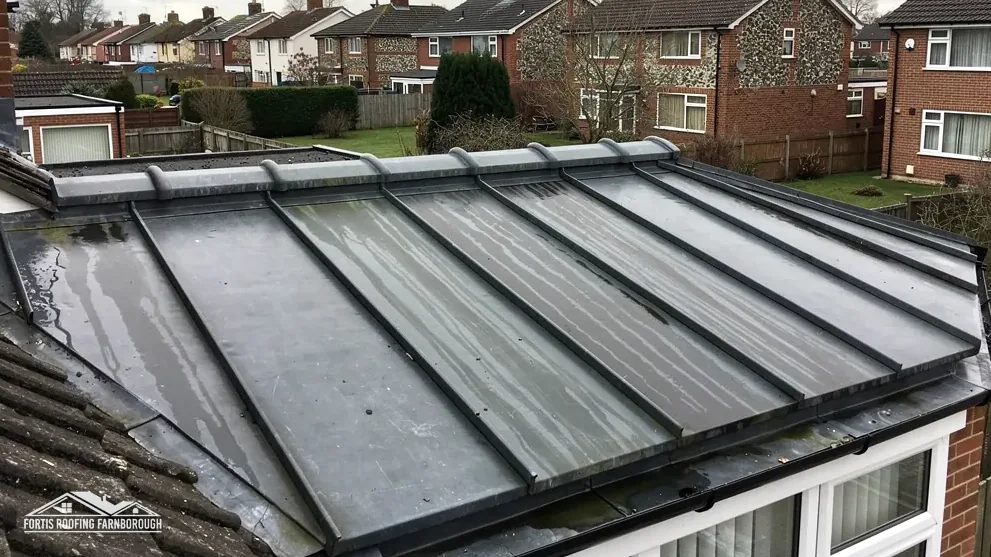
- Ask whether any extension roofs are flat, and when they were last re-covered.
Match the era to the questions
The year a house was built tells you which questions to ask. A house from before 2000 raises the asbestos question for soffits and sheets, according to HSE, and a house of the 1980s or earlier may have a ridge that predates the 2014 change in how ridge tiles are fixed. Our post on Farnborough roofs by house age goes through each era.
Get it surveyed
A building survey looks at the whole house. If it flags the roof, a roofer's survey measures and photographs the roof itself and leads to one written price. Our roof checks when buying a house guide takes you through the steps, and the survey gives you something concrete to take to the seller if repairs are needed. It also gives you a written record of the roof as it stood on the day you bought.