A chimney repair can be a morning's work or a week's, and the price does not follow the size of the fault in any simple way. A cracked flaunching and a rebuilt stack both happen at the same awkward spot, high on the roof, and the biggest part of the bill is often the platform needed to reach it rather than the bricks or mortar.
National cost guides give some figures, but not for every job. Where a published range exists, it is quoted here with its source and date, and described as a typical UK range. Where the guides disagree or have nothing reliable to say, this page explains what pushes the price up or down instead of inventing a number. A chimney price is not a fixed tariff, so a guide is a starting point for expectations and not a quote.
Below we cover why the same repair costs different amounts on different houses, why scaffold is so often the largest part, what the national guides say about leadwork and about chimney breast removal, what sets the price for repointing, flaunching and pots, and how to compare quotes fairly. Our own approach is a survey with photographs first.
Why chimney prices vary so much
Two chimneys with the same fault can cost very different amounts to put right. The reasons are practical.
Where the stack sits
A stack at the gable end of a bungalow is much easier to reach than a stack rising through the ridge of a three-storey terrace. Height, roof pitch and the ground beside the house all change what safe access involves.
How many parts are involved
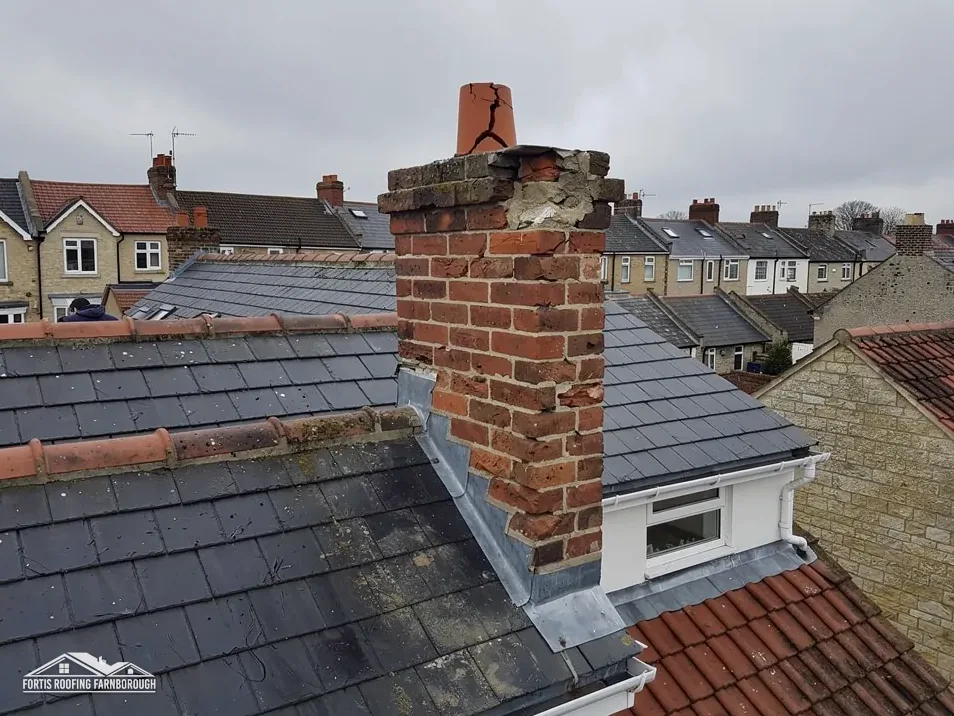
A stack has pots, flaunching, brick faces, joints, flashings and sometimes a flue lining. A repair to one is a small job. A stack with trouble in all of them is a bigger one, and the survey tells you which you have.
The state of the brick
Sound bricks can be repointed or reset. Bricks that crumble have to be replaced, and a stack that has failed throughout is rebuilt. The condition of the fabric decides which of these it is, and it is not always visible from the ground.
What is shared
A stack on a party wall serving two homes brings in the neighbour, and may need a notice and, in some cases, a surveyor. Those are real costs of their own.
Consents
A listed house, or one in a conservation area or an Article 4 area, can add steps before work begins. Our guide to chimney breast removal shows how Building Regulations and party wall rules add to a job.
Why a guide cannot give one number
It averages across houses that differ in every one of these ways. That is why we survey first.
Scaffold is the largest cost driver
On most chimney repairs, the cost of reaching the stack outweighs the cost of fixing it. A flaunching repair may take a few hours at the top of the stack, while the platform to get there takes longer to put up and take down.
Why a ladder will not do
Working at a stack means holding tools and materials at height, often on a pitched roof. A scaffold or tower gives a flat, guarded platform. It is the safe way to do the work, and it is not an optional extra to be trimmed from a quote.
What sets the scaffold cost
The height of the stack, the width of the house, the number of lifts, the length of time the scaffold stays up and whether it has to stand on or over the public highway all matter. Scaffold on the public highway needs the highway authority's licence, which brings a fee and a notice period of its own. On private land, none is needed.
Making the most of the access
Because the scaffold is the biggest element, it makes sense to do everything the stack needs in one visit. A stack that gets pointing, flaunching, a new flashing and a cap together costs less than the same four jobs done in four separate visits. Our guide to scaffolding for chimney repairs explains the licence and the timing.
In the written price
Access sits inside the total we write for you. We say what access the job needs, and why, so another firm can be asked to price the same arrangement.
Ask every roofer whether the scaffold is in the price. A quote that leaves it out may not be the cheaper one.
Leadwork and flashing costs
Lead flashings are the one chimney job where a published national range exists for a defined piece of work.
What the guide says
MyJobQuote's page on chimney leadwork says a full replacement costs between £350 and £920 (Sep 2026, typical UK range), and notes that the price depends on whether scaffolding is needed. That is a national figure for the job, and not a Fortis price.
What it covers
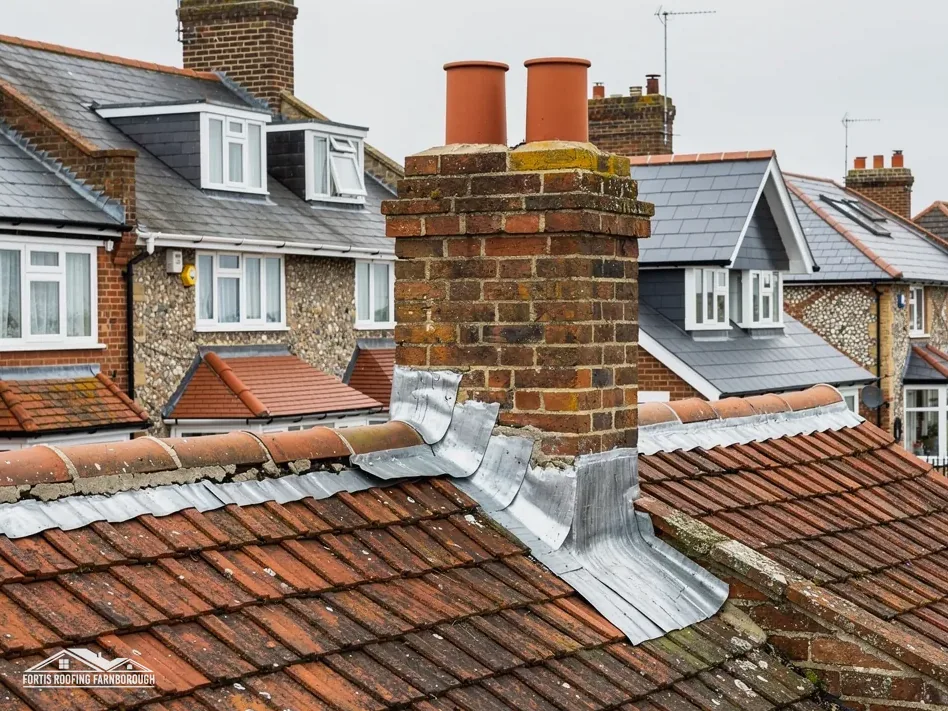
Full chimney leadwork means the flashings round the base of the stack: the apron at the front, the stepped flashings and soakers along the sides and the back gutter behind. Each needs lead cut to size, dressed over the tiles and fixed into the brickwork. Our guide to chimney flashing explains the parts.
What moves the price
- The size of the stack and the number of faces that need lead.
- The code of lead chosen, which sets thickness and weight.
- The state of the mortar the lead is fixed into, which may need repointing.
- Whether the roof tiles under the flashing are sound or need relaying.
- Access to the stack, and again the scaffold.
Lead lasts
MyJobQuote also says that lead flashing can last for over 80 years, which is a minimum and not a promise. A properly fixed flashing is a long-lived repair, so the cost is spread over many years.
A repair to a single failed section costs less than a full replacement, and the photographs from the stack show whether that would hold.
Breast removal: the other sourced range
MyJobQuote gives chimney breast removal as between £1,200 and £3,500 (Aug 2026, typical UK range). It is a general figure for taking out a breast inside a house, and the real cost depends on what is involved.
What the figure does not tell you
It is a range across many houses. It does not tell you whether the stack above the roof stays or goes, what support the brickwork overhead needs, how many floors the breast passes through or how much making good is required. Those are the details that move a job from one end of the range to the other.
Costs that sit beside it
Taking out a chimney breast always requires Building Regulations approval, so expect building control fees and usually a structural engineer's design. Where the breast is on a party wall, a notice to the neighbour is needed at least two months before work begins, and a party wall surveyor may be appointed if there is no agreement. None of these is included in a roofer's price for the roof end.
The roof end
If the stack above the roof is coming down, the gap it leaves in the slope must be closed and made weathertight. If the stack is staying, roof checks and any flashing renewal belong to the same plan. We sequence our work with the builder's.
Detail elsewhere
Our guide to chimney breast removal covers the approvals in full. The chimney repairs page lists the rest of the stack work.
Repointing, flaunching and pots
For these common jobs, the useful thing to know is what sets the price, because a single national number would mislead.
| Job | What sets the price |
|---|---|
| Repointing the stack | How many faces and courses are loose, the height, the access and the mortar suited to the brick |
| Flaunching repair | Number of pots, condition of the stack top beneath, whether a cap is fitted |
| Pot replacement | Number and type of pots, a match for appearance, the state of the flaunching |
| Cap or cowl | The fitting chosen, whether the flue is live, access |
| Rebuild above the roof | Height, width, courses rebuilt, brick match, flashings, scaffold |
Why repointing is hard to quote in general
The amount of loose mortar, the height of the stack and the type of brick vary from house to house. One face of a low stack on a bungalow and four faces of a tall stack are different jobs. Priced after the survey, with photographs of each face, the figure is specific to your stack.
Why we group the work
These jobs share a scaffold. When the survey shows several are needed, we propose doing them together and give one price for the lot. Our guide to chimney repointing and the one on flaunching explain each repair.
Beware of tiny prices
A figure that seems too low for a stack often leaves out the access or the proper repair. Ask what it includes, and ask whether the scaffold is part of it.
Getting a price you can compare
Comparing chimney quotes is harder than comparing most roofing jobs, because the work described can differ so much between firms.
Ask for the survey photographs
A quote with photographs of each part of the stack shows what the firm saw. If two firms describe the same chimney differently, the pictures show who is right. Our survey includes photographs and measurements, and you are welcome to show them to anyone else.
Check the scope in writing
Is it a repair or a rebuild? Which parts of the stack? Is the flue lining included? Is the scaffold in the price, and who arranges any licence? Are VAT and waste included? The answers should be on the page, in plain words, so that a second firm and you both read the same scope. If a point is left vague, ask for it to be written down before you agree, because the gaps are where disputes begin.
Citizens Advice's advice
Citizens Advice recommends at least 3 written quotes before you commit. For a chimney, that works only if each quote covers the same work, so hold the scope steady.
Beware pressure
A caller who says your stack is about to fall, offers a price on the doorstep and wants a deposit in cash should be treated with caution. Our page on how to spot a dodgy roofer covers the pattern.
Our approach
We measure and photograph the stack and talk you through what we saw. The figure is one total in writing, good and fair, with no surprise on the day.