Reclaimed slate has already served on another roof, been taken off with care and sold on for reuse. It is a familiar choice for repairing an old roof, for matching a house in a conservation area and for owners who prefer the look of weathered stone to a new, uniform one.
It sits in a middle position. It is more expensive than new Spanish natural slate on a per-square-metre supply basis, and cheaper than new Welsh slate. Its expected life is shorter than either new product, because it has already used some of its years. Its quality is variable, and that variability is the main thing to understand before buying.
Below: what reclaimed slate offers, its expected life, supply price against new slate, grading, where it helps most, what can go wrong and what to ask when buying, for roofs near Farnborough.
What reclaimed slate is and where it comes from
Slate comes off roofs for many reasons: a house is demolished, a roof is stripped for repair, or a building is converted. Slates that survive in good condition are sorted, cleaned and sold by salvage and reclamation businesses.
Why the surviving slates are worth saving
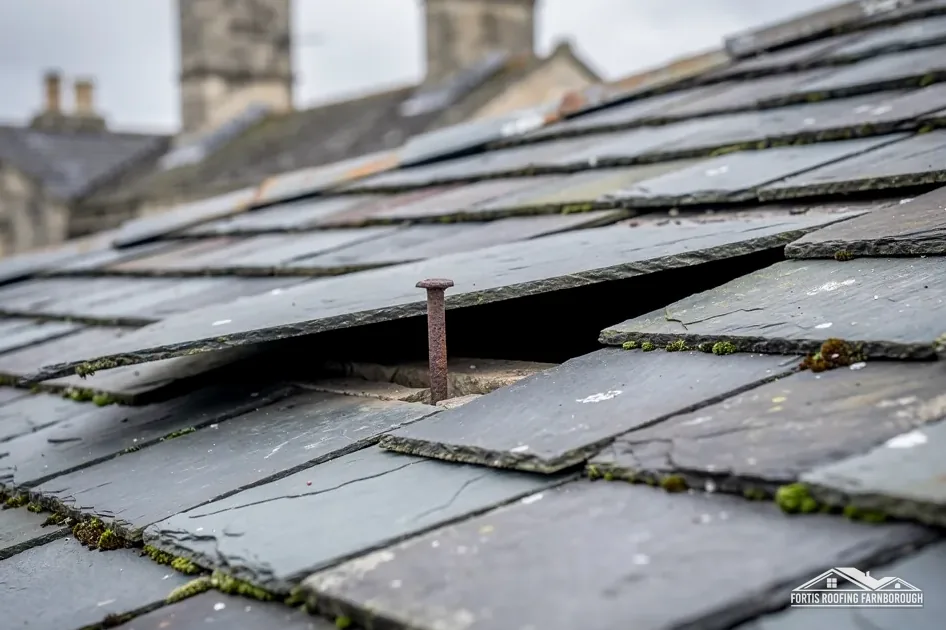
Natural slate does not rot or rust, so a slate on an old roof may be sound even after a century. It is the fixings and battens that tend to fail. A roof stripped for nail sickness often yields a high proportion of reusable slates. Our guide to nail sickness on slate roofs explains why.
Look and weathering
The face of a reclaimed slate carries decades of weather. Colour softens, the surface picks up a patina, and the edges round off. That is what draws many owners to reclaimed slate, and it is why a new slate set next to it looks stark. If you want the roof to look settled from day one, weathered stock does it better than anything new.
Variety
Reclaimed slate comes in a range of sizes, thicknesses, colours and origins, depending on the roof it came from. It may be Welsh, Cornish, Cumbrian or imported, and the supplier may or may not know which. Each slate carries the marks of its past use, including nail holes in its head, and weathering on the exposed face.
Reuse from your own roof
The lowest-cost source of reclaimed slate is often the roof being repaired. Sound slates are set aside and reused. That keeps the match perfect, though it relies on the slates being good enough to reuse.
Buying in
Where more is needed, a supplier sells reclaimed slate by the square metre or by the slate, sorted into sizes. Prices vary with grade, size and demand. The material should be inspected, since a pile of slates can hide a lot of rejects.
A roofer who deals in reclaimed slate will sort and select, and will warn you if the stock is not good enough.
Lifespan and supply cost, as published
HomeBuilding & Renovating publishes both a life expectancy and a supply-only price for the main slate types, which allows a direct comparison.
| Slate | Typical life | Supply price per m² |
|---|---|---|
| Spanish natural slate | 75 to 100 years | £72 |
| Reclaimed Welsh slate | 50 to 80 years | £90 |
| Welsh slate | 100+ years | £185 |
How to read it
Reclaimed Welsh slate costs more than new Spanish slate to buy, and less than half the price of new Welsh. Its expected life is shorter than both new options, which is what you would expect from a material that has already seen service. The figures are typical ranges and not promises.
Supply is not the whole bill
These prices are for the slate alone. Labour, underlay, battens, fixings, lead, scaffold and waste are on top. MyJobQuote (Oct 2026) reports around £7,800 as a typical average price in the UK for a complete fitted slate roof, though your own roof will differ. Our guide to slate roof cost sets out what moves the price.
Labour and wastage
Reclaimed slate takes more care to sort and lay, since each batch needs grading and some slates will be rejected. Allowance has to be made for wastage, so more is bought than is laid.
Why it may still be good value
If the alternative is a poor match on a period roof, or no match at all, a higher supply price for the right look is easy to justify.
Grading: what good reclaimed slate looks like
The quality of reclaimed slate varies more than that of new, so grading is the key skill. Good slate is hard to tell from the cheaper kind by price alone.
Signs of a good slate
- A clean, clear ring when tapped, rather than a dull thud.
- A flat, even surface without waves or deep laminations.
- Sound corners and edges.
- A head intact around the nail holes, with no cracking.
- Consistent thickness across a batch.
Signs of a poor one
- Flaking or peeling layers on the surface or edge.
- Hairline cracks running across the slate.
- Rusty marks or staining around the nail holes from old fixings.
- Soft, chalky or crumbling edges.
- Heavy variation in thickness.
Sizes
Slates are graded by size, and a roof may need several. Larger slates traditionally go at the eaves and smaller ones nearer the ridge, so a mixed batch has to be sorted. A batch of one size is easier to lay and costs more.
Holing
New fixing holes may be needed, since the old ones may not suit the new gauge. Drilling a slate that has aged is a skilled job, as each one can crack.
Ask for the sample
See and handle a sample before buying, and ask what proportion of a delivery is likely to be rejected. A supplier who stands behind the grade will say. Do not accept a mixed batch described only as reclaimed.
Where reclaimed slate is most useful
Some jobs suit reclaimed slate better than others. It earns its place where matching and character matter.
Repairs to an old roof
When a few slates are lost, a reclaimed one of the same size and colour is the best match. New slate can look bright beside old, at least for some years. Our guide to repairing a slate roof explains how single slates are replaced.
Conservation areas and listed buildings
Inside a conservation area, or at a listed house, the council may expect the original materials to be kept or matched. Basingstoke and Deane expects original slate and clay coverings to stay in its four town-centre areas, and a listed house needs consent where work alters its character. Reclaimed slate helps meet those expectations. Check with your local planning authority.
Re-slating
A roof being re-slated usually has plenty of reusable slate of its own, and reclaimed slate fills the gaps. The result is a roof that keeps its age and appearance.
Extensions and new work
For an extension to an older house, reclaimed slate can tie the new roof to the old, so the join is hard to see.
Where it is a poor fit
If you want a long, trouble-free life with no sorting, or a perfectly uniform finish, new slate suits better. Where budget is tight and the look is secondary, new Spanish slate has the lowest supply price in the published table.
A reclaimed roof is a choice of character, and the roofer should explain what it does to the look and the price.
Risks and how to manage them
Reclaimed slate is a good material and an uneven one. Knowing the risks helps you buy well.
Hidden defects
A slate can look sound and still be cracked or delaminating. Defects often show only when the slate is fixed and weighted. The remedy is careful sorting and a sensible allowance for rejects.
Supply and matching
Stock comes and goes. A particular size or colour may not be available when you need more, and a repair a few years later may not find a match. Keep spare slates from the job.
Shorter remaining life
A reclaimed slate has already used part of its life, and its published range is shorter than a new one. A roof laid with reclaimed slate on new battens with good fixings can still last for a long time. Fixings count for as much as the stone. Our guide to slate hooks against nails explains the options.
Pitch and fixing
The pitch limits are the same for reclaimed slate as for new: 20° as the BS 5534 floor, and no hooks under 25° on Cupa's advice.
Asbestos
Natural slate is not an asbestos material, but reclaimed roofing can arrive mixed with other sheeting. Buy from a supplier who sorts, and do not take mixed loads of unknown origin.
Paperwork
Ask for a written specification naming the slate type, size, grade and quantity. Our slate roofing service starts with a survey, and the quote names the slates used.
Buying reclaimed slate: a practical checklist
A few simple steps reduce the risk of buying the wrong slate and help the roofer plan the job.
Before you buy
- Measure the roof, or ask for it to be measured, so the quantity is known, with an allowance for wastage and cut slates.
- Record the size of the slates now on the roof, and their thickness and colour.
- Take a few of the existing slates to the supplier, so the match is checked against the real thing.
At the supplier
- Ask where the slate came from and whether it is the same type as yours.
- Look at a pallet, not only a sample, and check for cracks, flaking and rust staining.
- Ask what is done with rejects, and whether the supplier will take back unsuitable slate.
On delivery
Check the load against the order, stack the slates on edge on level ground and keep them dry and off the ground until they are used. A pallet left in the open collects moss and frost damage.
While laying
The roofer sorts as the slates go on, setting aside any that fail the ring test. A fair share of rejects is normal, and a good roofer tells you the figure rather than hiding it.
Afterwards
Keep any spare slates, with a note of the supplier, for future repairs. A written record of what was used, with photographs, helps whoever works on the roof next.
Price and paperwork
The price is a single written figure, VAT shown, and it names the slate, the grade and the quantity. If the survey cannot tell how many slates are reusable, the stripping stage settles it, and you are told before the figure changes.