The clay-tiled High Street
Surrey Heath's appraisal describes red brick with orangey-red or brown clay tiles on pitched roofs.
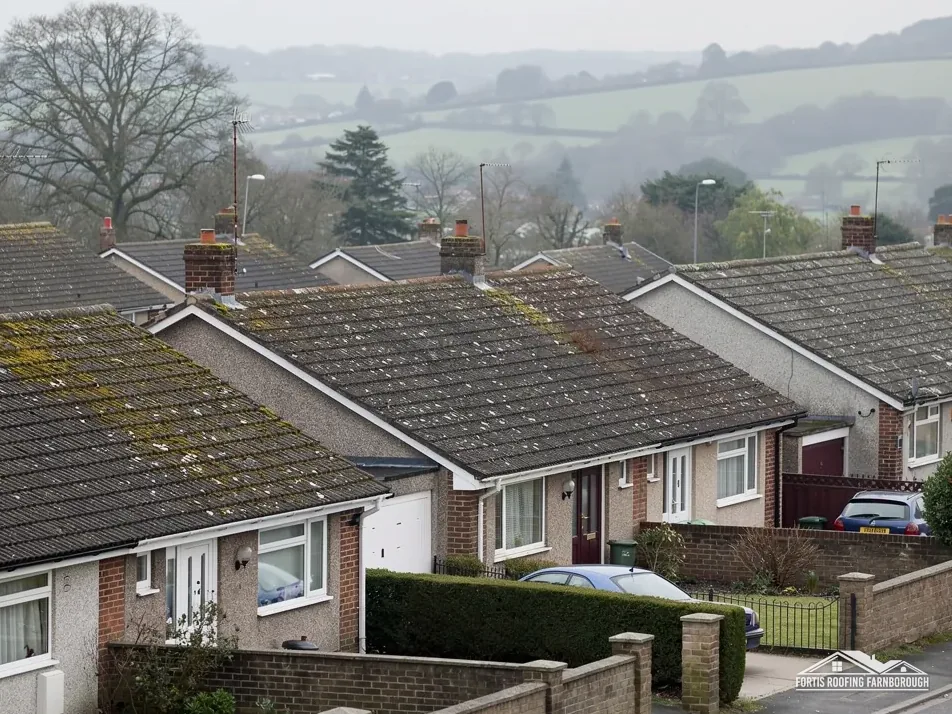
Roofs along Bagshot's clay-tiled High Street and Guildford Road
Bagshot is a village on the A30 east of Camberley, with a clay-tiled High Street and three conservation areas. Every roof is photographed and quoted once.
Surrey Heath's appraisal describes red brick with orangey-red or brown clay tiles on pitched roofs.
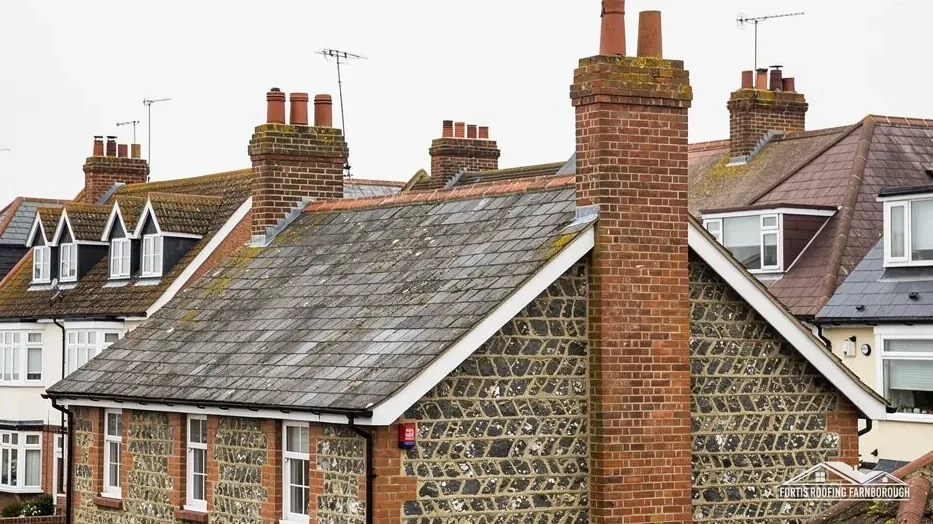
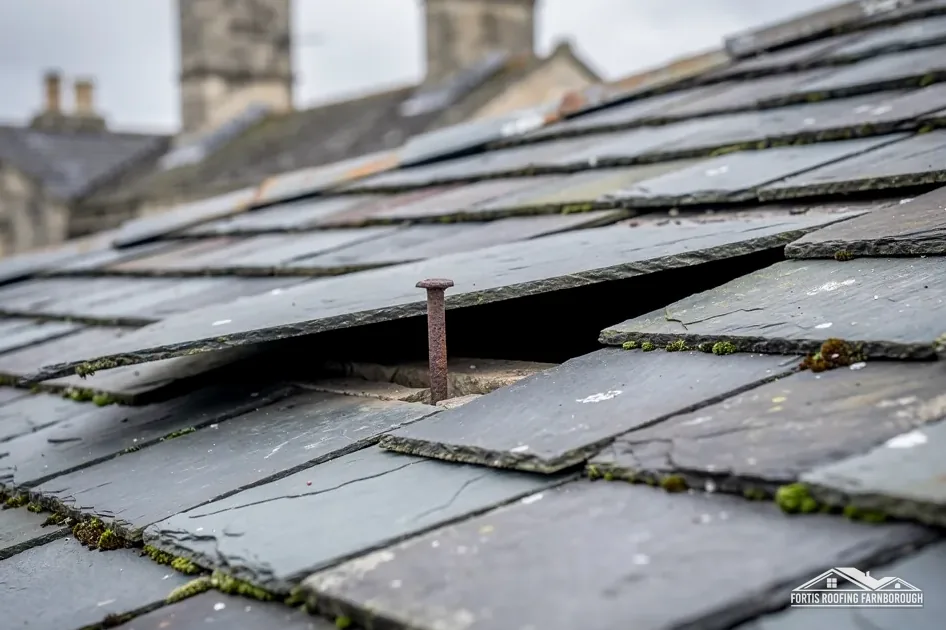
Some early 19th-century cottages on Guildford Road keep slate roofs far shallower than the High Street's.
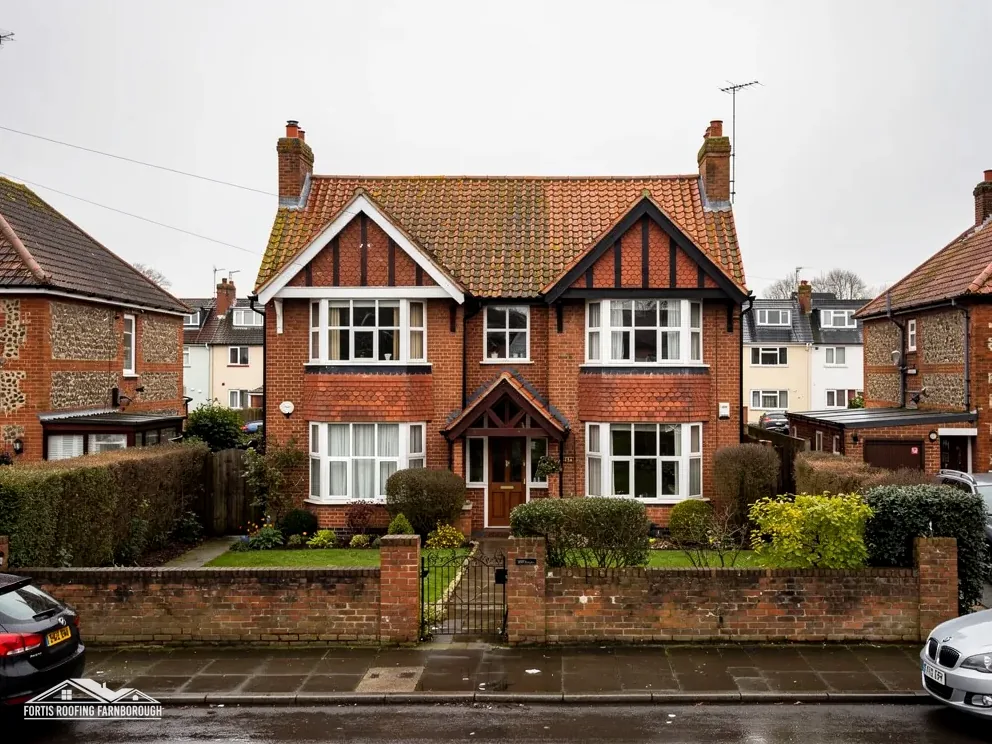
Bagshot has three of Surrey Heath's conservation areas: Village, Church Road and Park.
Map of Bagshot with Lightwater, Windlesham, Heatherside, West End, Surrey Heath marked around it.
Map data © OpenStreetMap contributors. Loads only when you ask for it.
Lightwater lies to the south-east, Windlesham to the east, Heatherside to the south, Camberley to the south-west, and South Ascot to the north.
About 7 road miles north-east of Farnborough · Surrey Heath Borough Council and Surrey County Council.
Bagshot, tile and slate
What Surrey Heath's appraisal says about Bagshot's clay-tiled High Street and shallower slate cottages, which conservation areas and listings shape a repair, and what Surrey Heath's inspectors and Surrey's licence involve.

| No. | Chapter | The figure it turns on |
|---|---|---|
| 01 | A clay-tiled High Street and shallower Guildford Road slate | Clay High Street; shallower slate on Guildford Road |
| 02 | Three conservation areas, and 85% of buildings that count | Designated October 1988; 85% of buildings |
| 03 | 44 High Street, St Anne's and Surrey's scaffold terms | 44 High Street Grade II*; scaffold 28 days |
Chapter 01 of 03
| Where | What the appraisal describes | What it means on the roof |
|---|---|---|
| High Street | Red brick with orangey-red or brown clay tiles on pitched roofs | Match tile colour, size and texture |
| Guildford Road | Some early 19th-century cottages with much shallower slate roofs | Check laps, nails and valleys closely |
| Conservation area | About 85% of buildings listed, locally listed or positive | Ask Surrey Heath before changing a covering |
Surrey Heath's Bagshot Village appraisal draws a clear contrast between two streets. It gives its overall impression of the conservation area as red brick with orangey-red or brown clay tiles on pitched roofs, and it notes that some early 19th-century cottages on the north side of Guildford Road keep slate roofs with a much shallower pitch than the clay-tiled High Street. The conservation area was designated in October 1988, and the appraisal says about 85% of its buildings are listed, locally listed or counted as positive contributors to the area's character.
A shallow slate roof and a steep clay one are not interchangeable. Each covering has a minimum pitch below which water can be driven back under the laps. For natural slate, BS 5534 indicates a minimum of 20 degrees, and Cupa advises against hook fixings on pitches below 25 degrees. Marley's data sheets set minimum pitches for its clay tiles too, from 30 degrees for some plain-tile ranges up to 40 degrees for Canterbury. So when we are asked to change one covering for another, the first thing we measure is the roof's angle.
That also explains why a repair on Guildford Road must be done in slate, with the laps and fixings of the original, and why a repair on the High Street must be done in clay tile of a matching colour. A mismatch would be visible from the road, and on a shallow slate roof a wrong covering could simply leak.
We look at both kinds in the same sequence: slopes first, then junctions, then roof space, then the rainwater route. Slates are checked for slipped courses, rusted nails and cracked corners, tiles for broken nibs, loose ridge bedding and cracked faces. Our slate roofing page explains slate repair, and our pitched roofing page covers tiled roofs.
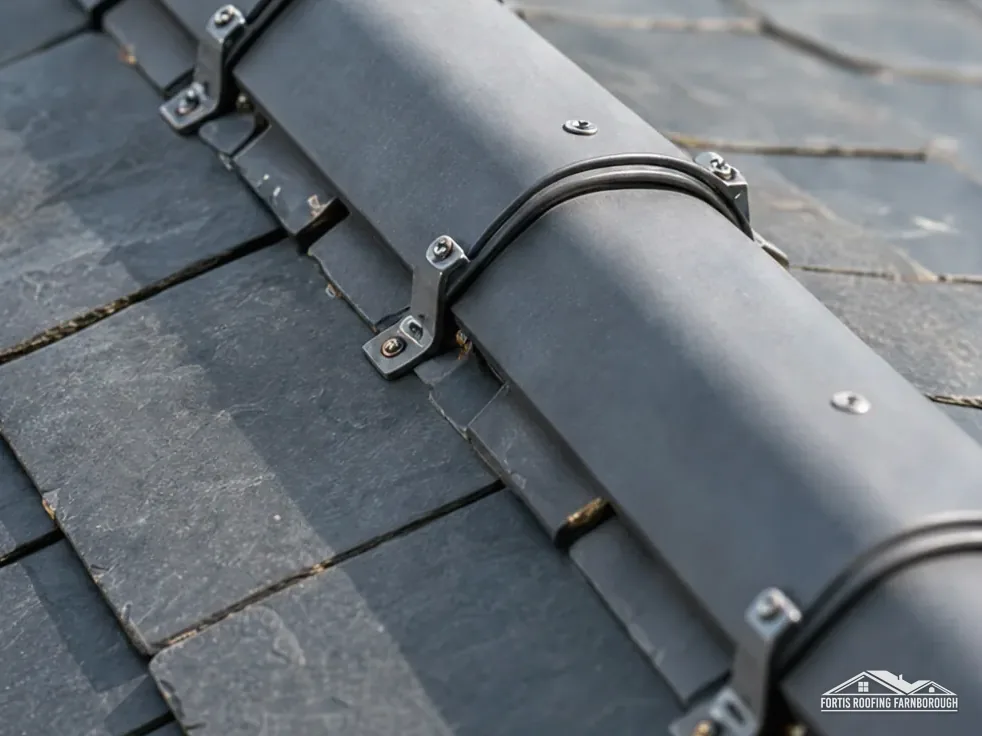
If a firm proposes tiles for a conservation-area roof, ask three things. Ask to see a sample held against your own roof, not in a brochure. Ask what will happen to the old tiles that are still sound. And ask whether the ridge will be bedded in mortar or fixed dry, since mortar alone is no longer relied upon for ridge and hip tiles under BS 5534, which Marley notes is good practice and not a legal requirement. We answer all three in the report.
Chapter 02 of 03
Bagshot's conservation areas and listings in published records

Bagshot has three of Surrey Heath's nine conservation areas: Bagshot Village, Bagshot Church Road and Bagshot Park. The Church Road area lies within about 0.75 km of the village centre, and the same search touches Bagshot Park and Bagshot Village. Surrey Heath's appraisal says about 85% of the buildings in the village area are listed, locally listed or counted as positive, which is a high share and explains why the council takes a close interest in changes to them.
When most buildings in an area are treated as contributing to its character, a change to one is a change to the whole street scene. A repair that matches is unlikely to raise questions. A different covering, a new roof window on a front slope or an altered chimney is not, and we ask Surrey Heath's planning team about it before we price. Whether your own house is inside any of the three areas is a matter for the council's map, which is consulted for each Bagshot address in turn.
We also check whether an Article 4 direction applies with Surrey Heath for each address, and the answer goes into the report. A matched repair keeps a building's contribution to the street intact, and the photographs show the match afterwards. Our chimney repairs page explains stack repairs, which are often what a direction would touch.
The report is written to be useful to the planning officer as well as to you. It contains dated photographs of the existing covering, ridge, eaves and chimneys, with measurements, so that a proposed repair can be judged against what exists. For a locally listed or positive building, a matched repair with a clear record is a straightforward case.
The appraisal's concern is the street scene, so the slopes that face the road matter most. We note which slopes of each house face the public side and which face the garden, because the same repair can be a quiet matter at the back and a visible one at the front. That distinction is marked on the roof sketch, so you and the planning team can see at a glance where the care is needed.
Chapter 03 of 03
| Item | Detail | Route or term |
|---|---|---|
| 44 High Street | Grade II*, NHLE 1135187, listed 17 April 1998 | Listed building consent |
| 25-31 and 63 High Street | Grade II, NHLE 1030004 and 1189943 | Listed building consent |
| Church of St Anne | Grade II, NHLE 1189873; Anglican, in use | Church of England faculty |
| Scaffold licence | Surrey County Council | 28-day period; 10 working days' notice |
| Building control | Surrey Heath Building Control Consultancy | Or a registered approver |
Eight listed buildings stand within 500 m of Bagshot's centre. Among them are 44 High Street, listed Grade II* on 17 April 1998, 25-31 High Street and 63 High Street, both Grade II, and the Church of St Anne, also Grade II. St Anne's still serves as an Anglican church, which puts its roof under the faculty system, while the High Street buildings need listed building consent for work that would change their character. High Street roofs are in full public view, and every repair on them must be matched and recorded.
Surrey Heath's building control service is SHBCC, the Surrey Heath Building Control Consultancy, and a registered building control approver is the private alternative. Neither is called for a handful of refixed tiles. For a re-roof, the Planning Portal's guide sets ceilings of 25 per cent of the building envelope and 50 per cent of the roof, and a new covering 15 per cent or more heavier calls for approval and a structural check.
Surrey County Council licenses scaffold on a road or pavement at £208 for each 28-day period, with 10 working days of notice wanted. The applicant goes unnamed on its page, so that point is resolved jointly with the scaffolder. On the High Street, where shops and homes share the pavement, the scaffold's position and the walkers' route are fixed with you at the survey. West Surrey Council replaces Surrey Heath and the county on 1 April 2027, and for a job spanning that date, we find out who takes over each part before any scaffold is booked.
The Environment Agency's mapping puts land within about 250 m of Bagshot's centre in Flood Zone 3. It says nothing about tiles but is a prompt to follow roof water from gutter to ground, and we photograph every outlet.
Weather decides the dates. The Met Office's South Farnborough averages for 1991 to 2020 show 118 wet days a year and about 53 days of air frost, so a 28-day licence will meet some of each. Spare days go into the plan, the roof is kept weatherproof whenever work pauses, and the site is tidied each evening, with waste taken away, which matters on a street where every doorway is a shop or a home.
Yes, in principle. Surrey Heath's appraisal describes orangey-red or brown clay tiles on the pitched roofs there. We photograph the existing tiles, salvage the sound ones and hold replacement samples against the roof before ordering. If the building is in a conservation area, any different covering is put to Surrey Heath first.
Surrey Heath's appraisal records some early 19th-century cottages on the north side with much shallower slate roofs than the clay-tiled High Street. Each covering has a minimum pitch, and natural slate's is 20 degrees under BS 5534, which is why a repair must be in slate with the original laps. We measure each slope's pitch before suggesting any covering.
No. Only the listed building itself needs listed building consent when work would change its special character. A neighbouring unlisted building is outside the listing, though it may be in a conservation area. Surrey Heath's map and the National Heritage List show which case yours is, and we check both at the survey.
Surrey County Council charges £208 per 28-day period for scaffold on a road or pavement and wants at least 10 working days of notice. The applicant is left unnamed on its page, so it is arranged with the scaffolder. On a shopping street, position and pedestrian routes are agreed at the survey.
Get your free roof quote
Tell us your Bagshot road and the symptom. We arrange the survey, then one written price follows.
10-year workmanship guarantee, in writing.