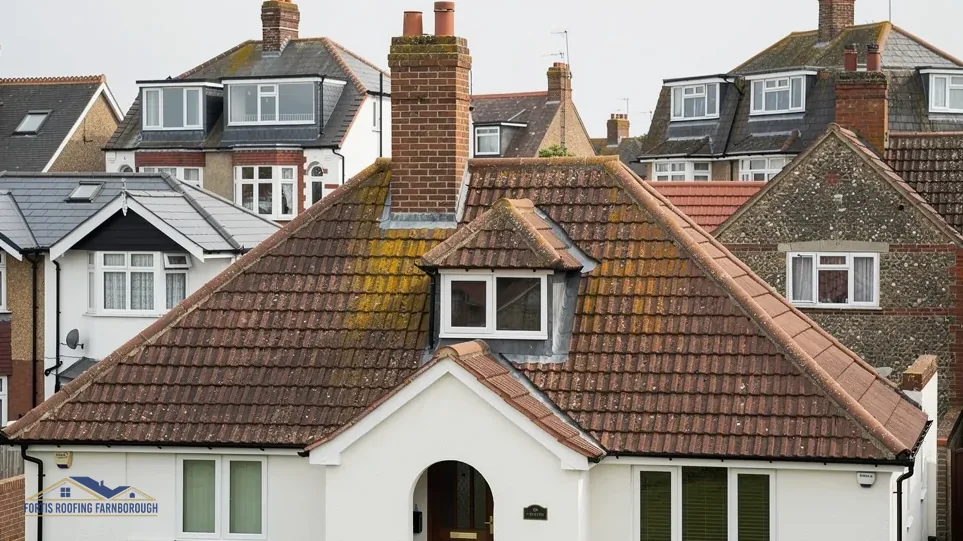
Steep clay-tile roofs
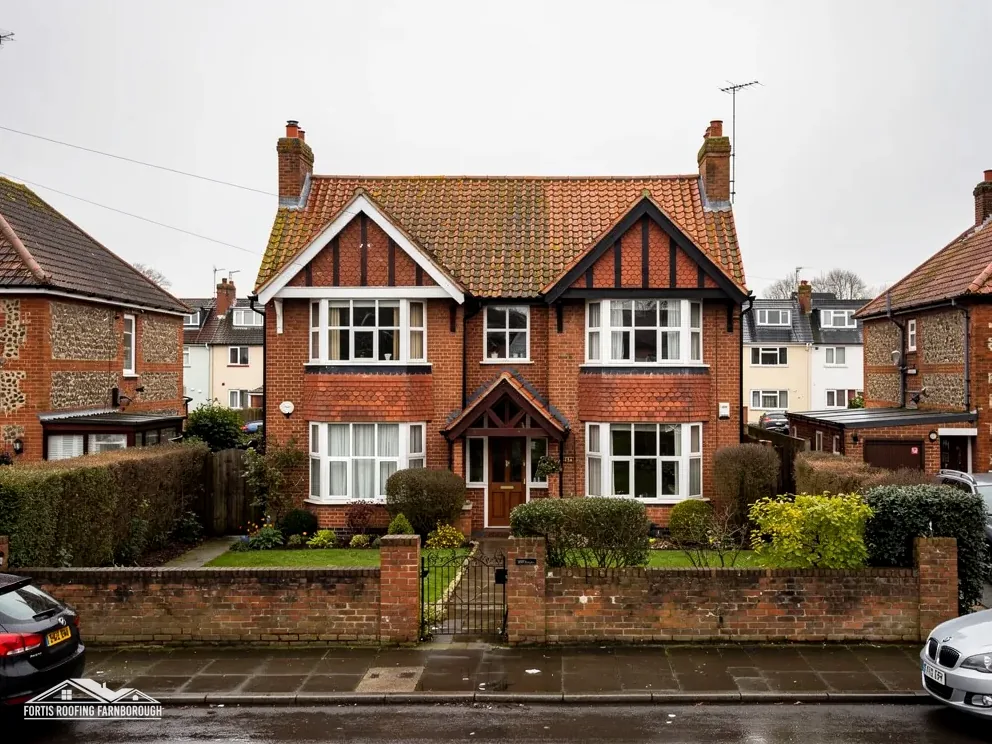
Hart's appraisal reads the steep pitch as a sign of former thatch, replaced with clay tiles from the 17th century.

Steep clay-tile roofs and Victorian slate in a conservation village
Crondall's steep roofs recall its thatch, replaced with clay tile from the 17th century, and slate followed the railway. We survey each house's own covering before we price a repair.
Hart's appraisal reads the steep pitch as a sign of former thatch, replaced with clay tiles from the 17th century.

By the end of the 17th century, wattle-and-daub panels were replaced with brick or covered with hung clay tiles.
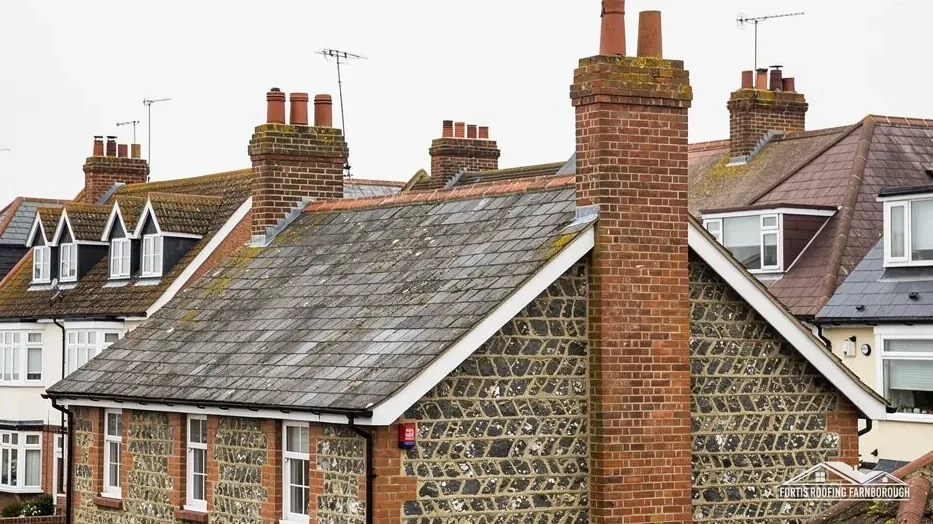
Slate came after the railway reached Winchfield in 1838; the few Victorian villas pair it with polychrome brick.
Map of Crondall with Ewshot, Crookham Village, Church Crookham, Bentley marked around it.
Map data © OpenStreetMap contributors. Loads only when you ask for it.
Ewshot lies to the north-east, Crookham Village and Church Crookham to the north, Bentley to the south, and Farnham and Wrecclesham to the south-east.
About 8.3 road miles south-west of Farnborough · Hart District Council and Hampshire County Council.
Crondall, roof by roof
The three councils behind a Crondall roof job, what Hart's appraisal says about the village's tile and slate roofs, and how Article 4 directions, listings and the church shape a repair, each figure sourced.
| No. | Chapter | The figure it turns on |
|---|---|---|
| 01 | Three councils behind a Crondall roof job | Hart, Hampshire and Rushmoor each play a part |
| 02 | From thatch to clay tile to slate | Slate arrives after the 1838 railway |
| 03 | Crondall's Grade I church and Article 4 direction | 62 listed buildings within 500 m |
Chapter 01 of 03
| Role | Body for Crondall addresses |
|---|---|
| Planning authority | Hart District Council |
| County council and highway authority | Hampshire County Council |
| Building control | Hart and Rushmoor Building Control Partnership |
| Scaffold licence on the highway | Hampshire County Council; scaffold firm applies |
Crondall lies 8.3 road miles south-west of Farnborough, measured from the A325 Farnborough Road. Planning decisions sit with Hart District Council, while Hampshire County Council runs the roads. Hart's page says its building control is supplied by Rushmoor from offices in Farnborough, and a Rushmoor cabinet report dates that shared service to July 2015, so one team covers Crondall and Farnborough alike.
The Planning Portal supplies the national test: under 25 per cent of the building envelope and under 50 per cent of the roof, building control is not normally involved. Refixing a ridge or renewing cracked tiles on a Crondall house falls inside it. A full roof replacement falls outside it, and so does any change of covering that makes the roof 15 per cent or more heavier, which brings in Building Regulations approval and a structural check. The Planning Portal suggests asking an engineer or surveyor about a job of that kind first. Slate over clay, or the reverse, is exactly the sort of change that raises the question.
The survey sets the existing covering beside the proposed one, so the written advice you receive says plainly whether an application is needed and nobody is surprised halfway through.
Any scaffold over a Hampshire road or footway needs Hampshire County Council's licence under section 169 of the Highways Act 1980, and the county puts the licence application on the scaffold firm, which files it for the customer, so you have no application to file yourself. Hampshire County Council charges £211.90 for the first 2 weeks and £72 for each further 2 week period, wants ten clear working days to pass between applying and the start date, and gives no extensions. A scaffold on your own drive needs no licence. On a narrow village street we settle where the poles stand on survey day, with the roof and the neighbours both in mind.
Because Hampshire's fee runs in two-week blocks, we plan the sequence at the survey: strip, repair or re-cover, make the roof watertight, and tell you each day what is done. The licence period is then spent on roof work, not on waiting.
Chapter 02 of 03
Crondall's roofing history in four dates and figures
Hart's Crondall appraisal, adopted in March 2024, reads the village through its roofs. It notes the steep pitch of Crondall's roofs as a sign of former thatch, which was replaced with clay tiles from the 17th century onwards. Pitch is part of a building's shape, so we keep it when a roof is repaired or re-covered. The 2021 Census counted 1,724 usual residents in the parish. The appraisal is the best single guide to why Crondall's roofs look as they do, which is why we read it before we survey.
The appraisal also records that by the end of the 17th century the wattle-and-daub panels of Crondall's timber-framed houses had been replaced with brick or covered with hung clay tiles. Hung tiles are fixed vertically on a wall, and they need the same care at the roof edge as the roof itself, because a failed junction there lets water behind the hanging. Slate came later. The appraisal says slate was only available in Crondall once the railway reached nearby Winchfield in 1838, and it names a few Victorian villas, such as Clynton Villas on Pankridge Street, with slate roofs and polychrome brickwork, meaning bricks laid in contrasting colours. Our report lists each covering we find, slope by slope.
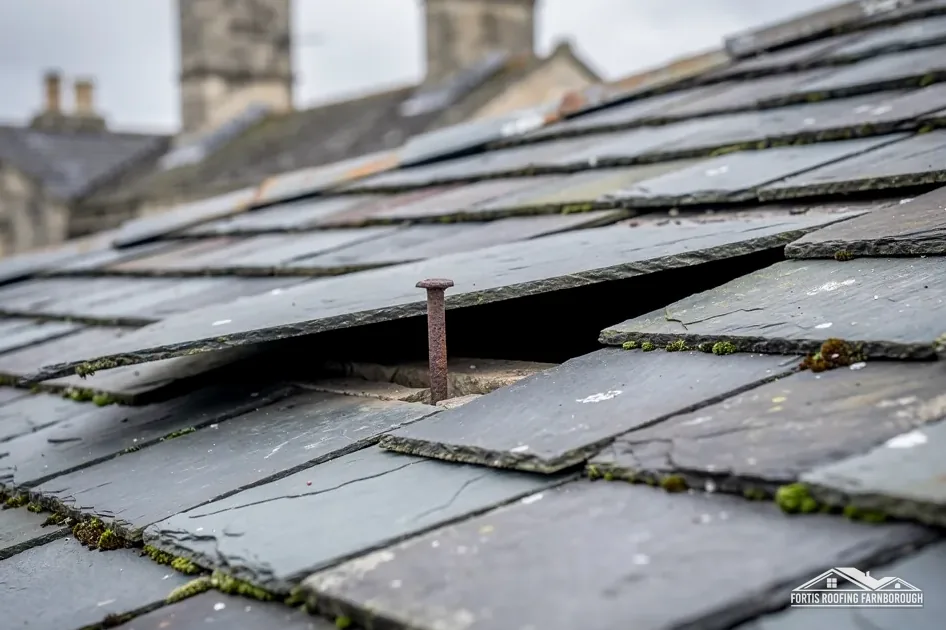
That gives Crondall two roofing stories: clay from the 17th century and slate from the Victorian years. We never assume which a house carries. On the survey we lift, photograph and name the covering on each slope, then match the repair to it. Our slate roofing page explains how a slate roof is surveyed, and why a few slipped slates are often a repair rather than a reason to replace the lot.
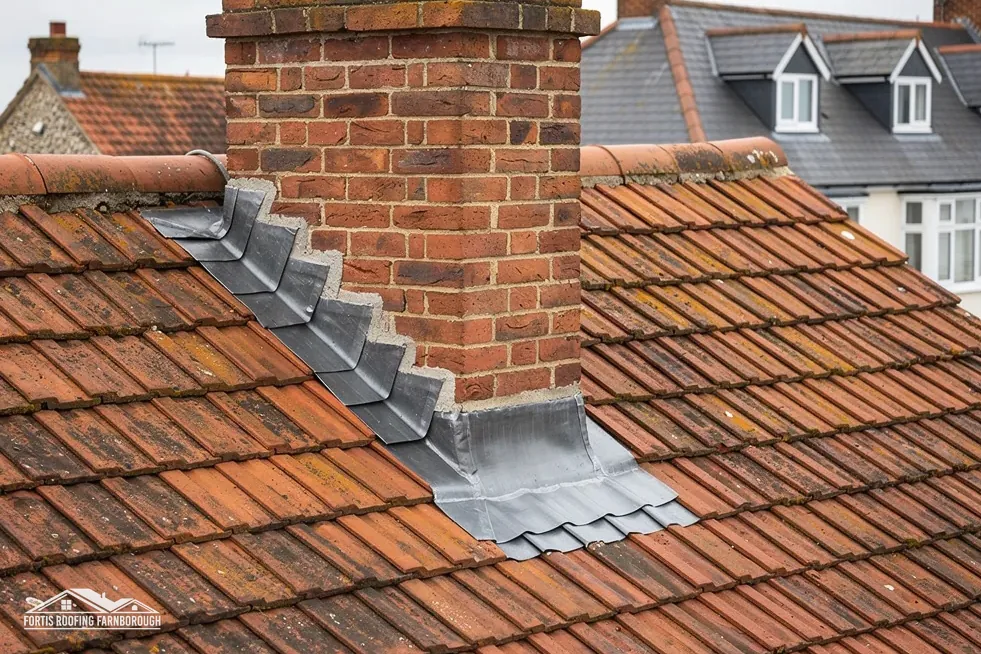
Where lead flashing is used at a chimney or a wall junction, MyJobQuote says it "can last for over 80 years", a lower bound, not a promise, so a sound old flashing may stay while the tiles around it are repaired.

A street with both coverings is read slope by slope. We work along the eaves, the verge and the valleys, lift a few tiles or slates wherever the top layer conceals what lies beneath, and photograph battens, underlay and fixings. The result is a short report in plain words with the photographs attached, and the written price follows from it.
Chapter 03 of 03
| Designation | In Crondall | For roof work |
|---|---|---|
| Conservation area | Crondall (appraisal March 2024) | Repairs in the traditional manner, same materials |
| Article 4 direction (1998) | Crondall Conservation Area | Frontage roof slopes and chimneys on dwellings |
| Article 4 directions (1985) | Land at and south of Heath Lane | Named on Hart's list; check by address |
| Grade I listed church in use | Church of All Saints (NHLE 1091946) | Church of England faculty, not listed building consent |
| Grade II listed | 1 and 2 Pankridge Street (NHLE 1339821) | Listed building consent for work affecting character |
Crondall has its own Hart conservation area. Hart's guidance on such areas is direct about maintenance: for a building that is not listed, repairs made in the traditional manner, following the original detail and using the same materials, need no planning permission. A repair of that kind on a Crondall roof is held to that standard, which is why we record the original before we touch it.
Hart's appraisal, adopted in March 2024, is the document to read ahead of any change that would alter how the roof reads from the street. On a survey in the conservation area we photograph the front slope, the ridge and each stack before any price is given, so the original is on file if the council asks to compare.
Hart decided to apply Article 4 directions to most of its conservation areas, and Crondall is on the list of 1998 directions. They reach alterations to the front of a dwelling, works affecting a roof slope that faces the street among them, and the erecting, altering or removing of a chimney. Hart's list also names two 1985 directions at Heath Lane. So on a house at the front of a Crondall street, a change to the roof slope or the stack is a matter for Hart's planning team before work, not after. Our chimney repairs page explains how we survey a stack.
All Saints is listed Grade I and still holds Church of England services, which puts its roof work under the faculty system and the ecclesiastical exemption, not listed building consent from Hart. The faculty system is the Church of England's own consent process for its buildings, so work on the church itself needs the parish's agreement, not Hart's. The National Heritage List counts 62 listed entries within 500 m of the point we use for Crondall. Several are homes, including 1 and 2 Pankridge Street, 10 the Borough, and 11 and 15 the Borough, each listed Grade II. For those houses, listed building consent covers work that affects their character.
None of this slows a genuine repair. A slipped tile, a cracked ridge or a failed flashing can be put right once the covering and detail are recorded, with the price set out in writing from what the survey found. The consent questions arise only when the plan changes how the roof looks, and the photographs go in your report either way.
A change of covering alters how the roof looks, and in a conservation area with an Article 4 direction on frontage roof slopes it is a matter for Hart's planning team before any work. It may also add weight: a covering 15 per cent or more heavier needs Building Regulations approval and a structural check. We tell you which applies after the survey.
Hart's 1998 directions reach chimneys on dwellings, so building, altering or taking down a stack needs a conversation with Hart first. Hart's own wording says repairs to non-listed buildings in the traditional manner, with the same materials, need no planning permission. We photograph and measure the stack before any work, so the comparison is easy to make later.
No. All Saints is Grade I listed, yet being an Anglican church in use it comes under the ecclesiastical exemption, and roof work follows the faculty system. Listed building consent from Hart applies to listed houses such as the Grade II homes on Pankridge Street and the Borough, and we check any listing first.
No. Hampshire County Council puts the application on the scaffolding company, which files it for you, and it allows no extensions to a licence once issued. Scaffold on your own drive needs no licence. We agree the scaffold position with the firm at the survey, so the street stays passable for the people who live along it.
Get your free roof quote
Tell us your road and what you have spotted, and we will book the survey.
10-year workmanship guarantee, in writing.