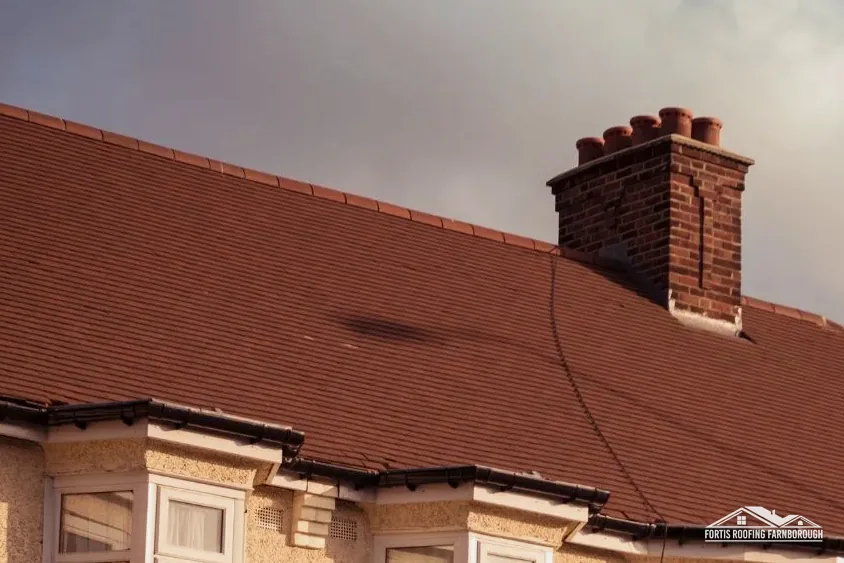
Castle quarter's clay roofscape
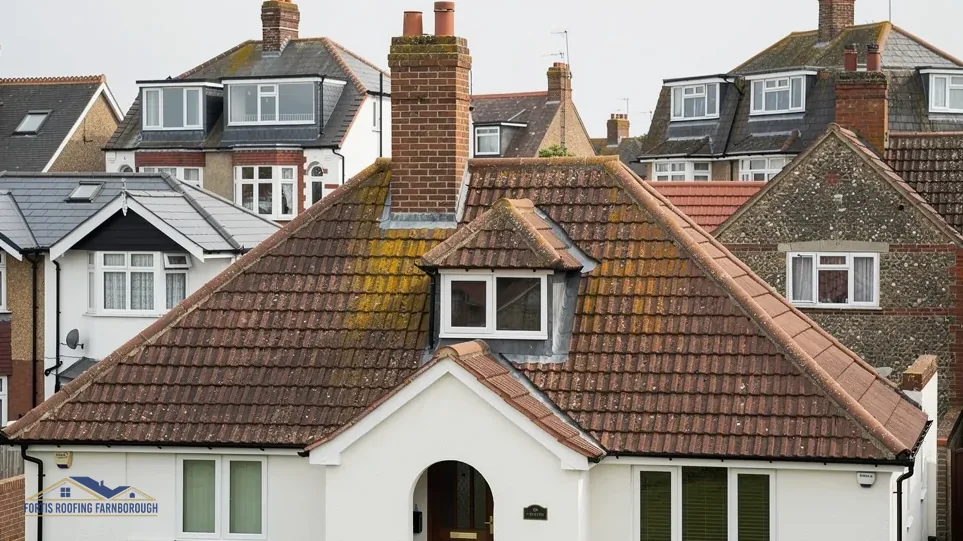
For the castle and Quarry Street area, the appraisal calls the roofscape very important: hand-made clay tiles, pitched, with brick chimneys.
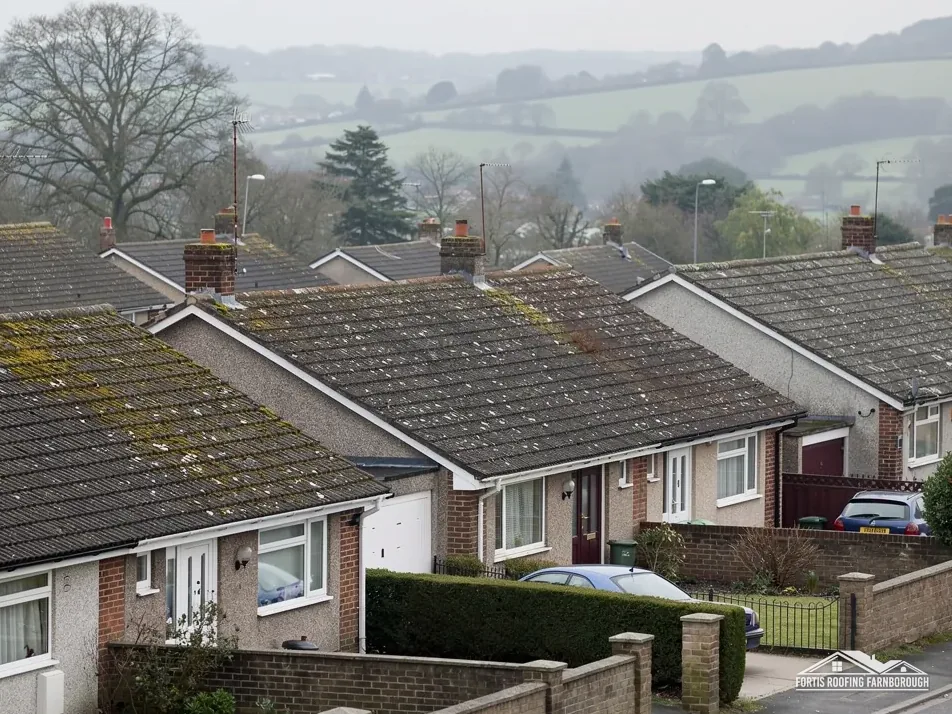
Roofs of clay tile, Welsh slate and brick chimneys
Guildford is Surrey's old county town, where the Wey cuts through the Downs. We survey its roofs, from the castle quarter's clay tiles to later slate, slope by slope.
For the castle and Quarry Street area, the appraisal calls the roofscape very important: hand-made clay tiles, pitched, with brick chimneys.
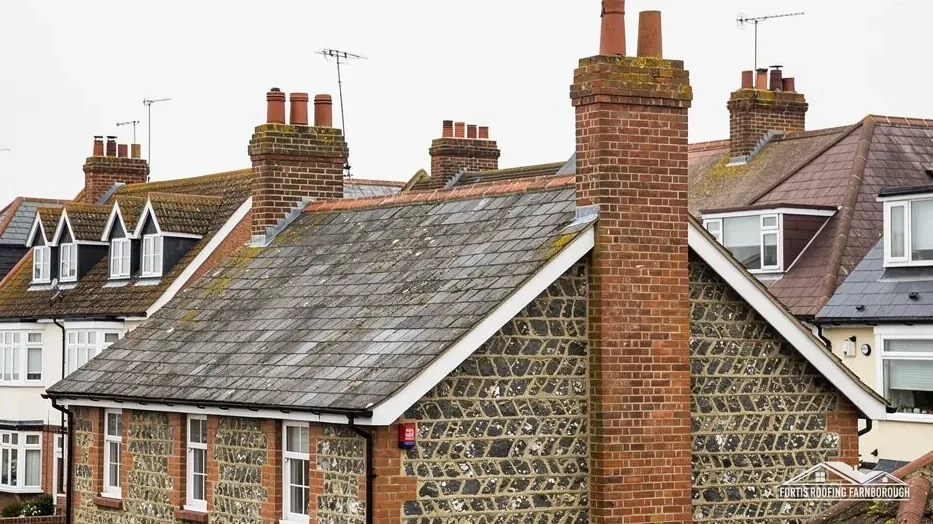
Welsh slate became the preferred roof covering after 1845, when the railways made it cheaper to transport.
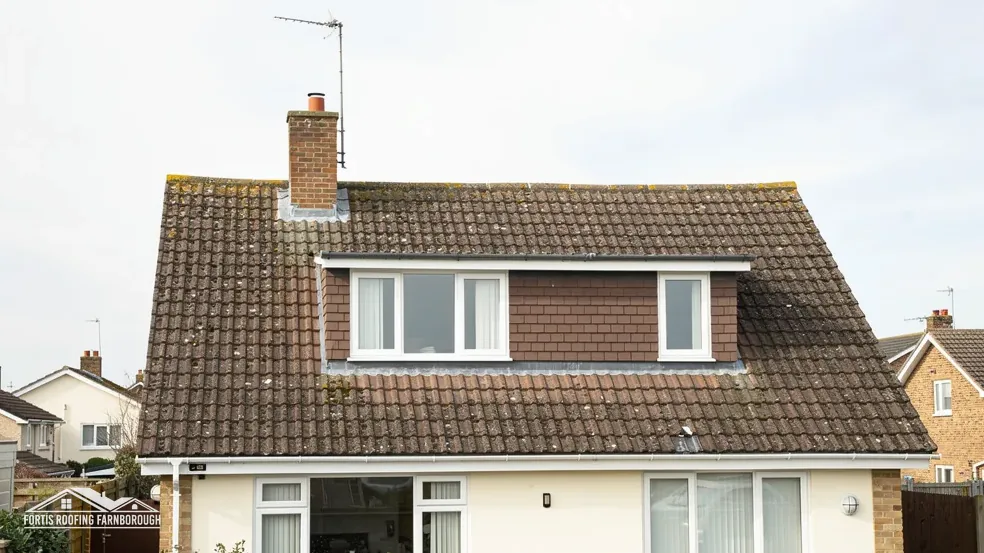
Vertical tile-hanging in local clay tiles, hand-made and later machine-made, appears on many buildings in the town centre area.
Map of Guildford with Stoughton, Shalford, Merrow, Burpham marked around it.
Map data © OpenStreetMap contributors. Loads only when you ask for it.
Guildford is Surrey's old county town, in the gap where the River Wey cuts through the chalk of the North Downs, and Farnborough lies 14.7 road miles away, north-west of the town.
About 14.7 road miles south-east of Farnborough · Guildford Borough Council and Surrey County Council.
Guildford, roofscape and rules
What Guildford's own appraisal says about its tiled and slated roofscape, how the borough's building control, Surrey's scaffold licence and its Article 4 chimney rule apply, and which Grade I buildings shape repair in the centre.

| No. | Chapter | The figure it turns on |
|---|---|---|
| 01 | Guildford's own service, Surrey's licence | Guildford inspects, Surrey licenses poles |
| 02 | Tile first, slate after the railways | Slate preferred after 1845 |
| 03 | Grade I buildings and a ring of conservation areas | 217 listed buildings within 900 m |
Chapter 01 of 03
| Body | Role in a Guildford roof job |
|---|---|
| Guildford Borough Council | Planning authority and building control, its own service |
| Surrey County Council | Highway authority and scaffold licences, until 31 March 2027 |
| West Surrey Council (from 1 April 2027) | Successor to both from 1 April 2027 |
| Registered building control approver | Private alternative, regime since 6 April 2024 |
Guildford Borough Council both decides planning and operates the town's building control, a service it presents as not for profit. The highways, and with them scaffold licences, stay with Surrey County Council until 31 March 2027, from which date West Surrey Council succeeds both bodies. Guildford is 14.7 road miles from the A325 in Farnborough, and the 2021 Census counted 77,854 people in its built-up area.
In a county town, a lot of roofs are reached from a pavement. A terrace on a narrow street gives scaffold no choice but the footway, and then the licence is part of every job. The terms on Surrey's page are short: £208 buys 28 days of scaffold or hoarding over the carriageway or footway, a renewal costs the same, 10 working days of notice are wanted, and for an unsafe structure the council asks you to call about an emergency licence.
The page names no filer for the form, which is one more question for the scaffolder when you book. On a busy street we also plan for pedestrians, deliveries and waste, and tell you in advance how the footway will be kept usable.
Old terraces share roofs and walls, and a repair on one house can show the state of its neighbour. Where houses join, we photograph the junction and describe what is visible of the next slope from our side, without stepping onto it. If a neighbour's roof needs work, that is a conversation for the two owners, and our photographs give both the same picture.
In conservation areas Guildford manages change through Article 4 directions, and on any address where one reaches a chimney, demolishing or reshaping the stack needs the council's consent. Its online map carries an Article 4 layer that shows which addresses are caught. A town of old terraces has many chimneys, and the stack is often the first thing an owner wants to take down. Repair, such as repointing, is a different thing, and ordinary upkeep.
We check the map before the survey, so the first conversation already knows whether a stack at your address is in play.
Chapter 02 of 03
Guildford's roof record in four published points
Guildford's town centre appraisal gives a clear account of the town's roofs, which we quote from the council's own words. For the character area around the castle and Quarry Street, it calls the roofscape very important, describing hand-made clay tiles on pitched roofs, with brick chimneys. It says Welsh slate became the preferred roof covering in the town after 1845, when the railways made it cheaper to transport. And it notes vertical tile-hanging in locally made clay tiles, hand-made and later machine-made after about 1900, on many buildings in the town centre conservation area.
Those three observations describe a town where clay tile, Welsh slate and tile-hanging sit side by side. They do not tell us what covers your roof, and a century and a half of repairs may have changed it. What they do give us is a language for matching. A hand-made clay tile has a texture and a colour range that a machine-made tile does not copy, and a slate roof changed to concrete tile alters a street's look.
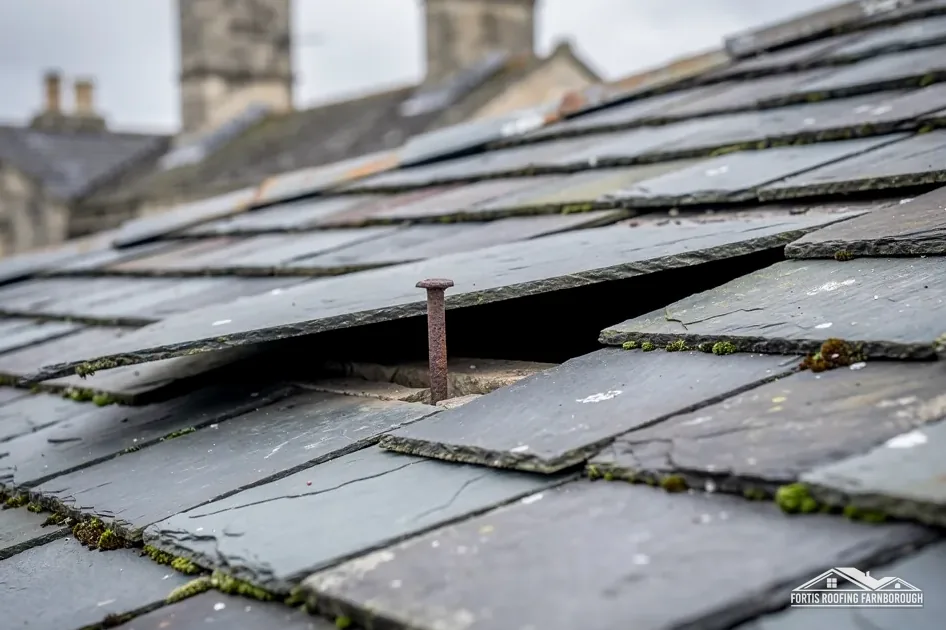
Where a few clay tiles need replacing, reclaimed stock or a near match in hand-made tile is the first thing sought, with samples held against photographs of your own slope. Where a Welsh slate roof has slipped slates, we look at the nails, because slates often slip when the fixings give out, and replacing a few slates on a failing roof is a short-term answer. On the slate roofing page you can read when a bigger job beats a patch.
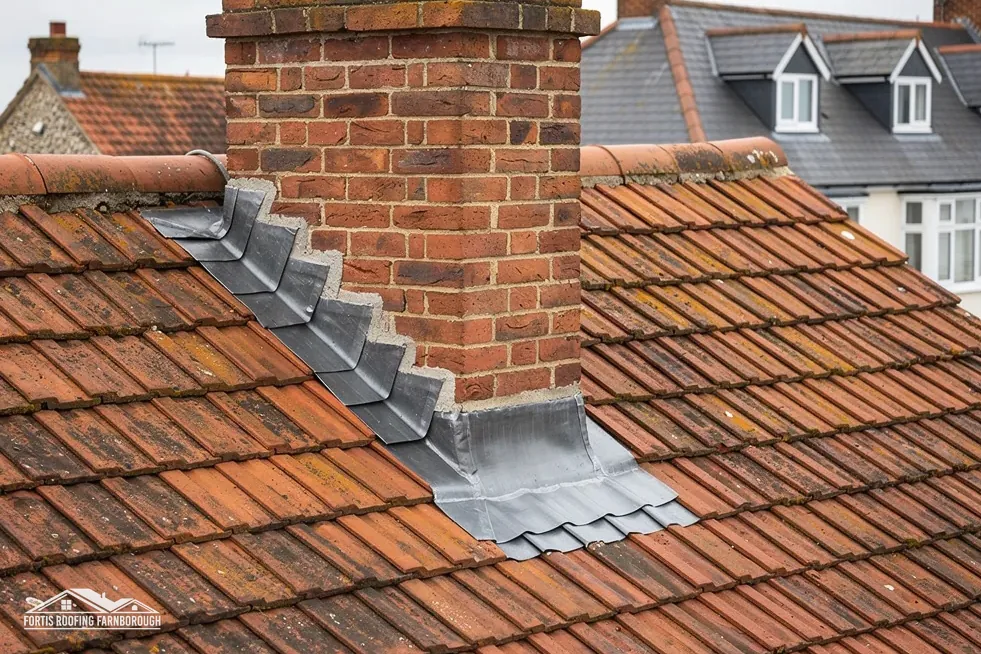
Tile-hanging deserves its own mention, because it is half wall and half roof. Where hung tiles meet a roof slope, at eaves, verges and abutments, a lead or metal flashing carries the water across the join, and when that flashing fails the water runs behind the tiles. We examine those junctions from the ladder and photograph them, since they are easy to overlook from the street.
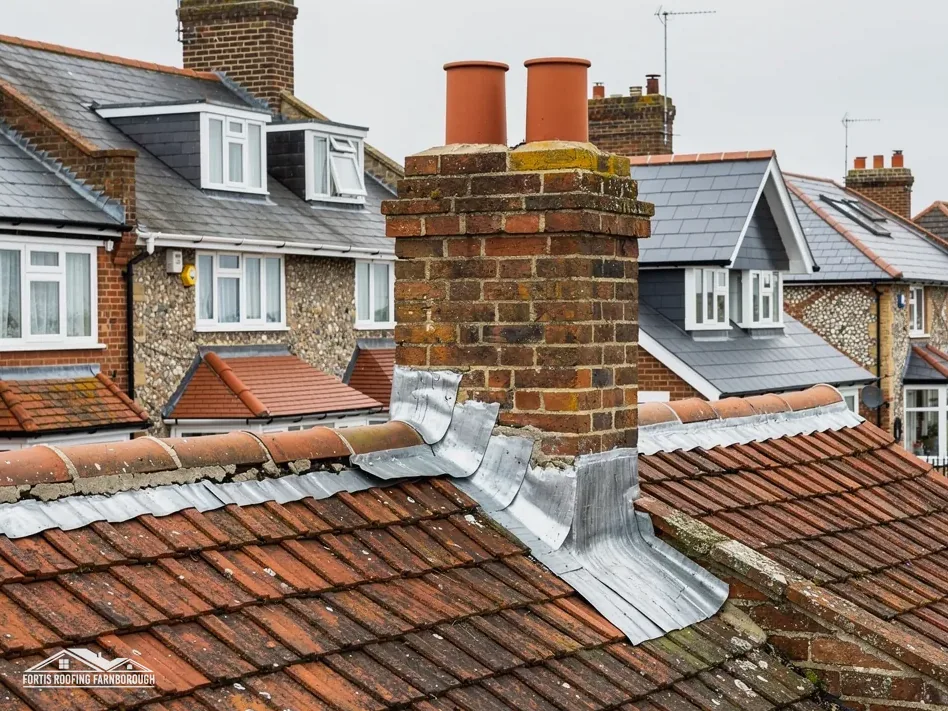
Brick chimneys are the other part of the roofscape, and they take the weather from every side. A leaning stack, loose pointing or a failed flashing at its foot are common findings on older terraces. We photograph each joint from the ladder and tell you what is sound.
The borough has over 1,000 buildings on the statutory list, so a roofer in Guildford meets listed buildings often. The routine is the same each time: record the roof, ask the council what is needed, and repair like for like.
Chapter 03 of 03
| Designation | In Guildford | For roof work |
|---|---|---|
| Grade I listed church in use | Church of Holy Trinity (NHLE 1029258) | Faculty, not listed building consent |
| Grade I listed | Former private apartments at Guildford Castle (NHLE 1029306) | Listed building consent |
| Grade I listed | Guildford House (NHLE 1180153) | Listed building consent |
| Conservation areas | Town Centre; Millmead and Portsmouth Road; Bridge Street; Charlotteville | Check Guildford's map |
The national list shows 217 listed buildings within 900 m of the centre of Guildford. Among them are the Church of Holy Trinity, listed Grade I on 1 May 1953, the former private apartments at Guildford Castle, also Grade I, and Guildford House and the Hospital of the Blessed Holy Trinity, both Grade I as well. Work on a Grade I building is always a matter for the specialists.
The national dataset names conservation areas around the centre, among them the Town Centre, Millmead and Portsmouth Road, Bridge Street, Charlotteville, Stokefields, Waterden Road and the Wey and Godalming Navigations. Guildford's own page lists them with their appraisals, and offers a postcode search. A house inside one is subject to the Article 4 chimney rule where a direction applies, and to a more careful look at any change of appearance.
Because the centre is so dense in listed buildings, an unlisted neighbour often shares a wall, a roofline or a gutter with a listed one. That can raise questions about who is responsible for a shared valley or parapet, and the answer sits in the deeds, not with a roofer. We photograph the shared parts and describe what is visible, so owners and their advisers can talk from the same evidence.
Holy Trinity serves as an Anglican church, and through the ecclesiastical exemption its roof is dealt with under the faculty system. The castle apartments and Guildford House are outside that exemption, and Guildford Borough Council's listed building consent covers work that would alter their character. A roofer asked to quote on a listed building should ask first who gives consent, because the answer decides the order of events.
Some land within about 250 m of the centre sits in Flood Zone 3 on the Environment Agency's Flood Map for Planning. It is a map of land, not of roofs, but it is a reason to keep roof water moving to proper drains. We clear and test outlets at the survey.
Holy Trinity, listed
For an unlisted house or block outside the areas, repair is straightforward. A dated photographic record is useful at a sale or with an insurer. Our chimney repairs page explains how stacks are repaired, and our commercial roofing page covers the shop, office and block roofs of the town.
You can, but the texture and colour differ, and the patch shows from the street. In a conservation area that also matters for the look the council protects. For a clay roof the search starts with reclaimed or near-matching hand-made tile, samples are held up against photographs of your own slope, and a lack of any match is reported to you plainly.
Repointing is repair, but where an Article 4 direction covers an address, Guildford requires consent to demolish or reshape a stack, so that is the step to check. We read the council's map for your address before the survey, and then tell you whether your stack needs a repair or a decision from the council.
Slates most often slip when their nails give out, though a cracked or flaking slate can fall too. Replacing slipped slates helps for a while, but a roof whose nails are corroding will keep losing them. Lifting a few slates shows the fixings, and then we can say whether repair, refix or re-roof is the sounder choice.
For scaffold or hoarding over the footway, Surrey County Council (until April 2027) charges £208 per 28 days and wants 10 working days of notice. Its page is silent on who files, so ask who applies. A busy shopfront also needs a plan for pedestrians and deliveries, which we settle with you.
Get your free roof quote
Tell us your Guildford street and what looks wrong on the roof, and a surveyor will come to look.
10-year workmanship guarantee, in writing.