Single-ply membrane
PVC, TPO or EPDM sheet with welded or bonded laps.
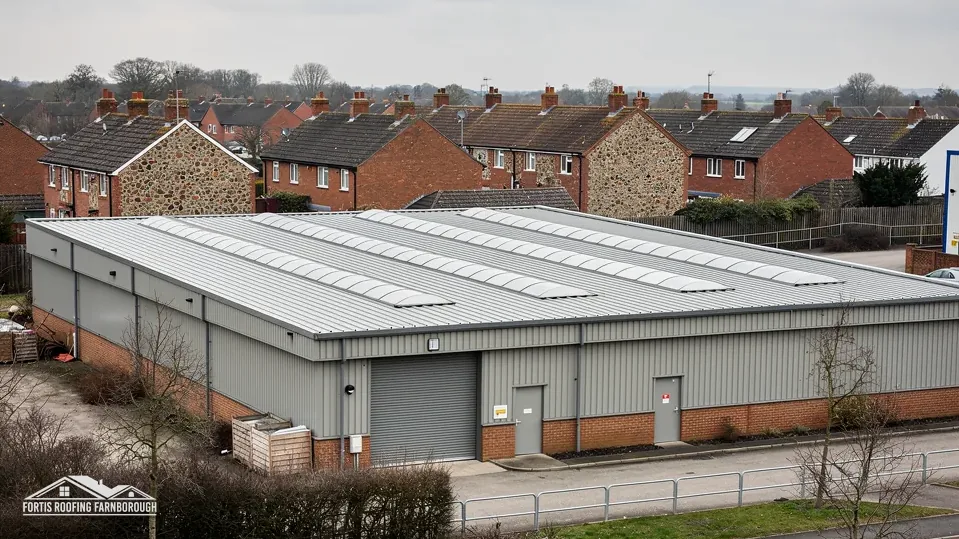
Units, offices and blocks, surveyed before anything is priced
Industrial units, offices, shops and blocks of flats across Farnborough and north-east Hampshire: membrane, felt, sheet and asbestos-cement roofs repaired, overlaid or replaced.

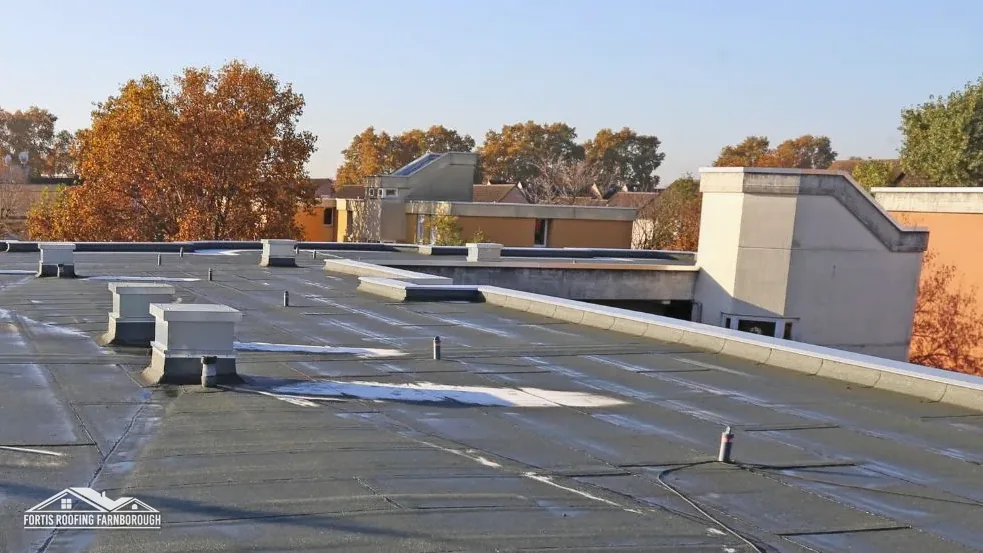
PVC, TPO or EPDM sheet with welded or bonded laps.
Layers of bitumen felt bonded on site under a cap sheet.
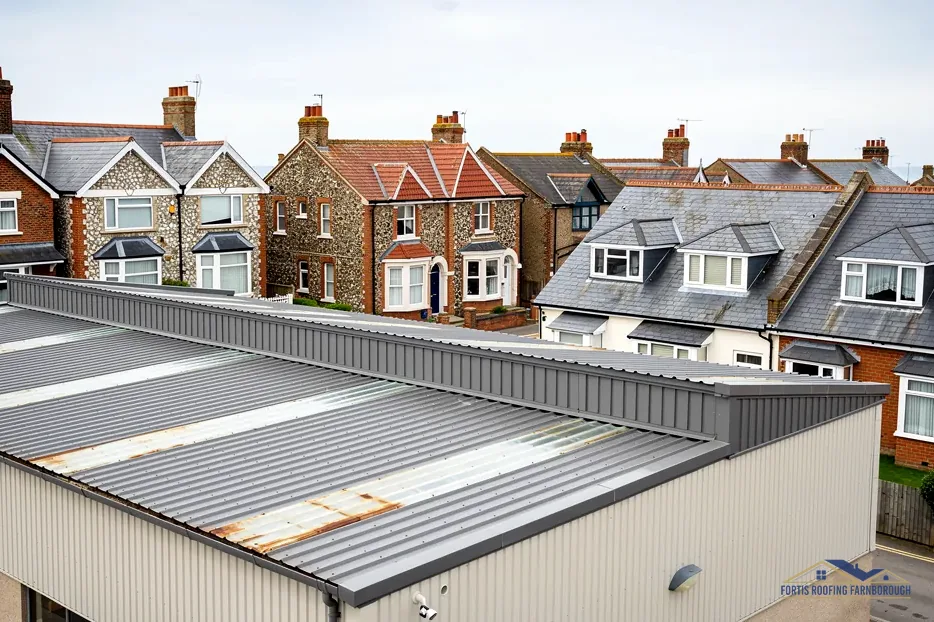
Steel sheets on purlins, checked for rust at the cut edges.
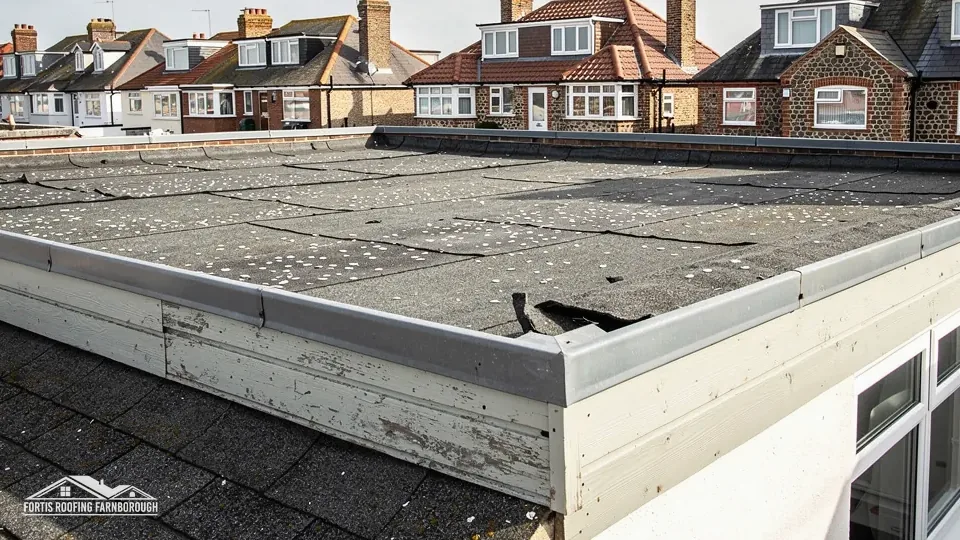 Leak tracing and repairs
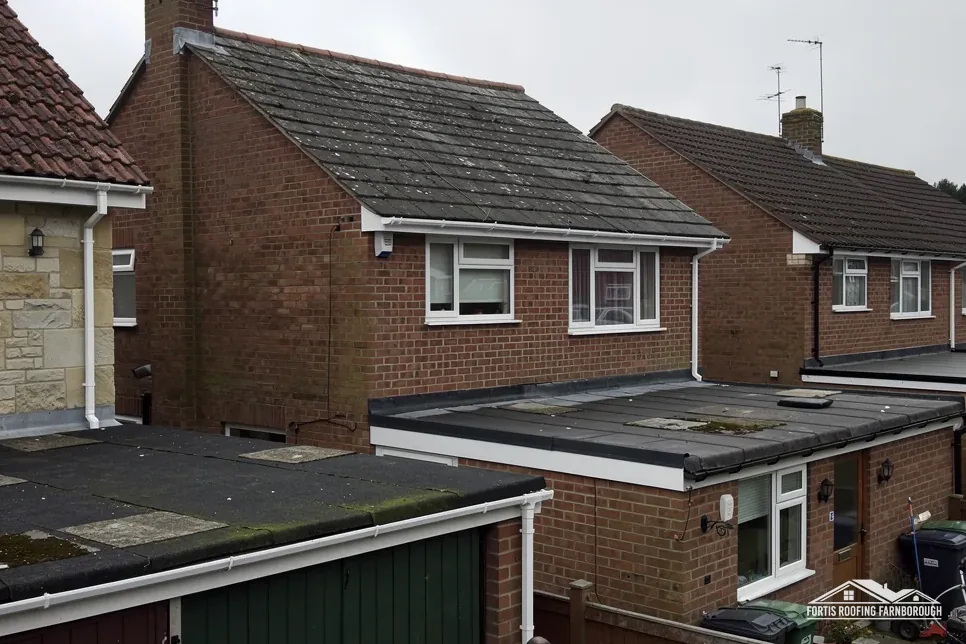 Flat roof refurbishment
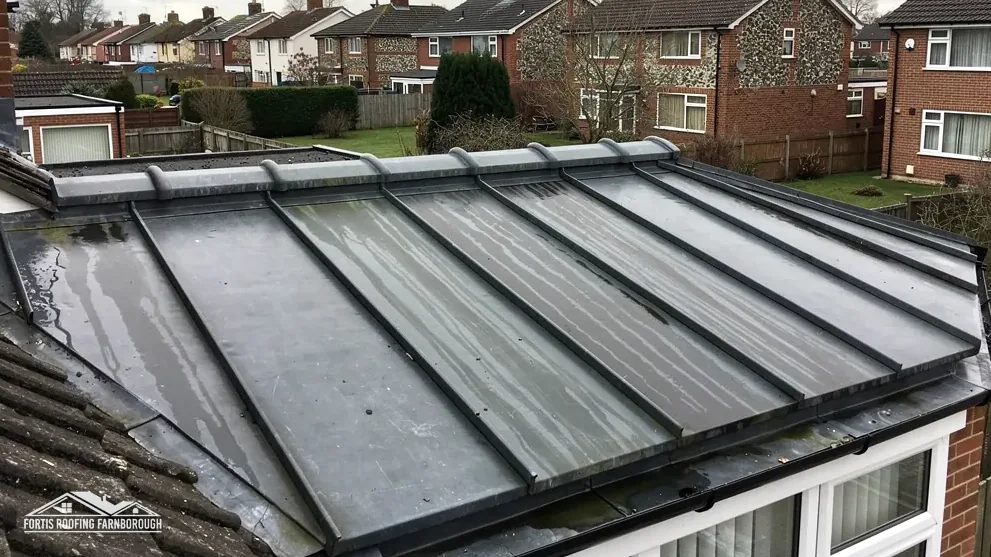 Metal sheet and cladding
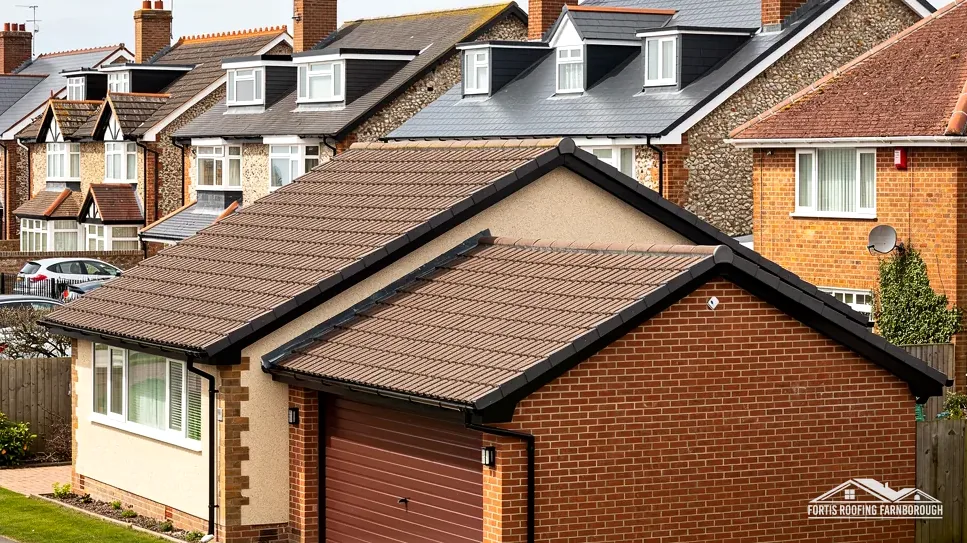 Asbestos-cement roofs
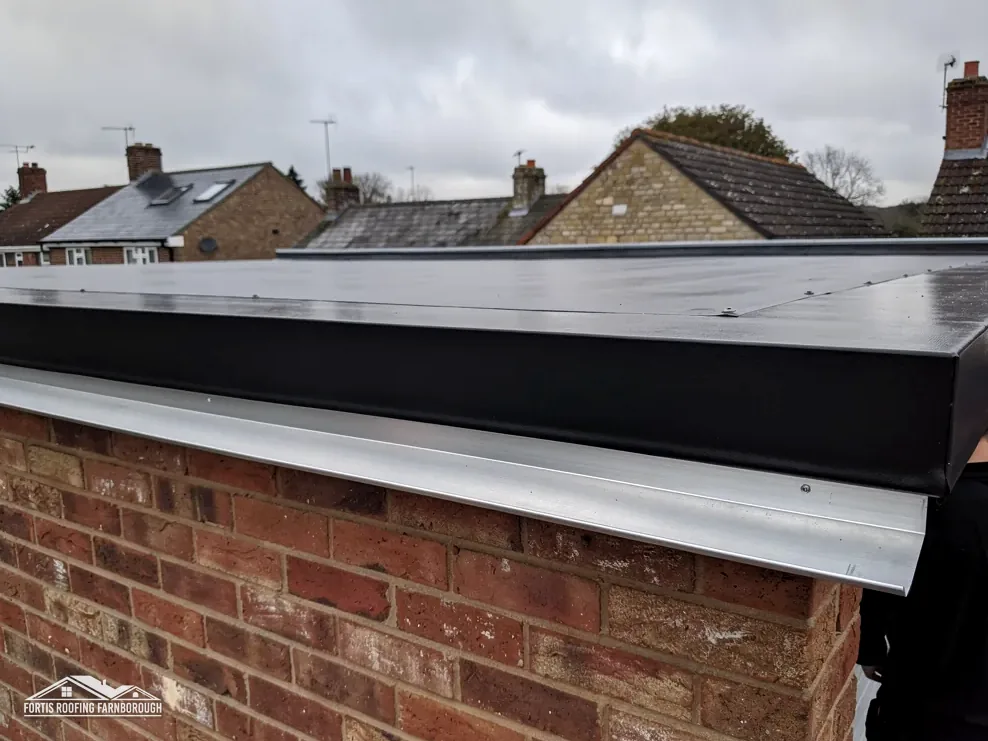 Gutter linings and outlets
 Roof condition surveys
The faults are local and the deck and covering around them are dry.
The covering is worn out but the deck beneath is dry and sound.
The deck is wet or failing across the roof, so a new roof lasts longer.
Commercial roofs, the figures
Falls, lifespans, asbestos categories, lead codes and the building control test for commercial roofs, taken from the standards and national guides, with what each figure means for a unit, shop or block.

| No. | Chapter | The figure it turns on |
|---|---|---|
| 01 | Membranes, felt and GRP on low-slope roofs | Flat-roof code covers pitches to 10° |
| 02 | Published lives of flat-roof coverings | Lead sheet: 60-100 years |
| 03 | Asbestos-cement sheets and the HSE categories | Registers of work kept 40 years |
| 04 | Fragile sheets, rooflights and CDM 2015 | CDM 2015 |
| 05 | Box gutters, parapets and lead linings | Box gutter lead codes: 5 to 8 |
| 06 | Building control, planning and VAT on business roofs | Roof area affected: under 50 per cent |
Chapter 01 of 06
The code of practice and the falls behind a flat commercial roof
A commercial building is rarely one roof. An industrial unit can carry a low-slope main roof, a two-storey office block on the front with its own flat roof, a canopy over the loading doors and a line of valley gutters between the bays. The flat and low-slope parts are where water sits longest, so they are where leaks start. This chapter covers the membrane systems on those roofs. Chapter 04 covers safety on fragile sheets, and chapter 05 the gutters.
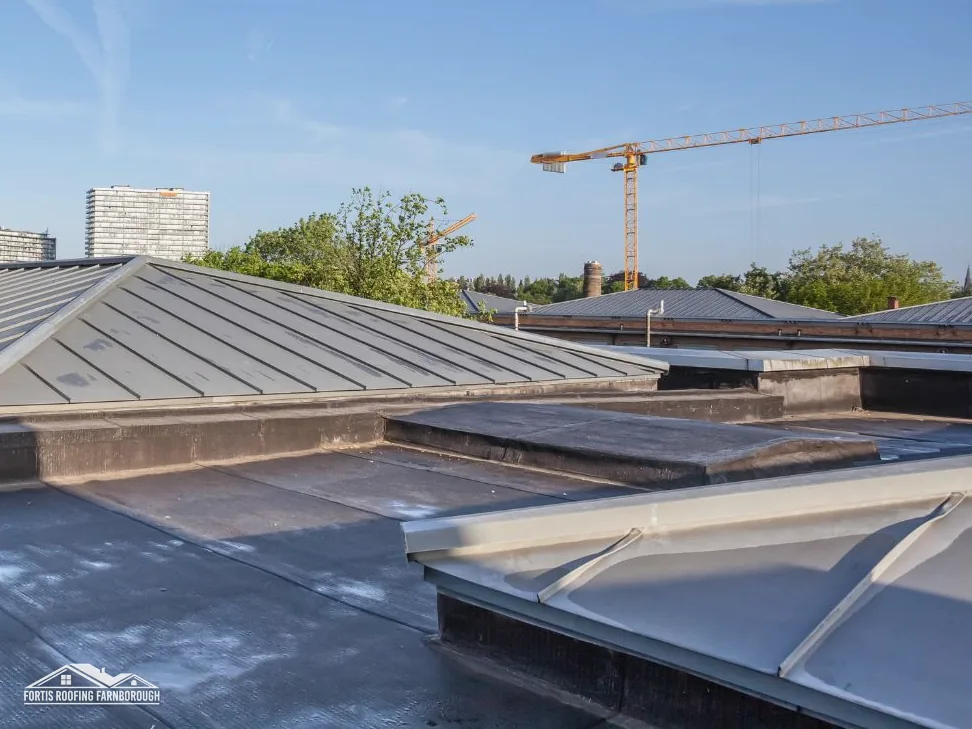
Single-ply is one sheet of synthetic membrane laid across the whole roof, with its laps welded or bonded. On a commercial roof it can be PVC, TPO (thermoplastic polyolefin, a single-ply sheet joined by hot-air welding) or EPDM, a synthetic rubber bonded at the seams. Built-up felt is two or three layers of bitumen felt, the top one often a mineral-surfaced cap sheet, torched or bonded together on site. GRP (glass-reinforced plastic, often called fibreglass) is laid wet over a boarded deck and cures into one hard skin. Liquid-applied coatings are rolled or brushed onto an existing roof and cure into a membrane. A coating suits a sound, dry surface; it cannot cure a wet deck hidden underneath.
Each system has its own repair. A split in PVC is patched with PVC and welded. A blister in felt is cut, dried out and capped. A crack in GRP is ground back and laminated over. Mixing materials at a repair, such as bitumen mastic smeared over a single-ply lap, tends to fail at the join and makes the next roof repair harder to do well.
No flat roof is truly flat. BS 6229:2025, the current code of practice for flat roofs with continuously supported flexible coverings, applies to roofs with a pitch of not more than 10 degrees, and it keeps a minimum finished fall of 1:80, both across the main roof and in any internal gutter. IKO's advice is to design the roof for a fall of 1:40, so that deflection of the deck, settlement and site tolerances still leave the finished surface at 1:80 or steeper. The 2018 edition of BS 6229 was withdrawn on 16 December 2025, so a specification still quoting it is out of date.
Where the fall is too shallow, water ponds. Standing water adds load to the deck, holds silt and moss against the surface and searches out any weak lap. On older industrial roofs the deck can sag between purlins, so the same puddles return after every heavy shower. Lead sits outside BS 6229 altogether: Approved Document C points to BS 6915:2001 for lead sheet roofing.
Our guide to single-ply roofing for commercial buildings goes further into how each membrane is chosen and fixed. Smaller flat roofs on homes, garages and rear extensions are covered by our flat roofing service.
Chapter 03 of 06
| Material and work | HSE category |
|---|---|
| Asbestos-cement sheet removed carefully without breaking up | Non-licensed work |
| Asbestos cement weathered but not otherwise substantially damaged | Non-licensed work |
| Asbestos cement substantially damaged or broken up | Notifiable non-licensed work |
| Short-duration AIB removal in a refurbishment | Notifiable non-licensed work |
| AIB work that will not be of short duration | Licensable work |
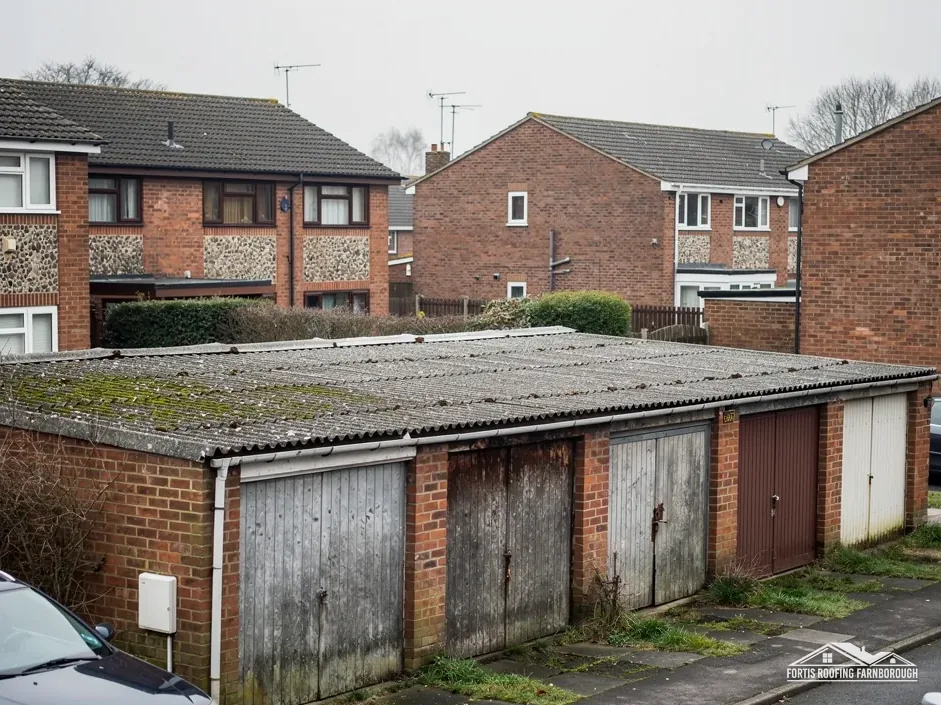
Asbestos cement is the grey corrugated or profiled sheet found on older warehouses, workshops, garages and farm buildings, often with gutters and downpipes made of the same material. HSE's advice is that if a building was built or refurbished before 2000, you should assume there is asbestos in it until a survey shows otherwise. That covers the roof sheets, the rainwater goods and, on some buildings, the boarding at the eaves: HSE lists external soffits among the places asbestos insulating board (AIB) turns up, and notes that it is difficult to tell AIB from boards without asbestos by eye.
The table shows how HSE classes the work. Taking asbestos-cement sheets off carefully, without breaking them up, is non-licensed work, and that holds for sheets that are weathered but not otherwise substantially damaged. Once the material will be substantially damaged or broken up, the job becomes notifiable non-licensed work, which brings advance notification and written records with it. Registers of work, the health records for notifiable jobs, must be kept for 40 years. Work on AIB that will not be of short duration is licensable work, in a different tier again.
So the method sets the category, and the condition of the sheets sets the method. Sheets sound enough to unbolt and lower whole keep a job in the lightest category. Sheets that have perished, or shattered under a fallen branch, may not.
An owner has three routes. Over-cladding fixes a new metal or composite sheet above the old roof on spacers, leaving the asbestos in place and enclosed. A coating seals sound sheets under a liquid-applied layer, which suits a roof with years left in it. Removal and replacement takes the asbestos off site for good. Each route has a different cost now and later, and each leaves different duties with whoever manages the building. Our guide on whether to overclad or replace an asbestos-cement roof weighs those up.
HSE in two figures
When sheets do come off, they leave as hazardous waste. HSE's EM9 sheet says to double-wrap and label asbestos waste. It travels on a consignment note with a carrier holding upper-tier registration, because the household exemption for hazardous waste excludes asbestos. Asbestos sheet never goes into an open skip.
The first step is always to know what is there. A survey of the roof sheets, gutters and soffits before work starts tells everyone on site what they are handling, which category the job falls in and what it will involve. On a shared estate, the landlord or managing agent may already hold an asbestos register for the building, and that is the first document to ask for.
Chapter 04 of 06
The safety rules that shape access to a commercial roof
A fall through a fragile surface is the main danger on a commercial roof. HSE's guidance is plain that asbestos-cement roofs are always fragile, and old plastic rooflights set into a profiled metal roof can be just as weak and hard to spot under dirt and moss. We treat every rooflight as fragile until it is proven otherwise, and the access is planned before anyone steps off a ladder: staging over the sheets, covers or netting at the rooflights, and edge protection wherever the work runs near an open edge. Our guide to fragile roofs and safety for building owners sets out the owner's side of this.
The Construction (Design and Management) Regulations 2015 apply to all building work. HSE defines a domestic client as an individual having work done on their own home, or a family member's, that is not done as part of a business. A company, landlord or managing agent commissioning work on a unit, a shop or a block is therefore a commercial client, and the client duties sit with them. Under regulation 5(1), where there is more than one contractor, a principal designer and a principal contractor are appointed. Under regulation 15(5), where there is only one contractor, that contractor must still draw up a construction phase plan. The extra duties turn on the number of contractors, not on whether the job is notified.
On a roof job the contractors might be us alone, or us alongside a scaffolder, an asbestos removal firm and an electrician isolating plant. Our guide to CDM 2015 on commercial roofing jobs walks through the appointments.
Roof work on a commercial building often goes on above people who are still at work. The plan for the job sets out where the scaffold or tower stands, how the yard and loading doors stay open, when noisy work and hot works happen, and how the floor beneath is protected if the covering is opened. Torch-on felt brings a fire watch with it. Deliveries, skips and waste routes are agreed with the site, and the person responsible for the building hears what is happening each day.
Where a scaffold stands on the public highway, section 169 of the Highways Act 1980 means the highway authority must license it: Hampshire County Council for Rushmoor and Hart addresses, and Surrey County Council (until April 2027) for the Surrey boroughs. Hampshire County Council expects the scaffolding company to make that application on the customer's behalf. A scaffold inside a private yard needs no licence; Bracknell Forest Council's page says similar structures on private land do not require one.
Chapter 05 of 06
| Code | Thickness | Weight | Parapet, box or tapered gutter |
|---|---|---|---|
| Code 3 | 1.32 mm | 14.97 kg/m² | Not listed (soakers only) |
| Code 4 | 1.80 mm | 20.41 kg/m² | Not listed |
| Code 5 | 2.24 mm | 25.40 kg/m² | Listed |
| Code 6 | 2.65 mm | 30.05 kg/m² | Listed |
| Code 7 | 3.15 mm | 35.72 kg/m² | Listed |
| Code 8 | 3.55 mm | 40.26 kg/m² | Listed |
Gutters work harder on a commercial building than on a house, because a large roof drains to a few outlets. Valley gutters between the bays of a portal-frame unit, box gutters behind parapet walls and eaves gutters along the office front all take water from big catchments. One blocked outlet can lift water over the edge of a gutter lining and into the building below, so a leak reported as a roof leak on an industrial unit can start in a gutter.
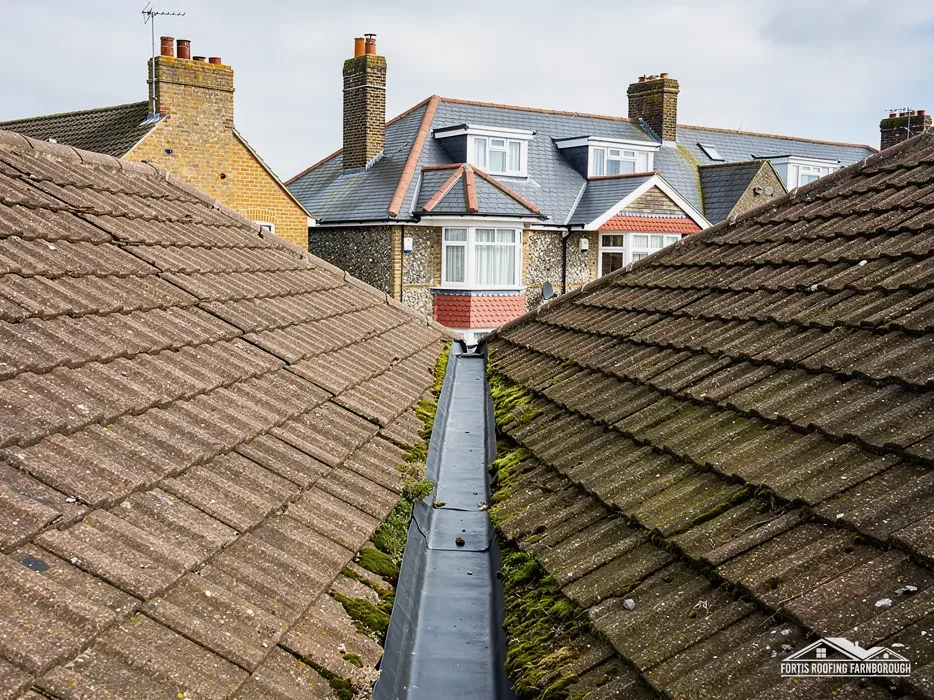
Older steel and cast iron valley gutters corrode first at their joints and outlets. Where a gutter is still structurally sound, it can be lined rather than replaced: cleaned, primed and covered with a single-ply, GRP or liquid-applied lining dressed up under the roof sheets on each side. Our answer on commercial gutter lining explains when lining is the better buy.
Box and parapet gutters on older buildings are often lined in lead. The table shows Royston's listings: the four heaviest codes, from 2.24 mm up to 3.55 mm, are the ones it lists for that duty, while codes 3 and 4 are left off. Lead sheet work follows BS 6915:2001, the standard Approved Document C points to, with drips and laps placed to give each bay of lead room for thermal movement.
BS 6229:2025 applies the same minimum finished fall of 1:80 to internal gutters as to the general roof area. For eaves gutters, Brett Martin's installation guidance gives a fall of 1mm for every 600mm of run. BS EN 12056-3:2000, the current standard for roof drainage layout and calculation, is where gutter and outlet sizes are worked out on a new design or a full roof replacement.
The front of a commercial building often has fascias and soffits like a house, in timber, uPVC or, on older buildings, AIB. Because HSE lists external soffits as a place AIB is found, boards on a building built or refurbished before 2000 are checked before anyone cuts or drills them. Rotten timber fascias let gutter brackets pull away, which spoils the fall and leaves water standing at the joints. For roofline work on homes and smaller premises, see our gutters, soffits and fascias service.
Gutter clearance is the simplest maintenance a commercial roof gets. Leaves, moss washed off the roof, silt and nesting material build up at outlets and in downpipe heads. A clearance timed for after leaf fall, with each outlet and downpipe run checked for flow, costs little next to a spoiled ceiling, ruined stock or a flooded server room.
Chapter 06 of 06
The Planning Portal's re-roofing test, its weight rule and the VAT rate
The Planning Portal's re-roofing test reads the same for a warehouse as for a house. Re-roofing normally needs no building control application if the work touches less than 25 per cent of the total building envelope and, at the same time, less than 50 per cent of the roof. A new covering weighing 15 per cent or more above the existing one, or one that would behave significantly differently in a fire, does need approval, and the Planning Portal suggests a structural engineer or surveyor looks at the frame first. Re-covering the whole of a large roof goes well past the 50 per cent figure, so building control is involved, either through the council or through a registered building control approver.
For Farnborough, Aldershot and the Hart towns, the council route is one shared team, the Hart and Rushmoor Building Control Partnership, which works from Rushmoor's offices in Farnborough (01252 398715). Premises in Bracknell Forest are a special case: that council names the replacement of pitched and flat roof coverings as work for which approval may be needed, so we confirm the position with it before any re-covering there.
The Class C permitted development rules for roofs apply to houses, not to business premises or flats. For a commercial building, the useful test is in section 55 of the Town and Country Planning Act 1990: work that leaves the building's external appearance materially unaffected is not development at all. A like-for-like repair or re-covering normally passes that test. Over-cladding in a new profile or colour, adding rooflights or raising the roof line may not, so those changes go to the local planning authority first. Rushmoor puts it plainly for blocks: flats have no permitted development rights, so work that is not like-for-like needs planning permission.
Commercial roof work carries VAT at the standard rate of 20%. The domestic reverse charge applies to supplies between VAT-registered businesses that are reported within the Construction Industry Scheme, so whether it applies depends on where the customer sits in the contract chain. Your accountant can confirm which side of that line a given contract falls on. A homeowner paying a roofer never falls under it.
What drives the cost of a commercial job is the roof area, the system, the access, the state of the deck and whether asbestos is present. A roof over a busy warehouse floor, with work fitted around deliveries, takes longer than the same area over an empty unit. Scaffold and access equipment are part of the one total we give. When you compare quotes, check that each includes VAT and the access, so the figures line up.
Send us the address and what you have seen inside; we survey the roof, photograph each fault and give one written price.
| Job | Typical UK range |
|---|---|
| Roof survey, average (MyJobQuote) | around £300 |
| Asbestos survey (MyJobQuote) | around £325 |
| Asbestos roof removal (MyJobQuote) | around £2,750 |
| EPDM rubber roof, domestic guide (MyJobQuote) | around £60 per square metre |
Source: MyJobQuote (roof survey, October 2026; asbestos roof removal and survey, September 2026; rubber roofing, October 2026)
National guide figures, set for smaller domestic-scale jobs and never our own prices. A commercial roof is priced on its area, system, access and condition.
Short reads on asbestos sheets, fragile roofs, single-ply, maintenance plans and CDM, written for landlords, facilities managers and unit owners.
Guide · 9 min read
A commercial roof price follows the system, size, access, condition and use of the building. One rate per…
Guide · 9 min read
An ageing asbestos-cement roof can be covered over or taken off. The choice turns on the condition of…
Guide · 9 min read
A fragile roof looks solid and fails without warning under a person's weight. Building owners need to know…
Yes, with some planning. We agree access, working hours, hot works and waste routes with the site before starting, fence the work area off from staff and visitors, and protect stock or equipment beneath any section of roof that is opened. The person responsible for the building is told what happens each day.
It is rust that starts at the cut ends of profiled steel sheets, where the factory coating stops, and creeps back under the paint as it peels. It shows first at the eaves and end laps. Caught early, the edges are cleaned, treated and sealed; left alone, the sheet ends can rust through.
Yes. A single split lap, a lifted flashing or a blocked outlet is a proper job in its own right, and fixing it early is what keeps a commercial flat roof inside its published life. The inspection tells you whether the fault is a one-off or one of many across the roof.
Yes. A condition survey records each roof area, its covering, the faults found and where they are, with photos, so a landlord, tenant or managing agent has a dated record. It is useful at the start or end of a lease, before a sale, or to plan maintenance spending over the next few years.
Report it to your insurer straight away and keep a record: photos of the roof and the damage inside, and receipts for any emergency work. A temporary repair stops further damage. Whether storm cover applies turns on your policy's own storm definition, and a disputed refusal can go to the Financial Ombudsman Service.
If it was built or refurbished before 2000, HSE's advice is to assume asbestos is present until shown otherwise. A survey of the roof sheets, gutters and soffits before work starts tells everyone what they are handling and which HSE category the job falls in, and that sets the method and the cost.
Get your free roof quote
Tell us the building, the roof type if you know it, and where water is getting in.
10-year workmanship guarantee, in writing.