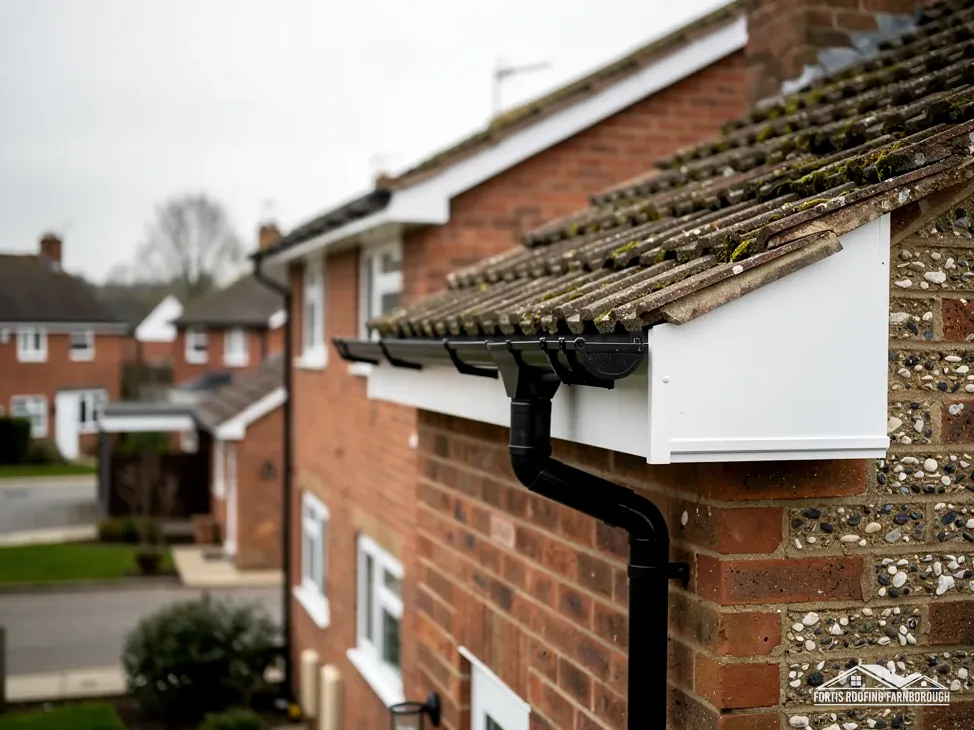
Gutters sit at the lowest edge of a roof, and that tempts people to treat them as a ladder job. For a short run at the back of a bungalow, that can be right. For the front of a two-storey house, with fascias and soffits to change too, it is not, and the difference is not only a matter of comfort. Safe access is what keeps a long job from becoming a risky one, and it decides who is on the pavement, for how long and under whose permission.
This post is the access post in our gutters cluster. It sets out the realistic options by the height and shape of the house, explains the highway licence that applies when a platform occupies part of the footway or carriageway, with the fees and notice periods that the highway authorities in our area publish, and covers the CDM rules for jobs with more than one firm. The questions of consent and cost have posts of their own: planning permission to replace gutters, and the cost of uPVC fascias and soffits.
The gutters, soffits and fascias page explains how we approach the work.
What decides whether scaffold is needed
Four things decide it, and they are all things you can see from the garden.
The height of the eaves
A bungalow or a single-storey extension has eaves within reach of simple equipment. A two-storey house does not, and a three-storey one is further still. The higher the eaves, the less sensible it is to rely on a ladder for anything beyond a quick inspection.
The scope of the job
Clearing a gutter or re-fixing a single bracket is a short task. Replacing a whole run, with new brackets, joints and downpipes, takes hours and needs both hands, so the platform has to be stable. Replacing the fascia and soffit as well adds boards to lift, cut and fix.
The ground
Level paving and a clear drive make access simple, because equipment can be positioned close to the wall and moved along it. A sloping garden, a flower bed, a pond or a conservatory roof beneath the eaves complicates it.
What is below
A gutter above a pavement, a road, a neighbour's land or a doorway raises the question of where the equipment can stand, and who has to give permission.
If those four answers are simple, the job can often be done from a tower or a platform. If any of them is awkward, scaffold is usually the sensible choice, because it gives a long, level working platform and a guard at the edge. A short conversation on site, with someone standing in your garden and looking up, settles it faster than any rule of thumb written down here.
Access options by house height
There is a ladder of options, and each has its place. A good firm chooses the least disruptive one that is safe for the work.
Ladder
A ladder is for access and for short, light tasks: a look at the gutter, clearing a hopper, a single repair at low height. It is poor access for long work with both hands, because the person on it has little room and no edge protection.
Tower
A mobile tower gives a stable platform with a guard rail and can be moved along a wall. It suits one- and low two-storey work where the ground is level and the run is not long.
Cherry picker or platform
A powered platform reaches height quickly and avoids building scaffold, and it suits some jobs with clear, firm ground. It needs space to stand and move, and it is not always possible on a narrow drive.
Scaffold
A scaffold built along the elevation gives a long working platform at the eaves, with guard rails and a toe board. It is the usual choice when a two-storey house needs new gutters, fascias and soffits together, because the job takes time and the work is at the edge.
Roof ladders and edge protection
For work from the roof, edge protection is needed at the eaves.
Choosing
The rule of thumb is to match the access to the job, not to the lowest quote. Work from a poorly chosen platform is slower, and it is where mistakes and accidents come from. A cheaper quote that assumes a ladder for a job that needs scaffold has not removed the cost. It has moved the risk.
When scaffold stands on the highway
Once scaffold takes up part of a pavement or road, the law steps in. Under section 169 of the Highways Act 1980, nobody may put up or leave scaffolding or another structure that obstructs the highway without a licence from the highway authority.
Who the highway authority is
- Hampshire County Council looks after the whole of Rushmoor, so Farnborough, Aldershot and North Camp, and also the Hart district, East Hampshire and Basingstoke and Deane.
- Surrey County Council, until 31 March 2027, covers Camberley, Farnham, Guildford, Woking and the other Surrey districts around us.
- Bracknell Forest, Wokingham and Windsor and Maidenhead are unitary councils that license the scaffolds on their own roads.
A district council such as Rushmoor does not issue these licences.
Not every scaffold needs one
A scaffold that stays entirely on private land is outside the rule, as Bracknell Forest and Wokingham both note, and that covers many back gardens. One built in your own front garden, or on a private road, does not obstruct the highway.
Private roads and estates
Wokingham makes the point for private roads in particular. On a private estate the question moves to whoever owns the road, who may set rules of their own.
What the council expects
The application is made before work starts and includes documents such as proof of the scaffold firm's insurance cover. Councils want to be sure that pedestrians, including those with prams or wheelchairs, can still pass, so the position of the scaffold and the width left on the footway both count. Wokingham, for example, gives a footway width of at least 1.2 metres.
An unlicensed scaffold on the highway is an offence, and RBWM says fines of up to £5,000 apply to non-compliance with a scaffolding licence.
Fees, notice and who applies, council by council
The councils publish their own terms, and they differ. These are the figures each has published, from the councils' own pages.
| Authority | Fee as published | Notice |
|---|---|---|
| Hampshire County Council | £211.90 for the first 2 weeks, £72 for each further 2 weeks | Ten clear working days; no extensions |
| Surrey County Council (until April 2027) | £208 per 28 days | At least 10 working days |
| Wokingham Borough Council | £263 for the first 4 weeks, £163 for each 4 weeks after | At least 10 working days |
| Bracknell Forest Council | Residential £350, including a £100 non-refundable application fee, for 6 weeks | Not stated |
| RBWM | Not published | Not stated |
Who applies
Hampshire County Council's page expects scaffolding firms to apply for their customers, and Wokingham Borough Council's page expects the same. Surrey, Bracknell Forest and RBWM stay silent on the point, so ask the roofer who will apply, and expect the licence to be handled between us and the scaffolder.
Why it affects timing
Hampshire County Council grants no extensions, which means a job running past its licence date has to start again with a new application. Allow ten clear working days at the start, and plan the work to finish inside the period.
Who is in charge with two firms
Gutter work rarely involves only one firm if scaffold is separate. The Construction (Design and Management) Regulations 2015 shape what follows.
Domestic client
HSE's description of a domestic client is a householder having building work done at home, with no business involved.
One contractor
With a single contractor on the project, regulation 15(5) makes that contractor responsible for the construction phase plan.
More than one
Regulation 5(1) names two roles, principal designer and principal contractor, and both are needed when a second contractor joins the project. A scaffold firm engaged separately from the roofer makes two contractors, so the roles come into play.
In practice
On a domestic gutter job, the roofer who arranges the scaffold usually takes the coordinating role, so one firm is in charge of the site. Ask who that is, and ask to see the plan for how the work will be done safely. A competent firm can explain it in a few sentences, covering who erects the platform, who inspects it before the work starts, and where materials and waste will be kept.
The count is what triggers it
What brings in the extra roles is the number of contractors, not whether the work was notified to anyone. That is worth knowing if you are told that the job is too small for any of it.
Our guide to scaffolding for chimney repair covers a related case.
What access adds, and how to plan it
Access forms a real share of the price, and a clear quote says how it has been dealt with.
What drives the cost
The length of the elevation, the number of storeys, the time the platform stays up, whether a licence is needed and who erects and removes it all affect the cost. Scaffold is priced after a survey, because it depends on the elevation and the time it stays up.
Combine jobs
If you also need fascias, soffits, a chimney repair or roof work, doing them together saves paying for the platform twice. Ask the survey to cover the whole roofline.
Asbestos and soffits
For a house from before 2000, HSE's advice is to presume asbestos until a test says otherwise, listing external soffits as one such place. The soffits should be identified before anyone disturbs them. Our post on asbestos in soffits for Farnborough homeowners explains the steps.
Questions to ask
- What access is proposed, and why that choice?
- Will it stand on the pavement, and who arranges and pays for the licence?
- How long will it be up?
- Is it included in the written price, along with removal and waste?
One price
After the survey you get one price on paper, and access, any licence, removal and waste are covered in that same document. A survey is the first step, and it shows whether a ladder, a tower or scaffold is the right choice for your house.