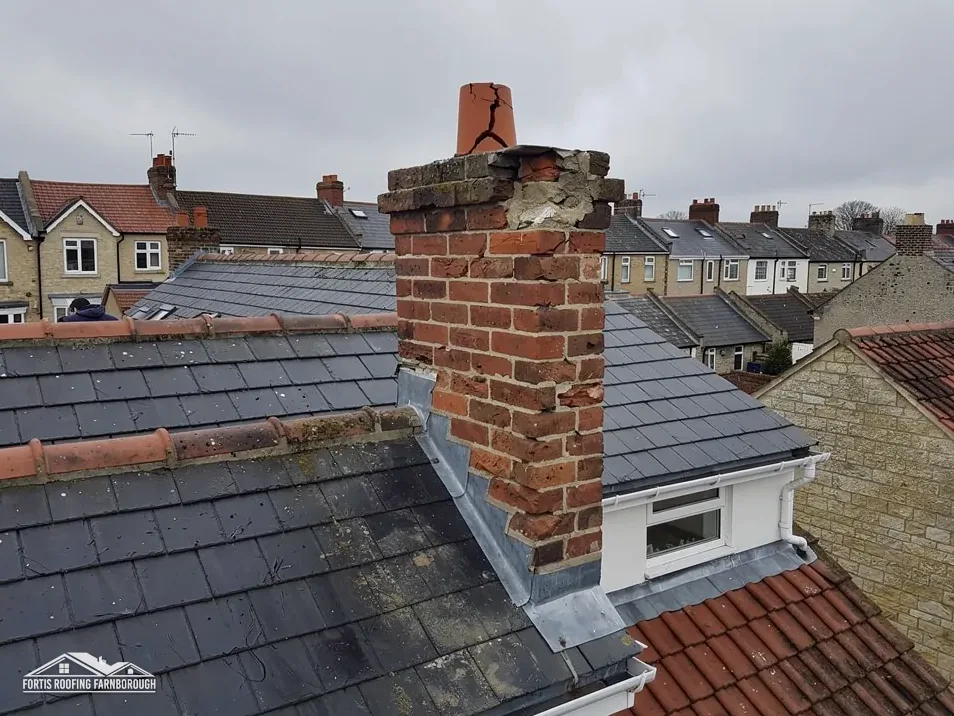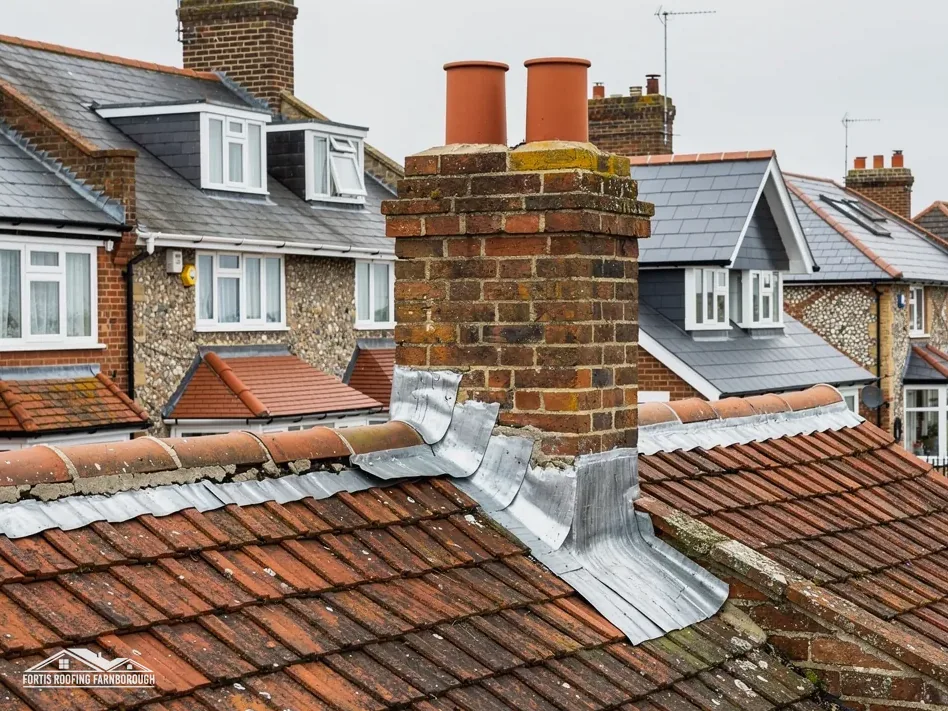
Look at the top of a brick chimney stack and you will see a rounded bed of mortar around the base of each pot. That is the flaunching. It does two jobs at once: it fixes the pot to the brickwork so wind cannot shift it, and it forms a slope that sheds rain outward, away from the opening of the flue and off the top of the stack.
It is also one of the most exposed pieces of masonry on the house. It sits on the highest point of the building, takes the full weight of the weather and has no covering over it. Mortar is hard, but it is porous and brittle, and years of wetting and freezing make it crack, shrink and fall away.
Once the flaunching has gone, rain runs into the gap between pot and brick, soaks the stack from the top and may find its way down the flue to the breast below. The repair, though, is a modest job when it is caught at the start. This guide explains what flaunching is for, how it fails, how to spot the signs, how a proper repair is carried out, and when the problem goes beyond the flaunching.
What flaunching does for the pot
A chimney pot is a clay or terracotta tube that finishes the flue. It stands on the top course of brickwork, and without something to hold it, the first strong gust would send it over the side.
Holding the pot
The flaunching is a bed of mortar built up around the base of the pot, bonded to the top of the stack on one side and the pot on the other. It carries the pot's weight evenly and keeps it upright. Several pots on a stack each have their own flaunching, and on a wide stack the mortar can be a substantial mass.
Shedding the rain
The shape matters. The surface slopes outward and downward from the pot, which is called a fall. Rain landing on it runs to the edge and drips clear, rather than lying round the pot or running in. A flat or hollowed flaunching holds water and speeds its own decay.
Protecting the brickwork
The top of a stack is the part most exposed to rain, wind and frost. The flaunching forms a cap over the brick and mortar joints beneath. Take it away and the top courses of brick take the full force of the rain, and the stack begins to break up from the top.
Not the same as capping
A cap is a fitting that goes on or over the pot to keep rain and birds out. Flaunching is the mortar below it. Our guide to capping a chimney explains the difference, and the two are often renewed together since they share the same access.
How cracks, frost and rain wear it down
Flaunching fails slowly, then quickly. A hairline crack turns into a gap over a few winters.
Shrinkage and movement
New mortar shrinks a little as it dries and may crack soon after being laid if it was mixed or applied badly. Beyond that, the pot and the stack expand and contract at different rates in the sun and the cold, so the joint between them is worked back and forth every day.
Freeze and thaw
Water that enters a crack and then freezes expands and widens it. The Met Office's South Farnborough station records annual rainfall of about 715 mm over 118 days of 1 mm or more and around 53 days of air frost, on 1991 to 2020 averages. Those are averages for one station, but they show the sort of cycle a stack top goes through: wetted often, frozen on a good number of nights.
Wrong mortar
A mortar that is too strong or too weak for the brick can crack or crumble. A rich cement mix over old soft brick can trap water and cause the brick face to spall, which means flake off. We match the mix to the stack.
Neglect and age
Moss and lichen keep the surface wet for longer, and birds can pull at loose mortar. A stack that has never been maintained will have a flaunching that has been taking this for decades.
What it looks like
Hairline cracks, gaps between the mortar and the pot, mortar that sounds hollow when tapped, and pieces on the roof or in the gutter below are all stages of decay. Our guide to chimney repointing covers the matching joints below.
Reading the signs from below
You cannot see the top of a stack from the garden clearly, but the building often tells you something.
Signs outside
With binoculars, look for cracks running round the base of the pot, a gap where the pot meets the mortar, mortar that has gone green or black, and pots that seem to lean. Pieces of mortar on the tiles below, or in the gutter, mean it is coming away.
Signs inside
Water that enters at the top of the stack runs down through the brickwork. The first effects are usually brown stains on the chimney breast, damp patches that grow after heavy rain, flaking plaster and wallpaper peeling away. In a loft, the brickwork of the stack may look dark and feel damp.
Not always the flaunching
Damp on a breast can have several causes: faulty flashing at the base, failed pointing, a cracked pot, condensation from an unused flue or a leaking roof tile. Our guide to a damp chimney breast sorts these. We work from the top down, because water arrives at the top.
Why look sooner than later
A pot that has lost its bed can fall, and a falling pot is dangerous to anyone below. If you see a pot that leans, keep the area beneath clear and arrange a survey promptly. Roof access means a safe platform, not a ladder against the gutter.
What we record
When we survey a stack, we photograph the flaunching from close range, tap the mortar to hear whether it is sound, and record the pots, pointing, brick faces and flashing. You see every picture.
Repairing flaunching properly
The repair is straightforward in principle: remove what has failed and build it again so it sheds water. The detail is where the quality lies.
Take out the loose mortar
The old flaunching is chipped away, taking out anything cracked or hollow. The tops of the bricks are cleaned and inspected. If the top courses are soft or broken, they are rebuilt first, since new mortar on a weak base fails again.
Reset the pot
The pot is lifted and checked. A cracked pot is replaced. Our answer on chimney pot replacement explains when a pot is past repair, and a matching pot can be sourced where the stack's look matters. The pot is then bedded plumb and level on fresh mortar.
Form the flaunching
New mortar is built up around the base and shaped to a smooth fall outward. It is tooled to a dense surface, and the edges are taken over the brick so water cannot get behind. The mix is chosen to suit the brick: hard enough to last, but no harder than the stack can take.
Let it cure
Fresh mortar needs time to set before it faces heavy rain or frost, so the weather forecast matters. Working in a hard frost risks damage to new mortar. A dry spell with moderate temperatures suits the job.
Access
Work at the top of a stack needs a stable platform, usually a scaffold or a tower. Where the access is already in place for flashings, pointing or a cap, the flaunching is a small addition to the same visit.
Pots, caps and the rest of the stack
Because the stack top is hard to reach, jobs are best grouped. Several repairs share the same access.
Pots
While the flaunching is open, the pots can be checked and, if needed, replaced. A cracked or leaning pot is a good reason to rebuild the bed. Clay pots come in many shapes, and a match is sometimes needed for appearance, especially on a terrace where the stacks are seen together along the street.
Caps and cowls
A cap or bird guard can be fitted at the same time, and the flaunching will be formed around it. If the flue is unused, a vented cap helps keep the flue dry.
Pointing and brick faces
If the joints below the flaunching have decayed, repointing the top courses is sensible while the scaffold is up. Bricks that have spalled may need replacing, and each one we change is recorded in the survey photographs, so you can see what came out and what went in.
Flashings
At the base of the stack, check the lead against the roof. A flaunching repair that leaves a failing flashing in place does only half the job, and the leak is likely to return. Look at the whole stack from pot to roof.
Writing it up
After a survey, we give one written price for the work we agree, and the survey photographs go with it. The price takes account of access, which is often the biggest part of a stack job. Our chimney repairs page shows the range of stack work we survey.
Group the jobs on a stack. The scaffold is the expensive part, and several repairs can share it.
When the problem is bigger than flaunching
Sometimes the flaunching is the visible part of a deeper issue. It is better to know before the work begins.
A leaning stack
If the whole stack leans, or bricks have moved, the cause is likely structural rather than a failed bed of mortar. That is a job for a rebuild or a specialist assessment, not a repair of the top. Our guide to a leaning chimney explains the signs, and the questions to ask before a rebuild is agreed.
Crumbling brickwork
When bricks are soft, powdery or flaking in thick layers, the stack has taken in water for a long time. New flaunching on bad brick will not hold. The top courses may need rebuilding, or the stack taken down and rebuilt.
Cracks through the stack
A crack running down the brickwork, particularly a stepped one, needs a proper look. It can be movement in the house, or in the stack itself.
Persistent damp inside
If the breast stays damp after the stack top and flashings are sound, the cause may be inside the house, such as condensation from an unventilated flue. A change of approach, such as a vented cap and a vent at the breast, may then be needed.
The sensible order
We would rather tell you a stack needs a rebuild than put new mortar on failing brick. The survey shows which case you have, with photographs and measurements, and we explain it in plain words. The price is written once the evidence is in.