Few things announce a chimney problem as clearly as a damp breast, and the signs are familiar in many older houses. It may be a brown stain that spreads after rain, wallpaper that lifts, plaster that flakes or a white powder that returns after each repair. It is tempting to treat the surface with paint or a damp-proofing fluid, but the stain is a symptom, and the water has a source.
A chimney is an unusual structure for damp. It runs through the whole house, it is exposed to weather above the roof, it contains a flue that can hold moist air, and it carries salts from years of burning fuel. Water can arrive at the top, at the base where the stack meets the roof, through the brickwork on the way down or from inside the flue.
This guide explains the three main routes, rain, condensation and salts, shows how the flashing and cap affect the result, and describes how we work out which route applies to your stack. We start at the roof, because that is where most of the water enters, and we leave the redecoration until the cause is fixed.
Three ways water reaches the breast
It helps to separate the routes, because each needs a different repair.
Rain from above
Water enters through the top of the stack or at its junction with the roof. The causes are a cracked flaunching, an uncapped pot, failed joints in the brickwork, a lifted flashing or a loose tile near the base. The stain tends to appear or worsen after heavy rain, and it is often strongest on the wall nearest the stack.
Condensation inside the flue
Moist indoor air finds its way into a cold flue and turns to water on the inner walls. If the flue has no ventilation, the moisture stays and soaks into the brickwork and the plaster. This is a problem in unused flues that have been sealed at the top and the bottom. It does not depend on rain, and it often gets worse in cold weather.
Salts
Chimneys that have carried smoke for years contain salts and soot in the flue walls. When moisture reaches them, the salts dissolve and migrate to the surface of the plaster, where they leave brown stains and a white crystalline deposit. They also draw moisture from the air, which is why a wall can feel damp on a humid day when no leak is present.
Often more than one
A stack with a cracked flaunching and a sealed flue has two problems at once. Fixing one will improve things, and the damp will not clear until both are dealt with. Our survey looks at every route.
Rain entry from the top and the sides
With rain landing on every face of the stack, there are many places for water to get in.
The stack top
Rain falls directly into an open pot. It also strikes the flaunching, the sloped mortar around the pot. Once that has cracked, water runs down behind it. Our guide to chimney flaunching repair explains the repair, and a cap fitted on top of cracked mortar will not last.
The joints and the brick faces
Mortar that has eroded lets rain into the brickwork, and the bricks themselves are porous. A stack that is wet through its thickness passes moisture to the inside face of the breast, where it shows as a damp patch. Frost damage opens the joints further, so the problem accelerates.
The roof junction
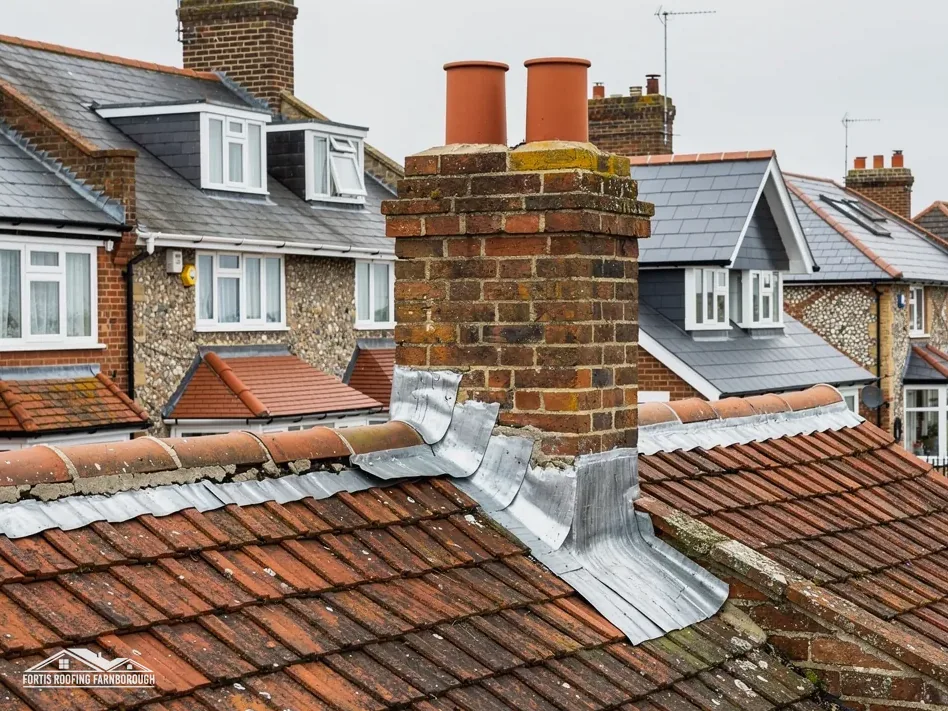
Where the stack meets the roof, lead flashings seal the gap. A lifted flashing or a failed back gutter lets water down the outside of the stack, and in the roof space. Damp near the ceiling line of an upper room, next to the chimney, is a classic sign. Our guide to chimney flashing shows how it is built.
Roof tiles nearby
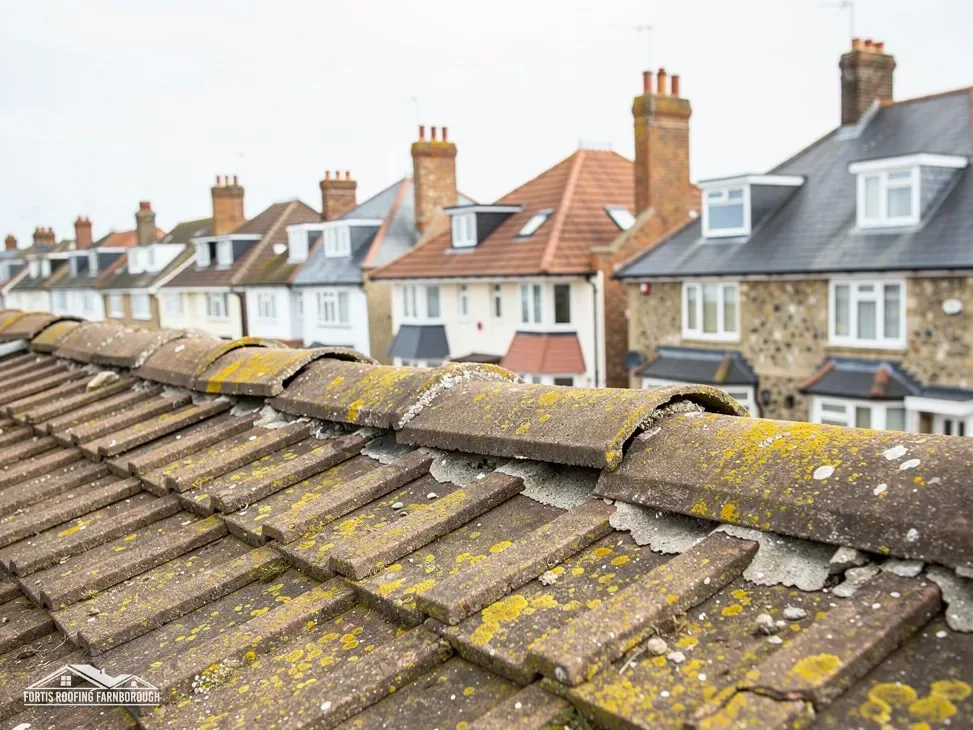
A slipped tile close to the stack can let water onto the brickwork or into the loft, and the stain then appears on the breast. A tile that looks sound from the ground may be cracked on its upper face, which only a close look from the roof reveals.
Why heavy rain matters
If the stain grows after wind-driven rain and dries off in a spell of dry weather, rain entry is the likely cause. Our short answer on a chimney leaking in heavy rain has a checklist.
Condensation in a cold or unused flue
Not every damp breast is a roof leak. Approved Document C, paragraph 6.2, wants a roof built so that condensation forming within the structure does no harm to it, which is what interstitial condensation means. A flue is a hidden void in the same building, and the same physics holds there.
How it happens
When a fireplace is blocked off, the flue stops moving air. Warm air from the room leaks into it through gaps, meets cold brick and condenses. If nothing ventilates the flue, that moisture stays. The wall gets damp from the inside out, and a stain may appear even in dry weather.
Telling it from a leak
- The stain appears in cold spells and does not follow rainfall.
- It is worst on the coldest face of the breast, often on an outside wall.
- The flue is capped tight, or blocked at the fireplace with no vent.
- The stack top is sound, with good flaunching and flashings.
The fix
Air has to move through the flue for it to dry, which a cap with gaps and a vent low down can provide. Our guide to capping a chimney explains why venting beats sealing.
Live flues
If the flue serves an appliance, do not alter the terminal or block the flue. A qualified heating engineer should deal with anything connected to a fuel-burning appliance.
Salts, soot and brown stains
Brown staining that comes through new paint, and a white crust that returns after cleaning, are the usual signs of salts and soot in the flue walls.
Where they come from
Smoke from coal, wood and other fuels leaves deposits in the flue, and some of those are soluble salts. They sit in the brick and the lining until water arrives.
How they show
Water moves through the brick, dissolves the salts and carries them to the surface of the plaster. As the water evaporates, the salts are left behind as crystals, or as brown tar-like stains where soot is involved. Redecorating over the top fails, because the salts keep coming through.
Hygroscopic behaviour
Some salts absorb moisture from the air, so a patch can feel damp on a humid day even when no water is entering from outside. That can mislead a diagnosis, and a damp meter reading alone does not show the cause.
What to do
The first step, whatever the stain looks like, is to stop the water supply, by repairing the stack top, flashings and joints and by ventilating an unused flue. Once the wall is dry, the old plaster, where it is contaminated, may need to be removed, and a salt-resistant treatment used under the new finish. Skipping the water repair and replastering first means the stain will come back, often within a season, and the new plaster is wasted.
Patience
A wall that has been wet for years takes time to dry, so we advise leaving redecoration until it has been stable and dry for a season.
Flashing, capping and how we diagnose it
The cap and the flashing are the two parts most likely to let in rain, and also the easiest to put right. We work from the top down.
On the roof
We inspect the pots, the cap, the flaunching, the brick faces, the joints and the lead at the base. We tap the brick and the mortar, check for movement, press a screwdriver into suspect joints and photograph each part, including the pot and any cap from several angles. We also look at nearby tiles and at the loft side of the stack, where damp timbers show water entry.
In the loft
Inside the roof space, the stack is visible. Damp brickwork, staining on the rafters beside it or a wet patch on the ceiling below can point to flashing or flaunching failure. Dryness here with a damp breast lower down points to the flue.
Cap and flue
We note whether the pot is capped, whether the cap allows air through and whether the flue is lined, blocked or in use. Approved Document C accepts that very small roofs, over a porch for example, may not need ventilation, but nothing in it suggests that a chimney flue can be left sealed.
Ruling out
We rule out other causes, such as plumbing leaks and bridged damp courses, by describing what we see and, where needed, suggesting a specialist. The method is to eliminate causes in order, starting with the quickest to check.
Your photographs
You receive the images and measurements, so you see what we saw.
Fixing the cause, then the plaster
Repairs follow the diagnosis. The right order saves money.
Roof first
Water entry at the stack is dealt with first. Flaunching is rebuilt, joints are repointed, flashings are re-fixed or renewed, and a cap is fitted. These share the same access, so they are best done together. Our short answer on chimney repairs in winter sets out how the weather affects timing, since fresh mortar must not freeze before it has set.
Then the flue
If condensation is the issue, a cap with ventilation is fitted, with an air path at the breast. If the flue is live, the heating engineer's advice comes first.
Then dry out
The wall needs time to dry. A moisture meter shows progress, though a meter can read high where salts are present. Heating the room gently helps, and so does keeping the room ventilated while the wall dries, so that the water leaving the wall has somewhere to go. Avoid forcing it with strong heat, which can bring salts to the surface faster. Using the fire is not advised in a flue that has just been repaired until the mortar has cured.
Then the finish
Only when the wall is dry should the plaster be repaired and the surface redecorated. Contaminated plaster comes off, and a suitable replacement goes on.
What it costs
The price turns on what the survey finds: which parts of the stack have failed, what access the work needs and whether the flue is involved. One written price follows the survey. Our chimney repairs page lists the jobs we carry out.