The short answer
A chimney that leaks only in heavy rain is usually letting water in at one of four places: the leadwork where it meets the roof, the flaunching round the pot, the pointing and brickwork, or the flue itself. Heavy rain is simply the test that finds the weak spot. Tracing it takes a look from the roof and the loft, then the repair follows the cause.
Why it shows up only in heavy rain
A small gap in a chimney's defences lets in nothing in light drizzle, because the water runs past it. Driving rain is different. It hits the stack from the side, pushes into hairline cracks and open joints, and overwhelms drainage points that cope with normal showers. Heavy rain lasts longer too, so the brickwork is wetter and water has time to travel.
That pattern is helpful, because it narrows the search. A stain that follows a gale from a single direction points at the face of the stack that took the weather. A leak that follows long, steady rain suggests saturated brickwork or a failed gutter behind the stack.
The stain you see inside is often not directly under the fault. Water enters, creeps along a rafter or a line of mortar and drips off somewhere else. A brown patch on the breast could come from the flashing, the pot or the brickwork higher up.
Write down when the leak happens, which side of the house the rain came from and where exactly the stain appears. Photograph it while it is wet. Those details help a roofer trace the entry point faster, and they cost nothing to record.
The usual suspects, from the top down
There are four common places, and a survey checks each of them.
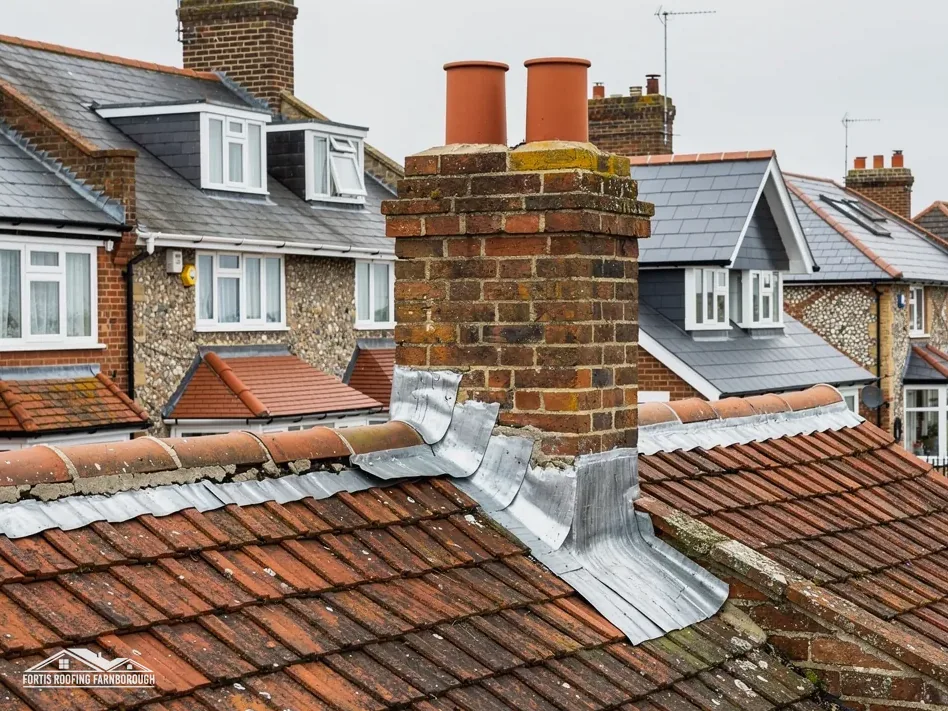
At the top sits the flaunching, the mortar bedding that wraps the base of each pot. If it cracks or shrinks away from the pot, water runs down inside the stack. The pot itself can also be cracked or loose.
The brickwork comes next. Porous bricks soak up water, and eroded pointing leaves open joints. A stack with joints that have worn back lets rain right through to the flue lining and the inside faces. Our guide to chimney repointing covers the repair.
Third is the flue. Rain that falls straight down an uncapped pot can wet the liner and the breast below. A cowl reduces this.
Fourth is the lead collar where the stack rises from the slope. Its front panel, its stepped side strips and the trough at the rear must all stay sealed. The back gutter takes the whole flow from the slope above, so it is a prime suspect after heavy rain. Our answer on the chimney back gutter explains why.
Leaks often come from more than one place. Fixing the obvious one and leaving another is a common reason a stain returns.
How the entry point is traced
The method is plain looking, then testing. We start in the loft, if there is one, looking at the timbers round the stack for dark staining, damp insulation and daylight at the brickwork. Then we go up to the roof and photograph each part of the stack and its surroundings.
Where the cause is not obvious, a controlled test helps. Water is run over one section at a time, starting low and working upward, while someone watches the inside. When the stain appears, the source is the section just wetted. It is slow work, and it avoids guessing, which is how roofs get patched in the wrong place.
We also check that the leak is from the roof and not from elsewhere. Condensation in a cold, unused flue can mimic a leak, and a failed gutter beside the house can wet the breast from outside. The answer matters, because a repair to the wrong thing costs money and leaves the leak in place.
You see the photographs and the explanation, and where work is needed, the written price covers the whole repair. If the weather is bad and the leak is active, a temporary cover goes over the stack before anything else.
Repairs that follow, and what to do meanwhile
The repair follows the cause. A cracked flaunching is raked out and re-laid. Open joints are repointed in a mortar that suits the brick. Failed lead is renewed, with new flashings dressed into the joints. A pot that is loose or cracked is rebedded or replaced, and a cowl goes on if the flue is exposed.
Cheap fixes disappoint. A coat of masonry sealer over crumbling brick rarely cures a leak, and a line of sealant on lead is a short-term measure. The Marley and lead-sector view on this is the same: work to the details, not over them.
While you wait for a visit, take sensible steps. Put a bowl or a bucket under any drip, move furniture away from the breast, and photograph the stain each time it appears. Leave the climbing to a roofer. Our guide to a damp chimney breast covers what to do inside the house.
If the leak is active in a storm, tell us when you book, and we will plan a temporary cover for the stack ahead of the repair. Our chimney repairs hub sets out the full range.