The short answer
A listed building keeps its usual permitted development rights for roof alterations, but listed building consent also applies to works touching its character, and a chimney is often part of that character. Like-for-like repair is the safe approach, but ask the council before starting, because a repair that changes materials or detail may need consent.
How listing and consent work
Listing protects a building because of its special architectural or historic value, and the protection covers the whole building, not just its front. A chimney stack, its pots and the brickwork are part of what is listed, and on many older houses they are some of its most visible features.
Two different systems apply, and they are easy to confuse. The first is planning permission. A listed house keeps its permitted development rights for alterations to the roof, including Class B for dormers and Class C for other roof changes. The listing does not take those away.
The second is listed building consent, which is a separate permission. Section 7 of the Planning (Listed Buildings and Conservation Areas) Act 1990 calls for consent to works that alter the character of a building listed for its special interest. So a job can be fine under planning rules and still need listed building consent, and both questions have to be answered.
The decision-maker is the local planning authority, through its conservation officer. In Rushmoor, Hart, Surrey Heath and the other councils in our area, it is the council planning team that handles the application. Our guide to chimney repairs in a conservation area covers the related area controls.
What counts as like for like
The basic principle is repair, not replacement. A repair that keeps the original fabric and puts back what failed, in the same materials and the same pattern, has the least effect on character. It is also the approach most likely to be accepted, and the one a conservation officer expects to hear about.
For a chimney, like for like looks like this:
- repointing in a mortar that matches the old in colour, texture and strength, and in the same joint profile;
- replacing a spalled or broken brick with one of the same size, colour and character, with reclaimed brick often the better match;
- re-bedding the existing pots, or replacing a failed one with the same pattern;
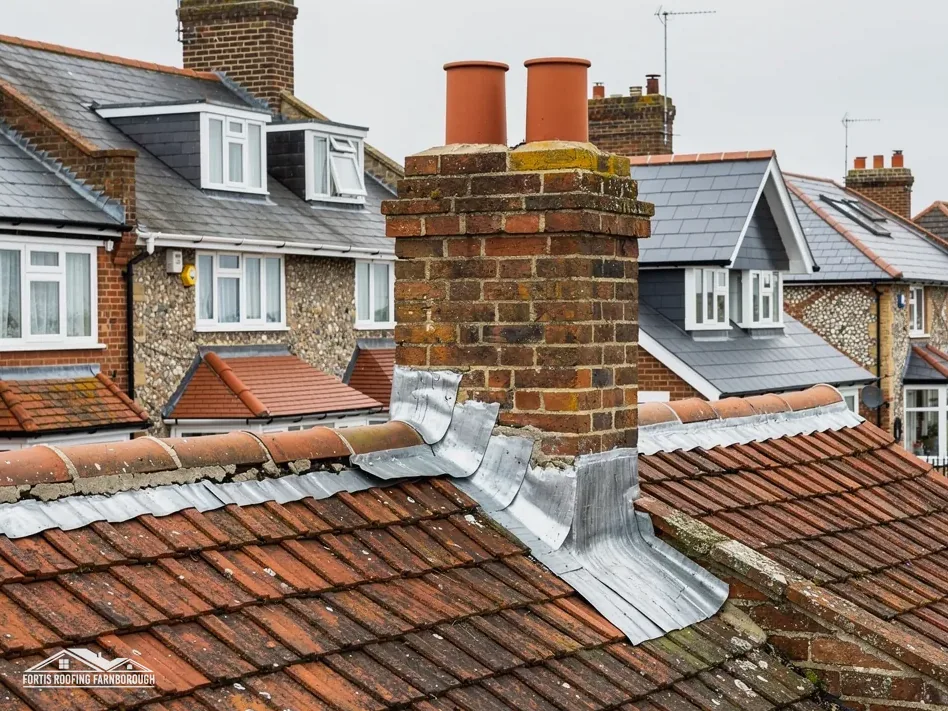
- renewing lead flashings in lead, dressed the same way as before.
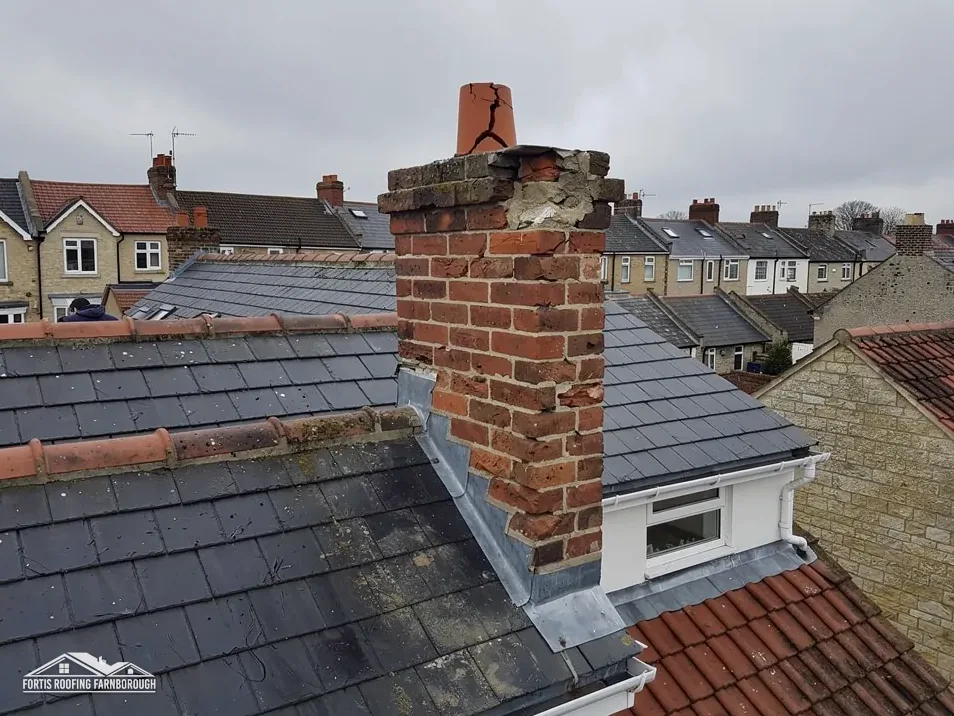
Several things take a job beyond repair: a different brick, a new mortar colour that changes the stack's look, removing pots, lowering the stack or changing its height. These alter the character and bring consent into play.
Where in doubt, photograph the existing detail before anything is touched, as a record of what has to be matched. Our guide to lead roofing on listed buildings covers the leadwork side.
Ask first, and what to bring
The rule that saves trouble is to ask the council before work starts. Do not assume that a repair is outside the controls because it looks small. The council can tell you whether the job needs consent or whether it counts as like-for-like maintenance, and a written answer protects you.
When you contact the planning team, have the address, the listing description if you have it, and photographs of the stack that show the defect. Describe the proposed work and the materials, and ask three questions: does this need listed building consent, who will decide and how long does it take?
If consent is needed, the application describes the works, shows the existing condition and sets out the materials. A survey with dated photographs supplies much of that. Allow for the time it takes to be decided, and do not book scaffolding or start work until the answer is in writing.
Where the building is also in a conservation area or subject to an Article 4 direction, the area controls apply as well. Hart, Rushmoor and Guildford have chimney-related directions in places, and the council can say whether one covers your address.
Our survey records the stack's condition as evidence for that conversation. The chimney repairs hub gives the wider picture.
Doing the work well
Once permission is clear, the work itself is careful and slow. A stack on a listed building is often old brick laid in a soft lime mortar, and a hard modern cement mortar can damage it, trapping water and causing the brick face to flake. The mortar choice is a point to settle with the conservation officer.
Access has to protect the building. Scaffolding is fixed so as to avoid harm to the walls and roof, and ties and boards are placed with the fabric in mind. Where the scaffold stands on the highway, a licence has to be granted by the highway authority first, with a lead time of ten working days or more in the councils that state one.
Materials are matched before they are ordered. Samples of brick, pots and lead go to the council if it asks, and a sample panel of repointing is sometimes agreed on the stack itself before the whole is done.
The record matters at the end. Photographs of the finished work, and of the stack before, show what was done, and they go in the house papers. If the building is sold, a buyer's solicitor will want evidence that works had consent.
You see the evidence at every stage, and a single written price follows once the survey and the consent route are clear.