The short answer
A liquid roof coating works when the roof beneath it is sound, dry and still able to drain. It is rolled or sprayed on as a continuous film, which can seal old felt, metal or concrete and extend its life. It does not fix a wet deck, rotten insulation, poor falls or structural movement, and the result depends heavily on how the surface is prepared.
What a liquid coating is
A liquid roof coating is a waterproofing product that arrives as a fluid, is applied to the existing surface and cures to form a flexible film. The film bonds to the roof beneath, covers joints and seams, and creates a continuous layer without laps. Several chemistries are used, including acrylic, polyurethane, bitumen-based and silicone, and each has its own strengths and limits.
The idea is attractive for commercial owners. A large flat roof or a sheet roof that leaks can sometimes be coated in a matter of days, with little disruption, and without the cost and waste of stripping the old covering. The building stays in use, and the roof gains a new waterproof skin.
Coatings are often reinforced. A layer of polyester fleece or glass-fibre mat is embedded in the wet product around details, joints and cracks, which strengthens the film where movement is likely. Reflective top coats are used on some roofs to reduce solar heat gain.
The product is only as good as the surface it sits on. A film cannot be stronger than the substrate, and the coating adds a few millimetres, not a new structure.
Our guide to commercial flat roof refurbishment places coatings among the other options, including strip and replace.
Surfaces that suit a coating
Coatings work best on substrates that are stable, sound and compatible with the product.
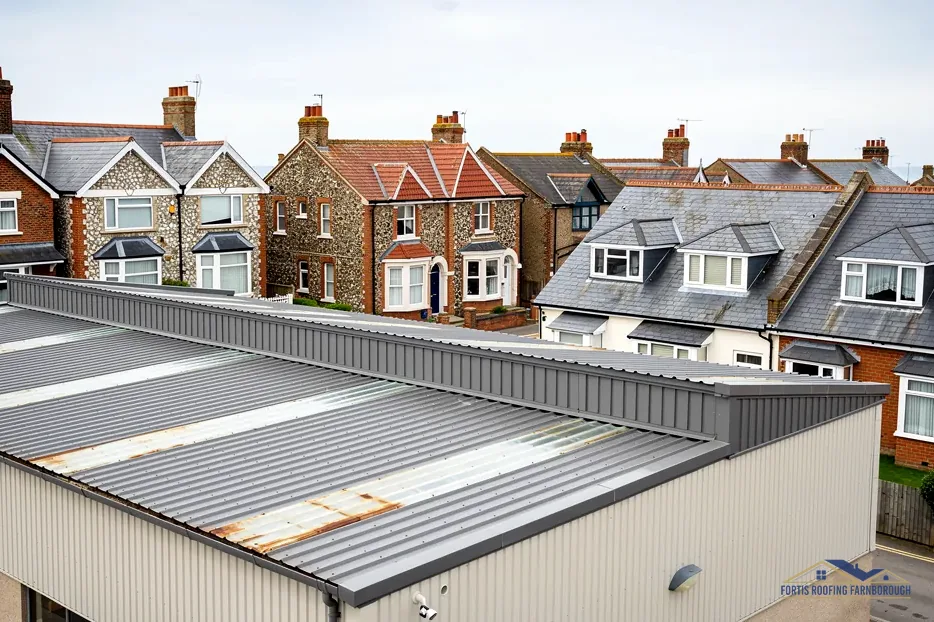
Metal sheet roofs are a common candidate. A profiled steel roof with surface corrosion, worn paint and leaking laps can be cleaned, treated for rust and coated, which seals the surface and slows further decay. Our answer on cut-edge corrosion explains the rust problem on sheet ends.
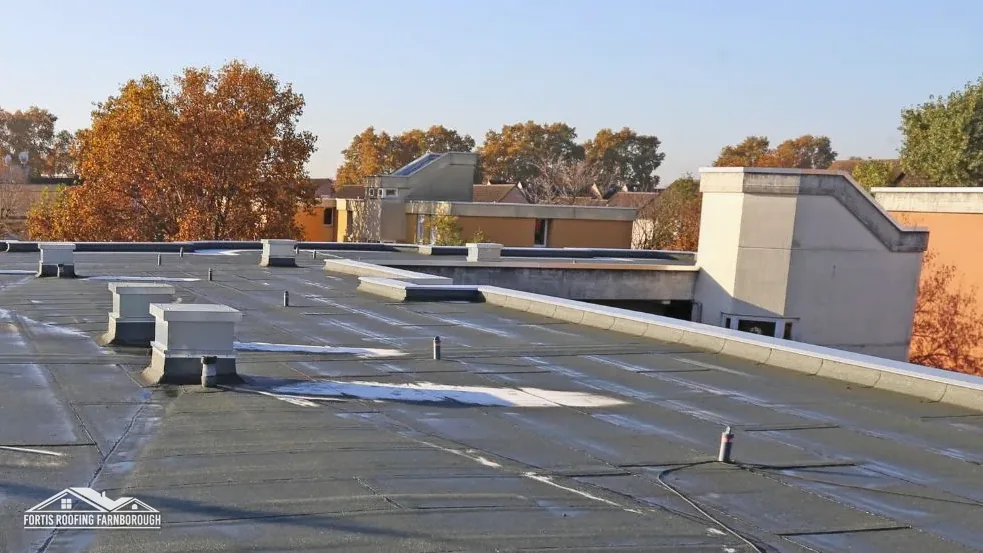
Old built-up felt that is still dry and well bonded can also take a coating, which seals the surface and covers blisters and minor splits after repair. Concrete roofs and some single-ply membranes may suit certain products, though the maker must confirm compatibility.
Fibre cement is a special case. If the sheets are asbestos cement, a coating over them is a form of encapsulation, and it needs careful planning, an asbestos survey and a method that does not disturb the surface. Scraping or wire-brushing to prepare the sheet is not acceptable.
The roof also has to drain. A coating on a roof with ponding water will not cure that fault, and standing water cuts short the life of most coatings.
The test for suitability is a survey. It examines the covering, checks for moisture below and confirms whether the surface can be prepared to hold the product.
Preparation decides the result
Almost every coating failure traces back to preparation. A product applied to a dirty, damp or loose surface will not bond, and it will blister or peel within a short time.
The steps follow a sequence:
- clean the roof to remove dirt, moss, algae and loose material, using methods that suit the surface and do not damage it;
- repair defects first, such as splits, open laps, loose fixings and failed sealant, since the coating will not span them;
- treat rust on metal back to sound steel and apply the manufacturer's primer;
- dry the roof fully, because trapped moisture drives blistering;
- apply primer where the product calls for it, then the coating in the thickness the maker specifies, with reinforcement at details.
Weather decides when this can happen. Most products need dry conditions and a minimum temperature, and the data sheet sets them. A roofer who coats in unsuitable weather is risking the job.
Thickness matters as well. A thin film wears fast, and the manufacturer's coverage rate has to be met across the whole roof, including edges and upstands.
Ask what preparation is included in a quote. A price that ignores cleaning and repair is a price for a coating that will not last.
The limits of coating
A coating is the right answer only for some roofs, and it is worth knowing where it stops.
A wet roof is the main exclusion. If water has soaked the insulation or the deck, sealing the top surface traps it in. The moisture then damages the structure and breaks the coating from below. A moisture survey or cores will show whether this has happened.
Poor falls are the second. A coating does not alter the slope of the roof, and a roof that ponds will keep ponding.
Structural movement is the third. A coating can bridge hairline cracks, but not a joint that opens and closes with temperature, unless it is detailed to allow for it.
The roof's age is the fourth. A covering that is at the end of its life, brittle and cracked all over, offers no sound base. At that point stripping and replacing is the better buy.
A coating also has its own life, which depends on the product, the preparation and the maintenance, and which needs recoating in time. The years it gives depend on those three things, and each roof differs.
The survey sets out the options, with photographs and a written price for each, so that you can choose between coating, overlay and strip. The commercial roofing hub lists the services.