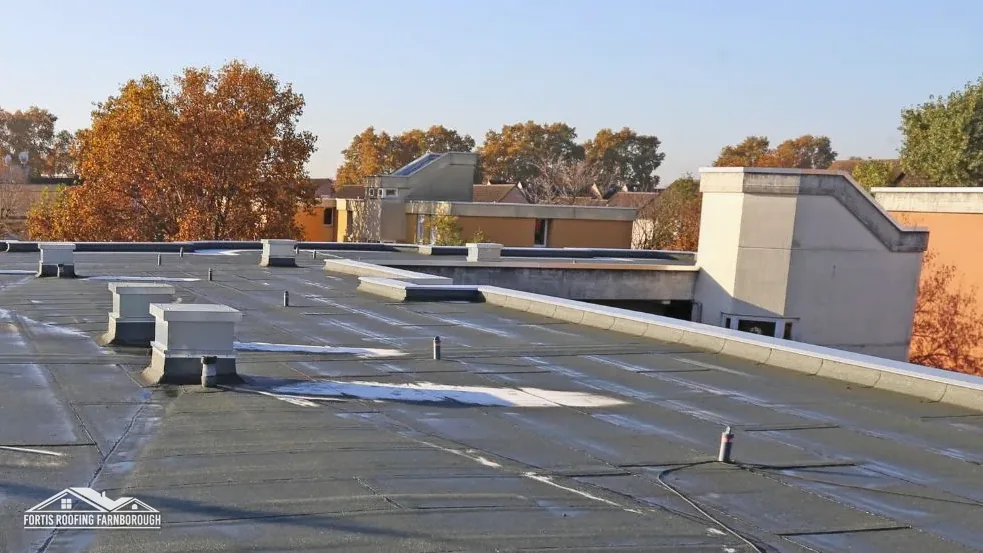
A single-ply roof covering is a flexible waterproof sheet, usually between one and two millimetres thick, made in a factory and rolled out on the roof in one layer. Where a traditional built-up felt roof relies on several layers bonded together on site, a single-ply system depends on one sheet and on the quality of its joints and details. That makes it quick to lay on large areas, and it shifts the risk from the thickness of the membrane to the care taken at every seam, upstand and penetration.
Three materials dominate commercial work. PVC is polyvinyl chloride, a plastic sheet, normally joined with hot air. TPO is thermoplastic polyolefin, a related plastic sheet that is also heat-welded. EPDM is ethylene propylene diene monomer, a synthetic rubber, and its sheets are bonded with adhesive or tape. Each has its own handling, and each suits different roofs.
This guide describes what single-ply is, how the three common types compare, what BS 6229:2025 says about falls, how membranes are fixed, why details matter most and when single-ply is the right choice for a shop, unit or block. It sets out the choices and the questions worth asking before any membrane is ordered.
What a single-ply membrane is
The name describes the construction: one layer of waterproofing, as against several. The membrane sits on an insulation layer, which in turn sits on a vapour control layer and the structural deck, so every layer below the sheet affects how well it performs. That build-up, with the membrane on top, is called a warm roof.
A factory-made sheet
The sheet is made under controlled conditions, so its thickness and quality are consistent. It arrives on site in large rolls, often several metres wide, which means fewer joints than a roof made from narrow strips of felt.
Joints are the weak point
A sheet is only as good as its seams. Heat-welded seams in PVC and TPO fuse the sheets into one. EPDM seams are made with adhesive or tape. Careful workmanship, testing and the right conditions are what make a good joint, which is why the installer matters as much as the product.
Flexible, light and adaptable
Single-ply is light, which suits roofs with limited load capacity, and it can follow curves and awkward shapes. It can be laid over existing coverings in some cases, which makes it common in refurbishment.
What it is not
It is not a mechanical barrier. It is a thin membrane that depends on its support, and it can be punctured by sharp objects or foot traffic. Protected walkways, where maintenance staff go, and care around plant are part of the design.
How it fits in a refurbishment
Our guide to commercial flat roof refurbishment places it among the alternatives for an ageing roof.
PVC, TPO and EPDM compared
The three are often offered side by side. Their differences are practical, and they matter more than any slogan.
| Membrane | What it is | How joints are made |
|---|---|---|
| PVC | Polyvinyl chloride, a plastic sheet | Hot-air welding |
| TPO | Thermoplastic polyolefin, a plastic sheet | Hot-air welding |
| EPDM | Synthetic rubber sheet | Adhesive or tape |
PVC
PVC membranes are widely used and come in many colours, which lets an owner choose a lighter surface to reflect heat or a darker one to match the building. They weld well, which gives strong seams, and they are reinforced with a fabric or glass mesh. Compatibility matters: PVC should not touch some bituminous materials or polystyrene insulation without a separating layer, and the manufacturer's guidance sets out which ones. Checking this before the roof is laid avoids a slow failure that shows up years later.
TPO
TPO sheets are similar in how they are laid and welded. The material is newer than PVC, and different manufacturers use different formulations, so the data sheet for the specific product matters.
EPDM
EPDM is a rubber sheet, supplied in very large widths, which suits big roofs with few seams and lets one sheet cover a wide span with very few joints to inspect. HomeBuilding gives EPDM a life of 25-30 years, and Less gives 30 to 50 years. The sources disagree, so both are shown, and these are typical ranges, not promises.
Choosing
The best choice depends on the roof's use, the other materials it touches, how many penetrations there are and the installer's experience with the product. Our answer on PVC against TPO roofing goes through the first two in more detail.
Falls and BS 6229:2025
A single-ply roof is a flat roof, and flat roofs need falls. Without a slope, water lies on the surface, and standing water shortens the life of any membrane.
The standard
BS 6229:2025 applies to single-ply and other flexible membranes bonded or fixed continuously to their support, where the roof pitch does not exceed 10 degrees. BS 6229:2018 was withdrawn on 16 December 2025, and any specification that still names it needs updating. The standard covers flexible membranes and not lead, which has its own standard, BS 6915, referred to in Approved Document C.
Two numbers
The finished-fall minimum in the 2025 standard is 1:80 across general areas and internal gutters. The designer aims higher, since IKO advises 1:40 as the design figure, so that tolerances and deflection do not leave the finished roof short. The two numbers are separate, and the design one is the larger.
Why it matters
A roof that ponds is a roof that ages quickly. Water sits on seams, dirt collects, algae grow and load increases. Some manufacturers limit their warranties on roofs with standing water, so check the terms.
Improving falls
On a refurbishment, tapered insulation can create the falls that the existing deck lacks. That is a reason to take a covering off and rebuild the layers, not just lay a membrane over it.
What we record
At survey we note where water lies after rain and measure levels where the roof allows, so the design is based on the roof as it is.
How membranes are fixed
A single-ply sheet has to stay in place in wind, and the method of fixing is a key part of the specification.
Mechanically fixed
The sheet is secured with fasteners and plates through to the deck, usually along the laps, so the fixings are covered by the next sheet. It is quick and suits roofs where adhesive would be a problem. The number of fixings is calculated for the wind loads the building faces.
Fully bonded
The sheet is stuck to the substrate with adhesive over its whole area. It resists wind uplift well and gives a smooth finish, though it needs a clean, dry, suitable surface and good conditions on the day.
Loose-laid and ballasted
The membrane is laid loose and held down by ballast, such as stone or paving, on top. It needs a structure that can carry the weight, and it makes later inspection harder, since the ballast has to be lifted. It is less common on refurbishment.
Induction and other systems
Some systems use fixings that are bonded or welded through the membrane by induction heating, avoiding penetrations. Manufacturers' systems differ, and the installer should be approved by the product maker where that is a condition of the warranty.
Wind and edges
Corners and edges of the roof see the highest wind forces, and they often need extra fixings. A specification should show how the perimeter is treated.
Existing roof
If the new membrane goes over an old covering, the compatibility of the two must be checked. Our answer on built-up felt roofing notes how bitumen and single-ply interact.
Details: upstands, outlets and roof lights
On a single-ply roof, the flat expanse is the easy part. Nearly every leak starts at a detail.
Upstands and parapets
At the wall or parapet, the membrane is turned up the face and fixed and sealed at the top. It needs a termination that keeps water out, such as a coping or a flashing, and a secure fixing so it does not slump. Corners are formed with pre-moulded pieces or careful folds.
Outlets
The membrane is bonded or welded to the outlet, which should be at the lowest point and sized for the area it drains. A blocked or high outlet causes ponding. The outlet may need replacing when the roof is renewed, so that it connects properly.
Roof lights, vents and plant
Every penetration needs its own collar or upstand, and its own seal. Pipes are fitted with pre-formed boots. Plant bases and walkways need protection, so that maintenance staff do not damage the membrane.
Edges and drips
The roof edge is finished with a trim that holds the membrane and throws water clear of the wall.
Movement joints
Where the building has expansion joints, the roof must accommodate them without tearing.
Quality control
Seams should be tested, and the work photographed as it goes, so that hidden details are on record. A good installer welcomes inspection.
Related reading
For gutters and outlets in more depth, see our commercial roofing page and the refurbishment guide above.
When single-ply is the right choice
Single-ply is not the answer to every flat roof. It suits some situations well and others less so.
It tends to suit
- Large, simple roofs, where long sheets reduce the number of joints.
- Roofs with limited load capacity, because the membrane is light.
- Refurbishment where the existing roof can be overlaid or stripped and rebuilt with new insulation and falls.
- Buildings where a quick installation matters.
It tends to suit less well
- Roofs with a great deal of foot traffic or heavy plant, unless protected walkways are fitted.
- Very complex roofs with many small details, where a liquid-applied system may be easier to make jointless.
- Roofs that cannot be made watertight at their details by a competent installer.
Compare with the alternatives
Built-up felt and liquid coatings both have a place. The refurbishment guide above sets the options against each other.
Check the installer
The installation matters at least as much as the product. Ask who will do the work, whether they have laid the system before, how seams will be tested and what documentation you will receive.
Costs
The price depends on the system, area, falls, details, access and phasing. The price follows a survey with photographs and measurements, and it is one total in writing, with the contents explained.
Next step
The first step is a survey of the existing roof, to see whether it should be overlaid or stripped.