A repair is cheaper than a replacement in the short term, almost every time. The question that matters is whether the repair buys enough years to be the better buy. A roof with a few slipped tiles and sound timbers beneath is a repair. A roof with a failing covering, brittle underlay and rotting battens is a roof where each repair is a down payment on a replacement.
The national cost guides show the gap clearly. Which? gives £75 to £400 per job, ex VAT, for a handful of broken or missing tiles (Nov 2025), and £7,000 to £21,000, ex VAT, for a whole new roof for a standard house with three bedrooms. MyJobQuote gives about £5,250 for a new roof (Oct 2026), and HomeBuilding £10,000 to £15,000 for a three-bedroom semi in plain concrete tiles (Sep 2025). These are typical UK ranges, and they disagree widely, which is a sign of how much depends on the individual roof.
This guide sets out four questions that decide the matter: age, extent, underlay and timbers. It then covers what the Building Regulations say about re-roofing and how to compare the two routes on your own roof, where only a survey can give the numbers.
Question one: how old is the covering?
Age does not decide the outcome alone, but it sets the context. Each covering has a typical life, and a repair is worth less on a roof close to the end of it than on one with decades to go. The published figures below are ranges for a sound installation in normal conditions.
| Covering | Typical life | Source |
|---|---|---|
| Natural slate (Welsh) | 100+ years | HomeBuilding, Sep 2025 |
| Clay tile | 60-80 years | HomeBuilding, Sep 2025 |
| Concrete tile | 40-50 years | HomeBuilding, Sep 2025 |
| Fibre cement tile | 30-40 years | HomeBuilding, Sep 2025 |
Reading the table
Marley takes a different line for concrete, expecting its roof tiles to last around 60 years, though it is clear that this offers no guarantee. The BRE minimum of 60 years applies to clay tiles only. Where sources differ, we name both and treat the result as a range, not a promise.
Age in practice
A 1960s concrete tile roof is near or past the lower HomeBuilding figure. That does not make it a replacement job. A tile in good order can serve beyond a typical range, and a tile in poor order may fail early. What matters is the condition we find, with the age as a pointer to what to look at first.
Where the covering is clearly past the end of its life, repairing it means paying for patches that will not hold. Ask what the roof looked like at its last survey or sale, and whether anyone has recorded its age or its repair history, because paperwork from earlier owners can save time.
Question two: how widespread is the damage?
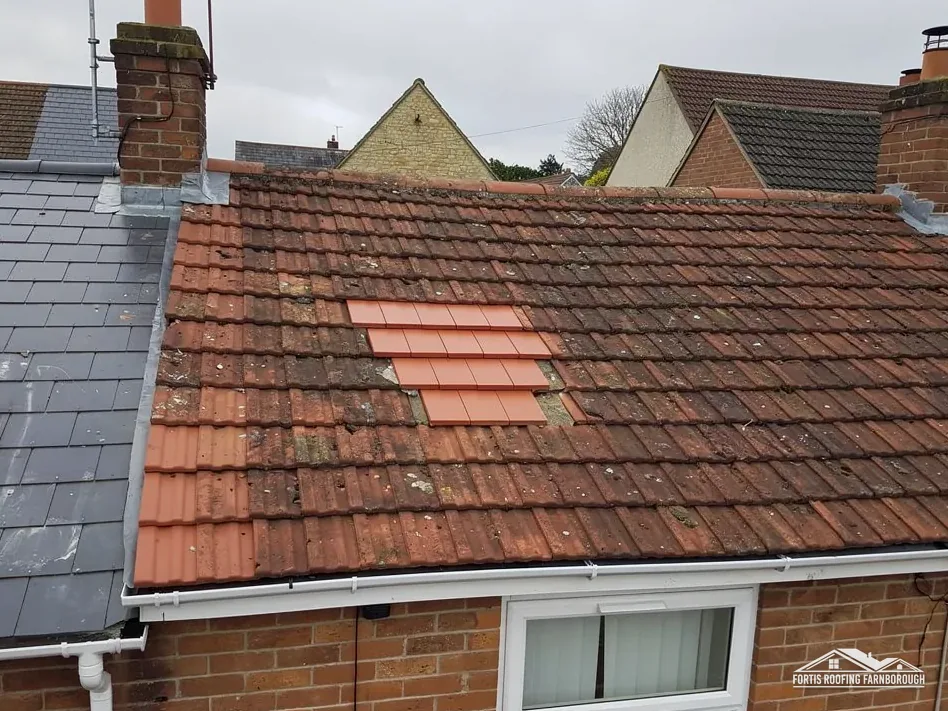
Extent is the clearest guide. Damage in one place suggests an event: a fallen branch, a storm, a failed flashing. Damage across the roof suggests the covering is wearing out.
Signs of a local problem
- One or two slipped or cracked tiles on a single slope.
- A failed ridge or hip section, with the slopes sound.
- A leak at one flashing or one valley.
- Damage from a single known event.
Signs of a general problem
- Tiles spalling, flaking or crumbling across several slopes.
- Repeated slips in different places as battens and nails weaken.
- Widespread moss and algae holding water against the surface.
- A pattern of repairs from previous owners, patch over patch.
A working rule
If the repair is a sensible fraction of the roof and the rest is sound, repair. If the faults are in many places and keep coming back, each repair prolongs the problem rather than ending it. Our guide to roof repair cost sets out the typical ranges for common repairs.
On a survey, we walk each slope and photograph tile condition, not just the obvious fault. That tells you whether the damage is a point or a pattern, and the answer drives the rest of this decision. A single photograph of a leak does not tell you that, which is why a full set matters. We also look at gutters, fascias and the junctions around chimneys, because a covering can be sound while the details around it are failing and cost much less to put right.
Question three: what is the underlay like?
The underlay is the layer under the battens that catches water driven past the tiles. It cannot be seen from the garden, yet it often settles whether a roof is mended or renewed.
Why it matters
Old bitumen felt goes brittle over time. It tears at the laps and sags between the rafters. Water that should run down to the gutter soaks the batten and rafter instead. A roof can look fine from the outside while the underlay beneath is nearly gone.
How we check
From the loft we look at the underside: daylight through the felt, tears, sagging pockets, dark stains on timbers and rust on nail tips. On a modern roof with a breathable membrane, we look for tears and stained laps.
What it means for your decision
If the underlay is sound, a tile repair is a real fix. If it has failed over a wide area, then repairing tiles is like patching the top of a bucket with a hole in the bottom. The only way to renew underlay across a slope is to lift the covering, which is the work of a re-roof on that slope, so a slope with failed underlay is usually better re-covered than patched.
Our answer on what a roof inspection includes explains how the loft side of the survey is done. If the roof was last covered a long time ago, ask whether the underlay has ever been replaced.
Failed underlay is the clearest sign that a patch will not hold, because the water gets past every new tile.
Question four: are the timbers sound?
The battens, rafters and wall plates carry the whole roof. If they are sound, the roof can take a repair or a new covering. If they are soft or split, they must be dealt with first, and the cost of that changes the arithmetic.
What rot looks like
Dark, spongy or crumbling timber is wet or decayed. Battens that split along their nail lines hold tiles poorly. Rafters that sag or bow, wall plates that are damp at their ends and ridge boards that have moved are all signs of structural trouble. We test with a screwdriver where we can reach safely, and photograph what we find.
Repair or re-batten
A short length of rotten batten under a slipped run of tiles can be renewed locally. Across a whole slope, re-battening goes hand in hand with re-covering, because stripping the tiles twice makes no sense. Our guide on whether roof battens need replacing sets out those signs in detail.
Structural timber
Where rafters or plates have rotted, the repair is structural. A structural engineer may be asked to look, and the work could include sistering (fixing a new timber alongside the old one) or replacing a section. That is a larger job than a repair, but it is still smaller than rebuilding the roof, if the problem is local.
Timber condition is the tie-breaker, and the one that most often changes the answer. A roof with a tired covering and sound timbers is a candidate for a new covering on the existing structure. A roof with failing timbers needs more than either a repair or a standard re-cover.
Building Regulations and a whole-roof job
A repair rarely needs Building Regulations approval, because it leaves the structure and the weight alone. A full replacement can. The Planning Portal's test for re-roofing asks two questions: is less than 25 per cent of the total building envelope affected, and is under half the roof affected? Two yes answers usually mean no application. A whole-roof replacement usually fails the second test.
Weight and fire performance
Approval follows if the new covering weighs 15 per cent or more above what it replaces, or performs very differently in a fire. Swapping a lightweight covering for a heavy one is the usual trigger, and the Planning Portal suggests a structural check before work begins.
What councils say
No council in this area publishes a percentage of its own. Bracknell Forest and Basingstoke and Deane each list roof re-covering as work that may need approval, and Windsor and Maidenhead names re-tiling. If your home is in one of those boroughs, a call to its building control team comes before the re-roof. Rushmoor and Hart share one building control service on 01252 398715, which points to the Planning Portal's test.
Planning
Re-roofing a house is normally permitted development under Class C, within its limits such as the 0.15 metre projection rule. Flats have no such rights, and conservation areas and listed buildings add their own checks. None of this applies to a repair, which is another reason a small repair has a lighter paperwork load.
This is general information, not legal advice. Your local planning team and building control body are the right ones to ask.
Putting the two routes side by side
Once the four questions are answered, the choice is clearer. A table helps to hold them together.
| Finding | Leans towards |
|---|---|
| Covering within its typical life, damage in one place | Repair |
| Covering near the end of its range, damage in several places | Replace, or repair a slope at a time |
| Underlay sound | Repair |
| Underlay torn or perished over a wide area | Replace the affected slope |
| Timbers sound | Either, on the other findings |
| Timbers soft or split | Replace, with timber repair first |
The cost over time
A repair that costs a few hundred pounds and buys ten years is excellent value. A series of repairs that adds up to a large part of a replacement and leaves you with an old roof is not. The Which? range of £7,000 to £21,000 and the MyJobQuote average of around £5,250 sit far apart, so your own roof's size, covering and access matter more than any average.
Doing it in stages
You do not always have to choose all or nothing. A slope with failed underlay can be re-covered while the others are repaired, and a ridge or valley can be renewed on its own. The written quote follows the survey and covers whichever route the evidence supports.
For the full range of work, start at our roof repairs page.