The short answer
Birds get under tiles through gaps at the eaves, the ridge and the verge, so the lasting answer is to close those gaps with eaves combs, repaired tiles and sound mortar or dry-fix parts. The timing matters. Under the Wildlife and Countryside Act 1981, intentionally wrecking an occupied or half-built nest is an offence, so the closing-up waits until the birds have gone.
Where birds find a way in
Birds look for a sheltered ledge with a narrow entrance, and a tiled roof has several. The commonest entry points are these.
- The eaves, where the bottom row of tiles meets the fascia and the gap beneath the first course is open to the loft.
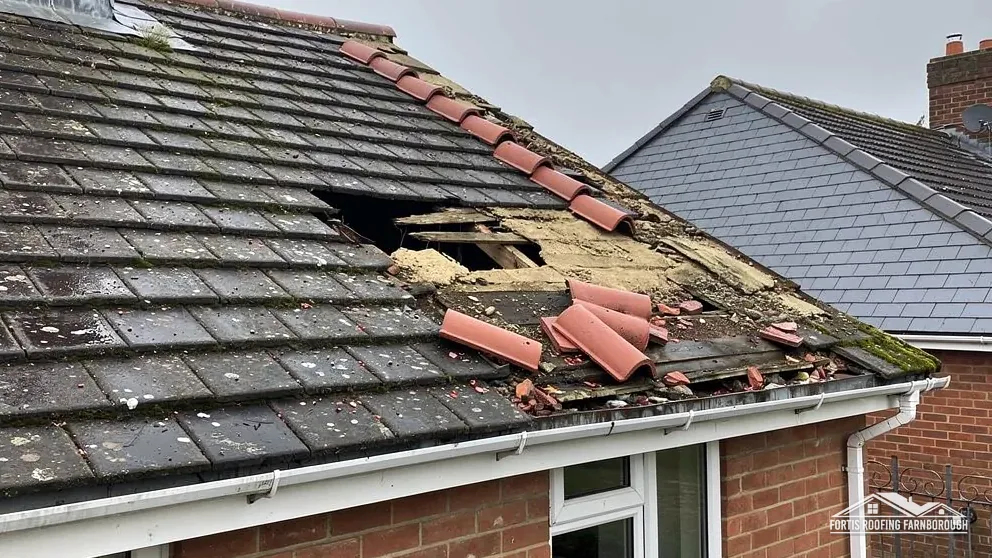
- The ridge, where bedding mortar has cracked and fallen away, leaving a channel under the ridge tiles.
- The verge, at a gable end, where mortar has crumbled between the tile edge and the wall.
- Broken or slipped tiles, which open a hole large enough for a bird to squeeze through.
Once birds are inside, nesting material builds up under the tiles and in the roof space. That causes trouble beyond the noise. Straw and droppings can block eaves ventilation, and damp nesting material sits against the timbers and the underlay.
Eaves are the most reachable of the four, which is why they are the usual place. Our page on rotten eaves felt covers what lies behind that bottom course and how it fails.
A roofer can often tell which species is using a gap from the entry point and the debris. We note what we find at the survey and photograph it, since it also shows where the roof needs repair.
The law on nests, and why timing matters
Section 1 of the Wildlife and Countryside Act 1981 turns on intent, because someone who intentionally interferes with an occupied or half-built nest of a wild bird has committed the offence. GOV.UK states that no licence is available for development or construction purposes, so roof work cannot be licensed as an exception.
That sets the order of work. With an active nest, the repair has to wait; nothing is pulled out and no entrance is sealed with birds inside. When the nest is empty and abandoned, the gap can be closed.
This is why a quote for bird-proofing needs a look at the roof first. A tile that appears to be hiding an old nest may be hiding a current one, and the survey establishes which.
Bats are a separate matter. On GOV.UK, a roof repair or replacement counts as work that may harm them. If you suspect bats rather than birds, stop and take advice before closing any gap, and expect us to ask the same question on site.
Closing the gaps for good
The fix is to remove the gap, not to scare the birds off. A bird that can still get in will come back.
At the eaves, an eaves comb or a bird-proof strip is fitted beneath the first course of tiles. It is a plastic or metal profile that fills the open space under the tile edge while still letting air through, so the loft keeps its ventilation. Blocking the eaves solid would trap moisture in the roof space, which causes a problem of its own.
At the ridge and verge, the answer is sound bedding. Cracked mortar is raked out and relaid, or the ridge is rebuilt with a dry-fix system, which uses mechanical fixings and vented closers in place of a wet mortar bed. Our page on hip tile repair shows how the two methods compare.
Broken and slipped tiles are replaced, since each one is an open door. Where tiles are old and brittle, a patch may crack its neighbours.
After the work, nothing should be left to peck at: no loose mortar, no open channel and no missing course. Check from the ground once a year for new gaps at the eaves line.
What the roof visit covers
The visit takes in the eaves, ridge, verge and the tiles between them, from a ladder at the gutter line and with a camera on the slope. Photographs of any gaps, droppings or nesting material come back to you with a plain explanation of each.
The next question is what needs closing and whether the timing allows it. Where a nest is occupied, the repair follows when the birds have finished, and that date depends on them, not on us. Once the way is clear, closing the eaves and the ridge is a short job.
The work itself is tidy. Old nesting material is cleared and taken away, and the loft area is left clear. Because droppings can carry germs, anyone handling them should wear gloves and a mask and wash afterwards.
Our quote is a single total, and you see the evidence before agreeing to it. If more than one gap needs attention, such as an open eaves line and a cracked ridge, they can be dealt with in one visit, which saves putting access up twice.
The wider pitched roofing hub explains how the covering, ridge, verge and eaves work together as one weather-tight edge.