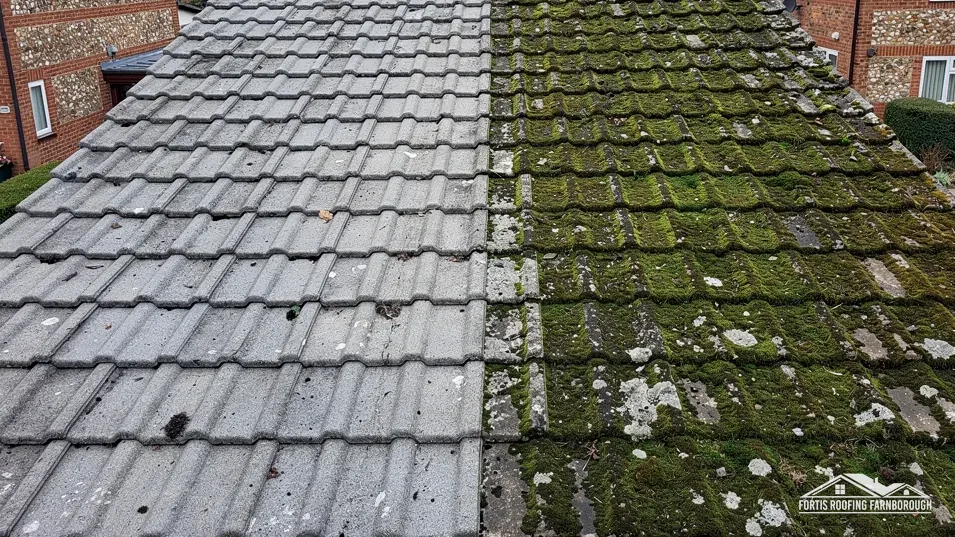
Moss and lichen make a roof look neglected, and a hired machine or a bottle of treatment from a shop looks like an easy afternoon. The reality is that cleaning a roof combines three hazards: height, a slippery surface and chemicals. Each one is manageable by someone trained and equipped. Together they catch out many owners.
There is a legal side as well. Some roof-cleaning products are made for trained users only, and HSE's biocides guidance tells the public to keep away from those. Some roofs, especially older asbestos cement ones, must not be scrubbed or sprayed at all.
This guide covers the ladder and access risks, fragile roofs and asbestos cement, the products the public must keep off, what damage a wrong method does to tiles, and the jobs you can safely do from the ground at your own house in the Farnborough area.
Ladders, access and working at height
Most of the danger in cleaning a roof is in getting to it and standing on it. A roof is not a floor, and a slope gets more slippery with every layer of moss.
The ladder
A ladder needs firm, level ground, the right angle and a tie or stabiliser at the top. It must not rest against plastic guttering, which can crack or bend under the load. Reaching the eaves is one thing, and stepping from the ladder onto the roof is another. The moment of transfer is where many slips happen. Wet or frosty mornings make it worse.
On the slope
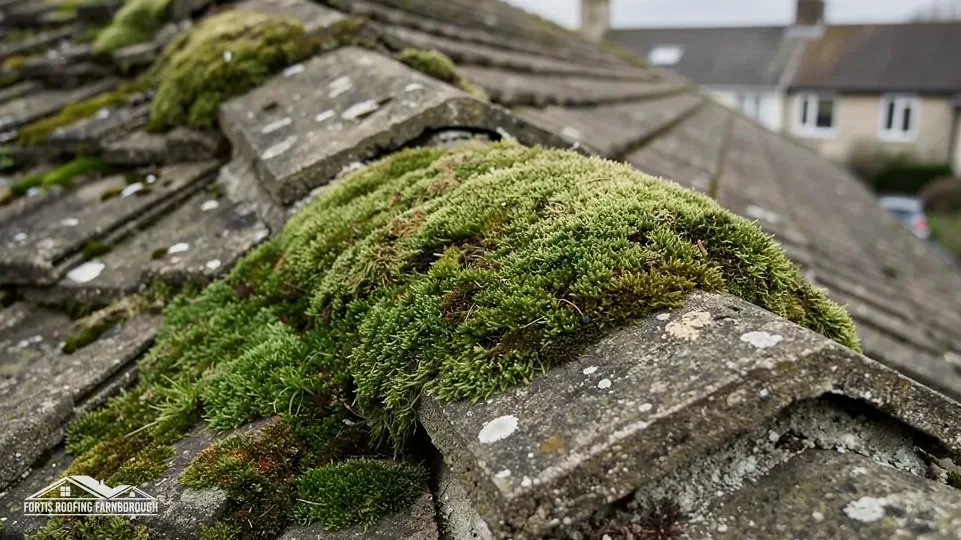
Moss, algae and lichen are slippery when wet and not much better dry. Walking on tiles can crack them, especially older concrete or clay tiles that have gone brittle. Roofers use roof ladders and crawling boards to spread their weight, and edge protection or harnesses when the job calls for them. Putting an unsecured ladder against a wet slope and climbing up with a brush is not the same thing.
Why not just stay at the edge
A job that starts at the eaves tends to move up the slope as the moss shows itself. The temptation to reach a bit further, or lean over to a stubborn patch, is how people end up off balance.
If cleaning needs you to stand on the roof, lean over its edge, or use a ladder above first-floor height, it is a job for someone with access equipment.
You can see the roof state from the ground without risk, and photographs from the garden can show a roofer what is going on before any visit.
Fragile roofs and what lies beneath
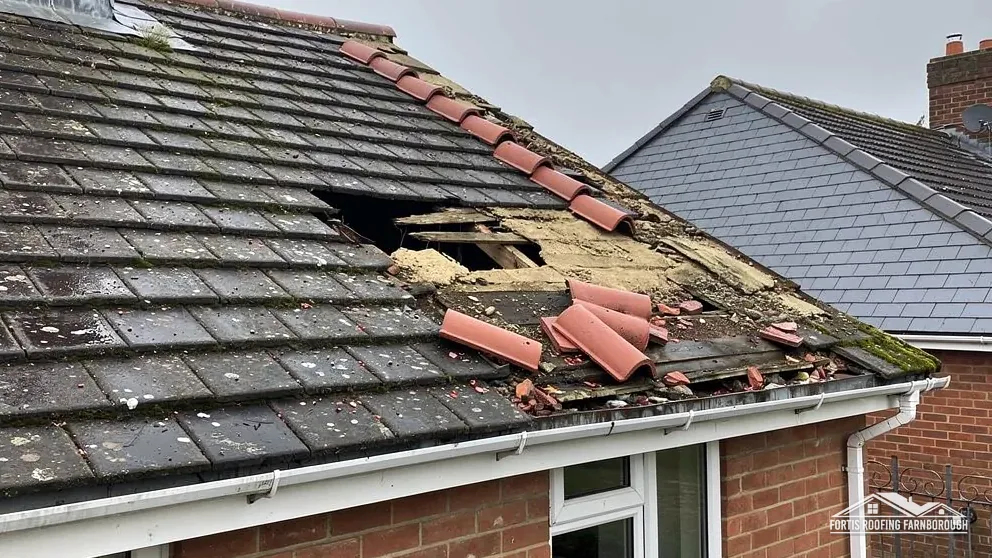
Not every surface that looks solid will take your weight. Some roofs are fragile, which means a person walking or kneeling on them can fall through.
Roofs that give way
Asbestos cement sheets, old fibre cement, plastic and glass roofs, rooflights and some garage and outbuilding roofs are all examples. A fragile roof can look sound from the ground. Moss and lichen hide cracks and weathering, and a rooflight painted over or covered by growth can be impossible to see.
Roofs that look fine and are not
Even a normal tiled roof has weak points. Tiles over a gap in the battens, a section where the timber below has rotted, and a roof built a long time ago and altered since all hide hazards. A moss-covered tile that has lost its fixings can slide as soon as it is stepped on.
The sensible rule
If you are not certain what the roof is made of, treat it as fragile. Do not walk on it. Look at it from the ground, and from the loft side if there is access, where you can see the underside of the sheets or tiles from a safe position on the joists.
Garages and extensions
Single-storey roofs are often the ones owners think they can reach. They can also be the ones with the weakest coverings, because outbuildings and garages were often roofed with sheeting. If the garage roof is sheet, read the next section before touching it.
Asbestos cement roofs: do not clean them
This is the point where the answer is firmly no. Asbestos cement was widely used in roof sheeting, garage roofs, outbuildings and some older house extensions. The fibres are locked into the cement while it is intact. Scrubbing or jetting it can release them.
What HSE says
HSE's guide to work on roofs (A14) puts it flatly: AC roofs are always fragile. Its asbestos pages add a rule of thumb tied to a date: if the building went up, or was refurbished, before 2000, assume asbestos until a test says otherwise. A garage or outbuilding of that age with corrugated sheeting should be treated as suspect until it has been tested.
Why cleaning is a problem
HSE sorts asbestos work by how the material is handled. Careful removal of asbestos cement, weathered but not badly damaged, is non-licensed work, and breaking it up substantially moves it into the notifiable non-licensed category. Brushing or jetting a weathered sheet damages its surface and risks releasing fibres into the air and the garden.
What to do instead
Do not clean or climb on a roof you think might be asbestos cement. Have it identified by an asbestos surveyor or the right specialist. Our guide to cleaning an asbestos roof goes into this in more detail, including why moss on such a roof is usually left in place until a plan is made.
If you find dust or debris you suspect is asbestos, keep people away, and do not sweep it up. Waste of this kind travels on a consignment note and is not for a household skip.
Products the public must not use
A moss killer sold in a garden centre is a biocide, and the law on biocides is stricter than many owners realise. Moss and algae killers count as biocidal products. Under the Biocidal Products Regulation (article 17(5)) each one has to be used on the terms of its authorisation. HSE adds a plain rule for householders: products intended only for professionals are not for you.
What approved means
HSE's summary of the Control of Pesticides Regulations is blunt: storing, supplying or using a product that is not approved is an offence. The label on a product tells you whether it is approved for the use and for the user. A product supplied for professional use only should not be bought and used at home, however it is described by a seller.
Read the label
- Look for the approval or authorisation number and the stated uses.
- Check whether the product is for amateur or professional use.
- Follow the dilution and the contact time on the label.
- Note any warning about runoff, ponds, plants and drains.
What we do and do not do
A roofer who treats roofs uses products that suit the job and applies them as the label requires. Our guide to roof biocide treatment explains how the treatment works. Homeowners should never use professional-only biocides, and a roofer should not offer them to you to apply yourself.
Runoff matters as well. Treatment liquid that runs off a roof carries into gutters, drains and the garden. Keep it away from fish ponds and vegetable beds.
Pressure washing and damage to tiles
A pressure washer feels like the obvious tool, and it is the one that does the most harm. A tile maker, Marley, puts jet washing in the not recommended column: a strong jet scars the face of slate and tile, and the expected life of the covering drops a long way.
What goes wrong
The surface of a concrete tile is a coating that gives it colour and protects it. A jet strips that coating and leaves the tile rough, so it soaks up water and grows moss faster than before. Clay tiles can lose their fired face, and old slate can flake. Water forced upwards can lift tiles and get into the loft through the gaps. Debris and moss clog the gutters below.
Soft washing and hand work
Gentler methods exist: brushing, and soft washing at low pressure with an approved treatment. They are done by people who understand the tile and the risks. Our guide to soft wash methods compared sets the options side by side.
A false saving
Hiring a pressure washer for a weekend looks cheap, but it is not a roof tool. If it ages the tiles, the cost comes back later as a recoat, a repair or a roof that wears out sooner. The price of a roof clean follows a survey, because area, pitch, access and the thickness of growth all feed into it.
A roofer looks at the tiles before and after cleaning, which is also when slipped tiles and perished mortar are found. A homeowner on a ladder rarely has that view.
What you can safely do from the ground
There is a good deal that helps your roof and needs no climbing. Keep to the ground, and the risk stays low.
Look and record
Check the roof after storms and at the change of each season. Binoculars show moss build-up, lifted tiles and gaps along the ridge. Take photographs from the same spot each time so you can compare them. If the roof has been quiet for years and suddenly sheds tiles, that is worth a call.
Keep trees and shade in check
Moss grows where it is damp and shaded. Trimming branches that overhang the roof lets in light and wind, and reduces the leaves that gather in valleys and gutters. If a tree is protected, or the house sits in a conservation area, check with the local planning authority before cutting. Rushmoor's planning pages are the starting point for Farnborough addresses.
Clear what you can reach
Gutters at ground-floor height can be cleared with a stable ladder and a gutter scoop, as long as the ladder stands on firm ground and you do not lean out. Do not wash moss down the roof into the gutters, because it blocks the outlets.
Birds and bats
If you see birds nesting on or in the roof, leave them. Birds are covered by the Wildlife and Countryside Act: to intentionally damage or destroy a nest in use, or one under construction, is an offence. Bats and their roosts have full protection, and GOV.UK names re-roofing as a job that can disturb them, so a roofer who meets signs of bats stops and takes advice.
For anything higher up, from tile checks to treatment, our roof cleaning and moss removal work starts with a survey and ends with a written total.