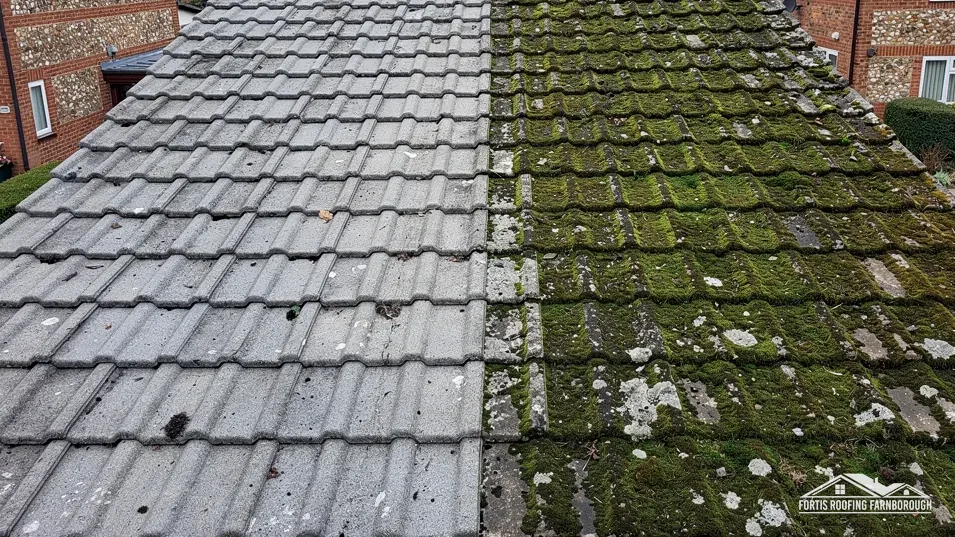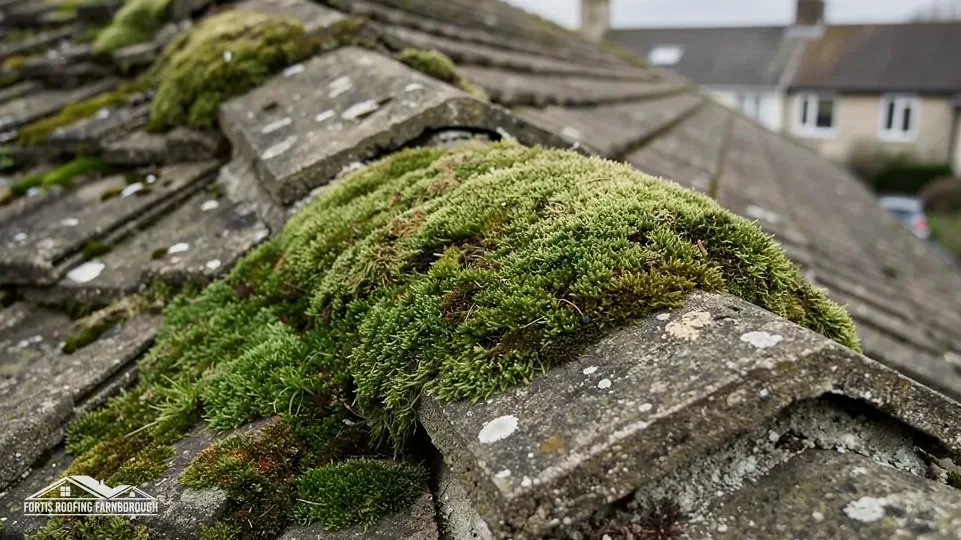
Corrugated sheet roofing on garages, sheds, farm buildings and older extensions was often made of asbestos cement. While the sheets are intact the fibres stay locked in, which is why they were in use for so long. Moss, lichen and weathering make these roofs look neglected, and the temptation is to clean them. That is the one thing you should not do without advice.
Cleaning works by rubbing, scraping or blasting the surface, and that is exactly what damages weathered asbestos cement. The sheets are also fragile, which means a person standing on one can go through it. Two separate hazards sit on the same roof: a fall, and fibres in the air.
This guide explains HSE's wording on fragile roofs, the rule about buildings from before 2000, why cleaning methods are unsuitable, how HSE splits asbestos work into categories, what to do with a suspect roof near Farnborough, and how waste from one is handled.
Why asbestos cement roofs are treated as fragile
HSE's roof-work guidance (A14) is short on this point: AC roofs are always fragile. It does not say sometimes, or when old. Whatever the age, whatever the colour, whatever the moss, the working assumption is that the sheet will not carry a person.
What fragile means in practice
A fragile surface is one that may give way under a person's weight. Asbestos cement sheets are rigid, so they feel solid, but they are brittle. They crack along the fixing lines and at the overlaps, and the cracks are hidden by moss and lichen. A sheet that carried a ladder safely last year can fail under a foot this year.
Why it is not a cleaning matter only
Moss growth can hold moisture against the sheet and darken it, which makes a roof look worse than it is. The sheet's strength comes from its fibre content and its condition, which moss does not change. The roofer's concern is how to get at it without stepping on it.
What this means for access
No ladder rests on the sheets, no one kneels on them, and no board is laid on them without a plan from someone who knows the rules for fragile roofs. Where work cannot be avoided, it is done from below, from a mobile platform, or over a system that spreads the load and catches a fall. Our guide to fragile roof safety covers the wider rules.
If you have a garage or outbuilding roof of corrugated sheeting, treat it as fragile until the material is known, and keep children and pets away from the edges.
The pre-2000 rule and identifying the material
You cannot identify asbestos by looking. For building owners, HSE gives a date test: anything constructed or refurbished before 2000 is assumed to contain asbestos. That is a rule of caution, and it applies to roofs as much as to ceilings and soffits.
Clues that raise the question
- Corrugated grey sheets on a garage, shed or lean-to.
- Flat panels under the eaves or in a porch roof.
- A building of the 1960s or 1970s with its original outbuildings.
- Any sheet with a flaking, chalky or lichen-covered surface of unknown make, whatever its colour.
How it is confirmed
The answer comes from a sample analysed by a laboratory, taken by a surveyor with the right training and equipment, or from paperwork showing what was fitted at the time. Photographs on their own do not settle it, and neither does the colour of the sheet or the way it has weathered. HSE says it is difficult to tell asbestos insulating board from non-asbestos equivalents by eye, and the same caution runs through the other materials. MyJobQuote gives around £325 for an asbestos survey (Sep 2026, typical UK range), and the price depends on how many materials are sampled.
Buying or selling a property
If you are buying a house with an old garage, the question may arise in a survey. Our guide to roof checks when buying a house sets out what the visible signs mean.
Until a result is in, the roof is handled as asbestos cement. A negative result is useful to have in writing, and so is a positive one, because each tells the next person what the roof is.
Why brushing, scraping and jetting are out
The usual ways of cleaning a roof all rely on abrading or blasting the surface. On asbestos cement, that is the wrong thing to do.
Weathered sheets shed fibres
Over decades, the cement matrix at the surface weathers away, and fibres sit closer to the face. Brushing and scraping lift fibres and dust. A jet drives water at the surface, breaks it up and scatters runoff and debris across gutters, paths and gardens. Dried debris can then be disturbed again by wind, the lawnmower or the children.
Work that breaks the material up
HSE draws a line in how it classes the work. Careful handling and removal of asbestos cement that is weathered but not substantially damaged is non-licensed work. If the sheet is substantially damaged or broken, that same work becomes notifiable non-licensed work, which carries its own duties. Cleaning that damages the surface pushes toward the second category.
Treatments are not a loophole
Painting or spraying a coating over a roof of this kind is not a cleaning job either, and a product sold for moss does not change the position. Do not use a biocide on it unless both the product and the person applying it are suited to the job, which for householders usually means they are not. Our guide to roof biocide treatment explains what the label and the law ask for.
If you have already scrubbed or jetted a roof you now suspect, stop, keep people away from the area below, and ask a specialist how to deal with the debris.
Asbestos insulating board and soffits
Cement sheets are one form of asbestos on a roof. Another is asbestos insulating board, usually called AIB, and it turns up in places that roof cleaners often touch.
Where AIB is found
External soffits appear in HSE's list of places where AIB turns up. The soffit, the board beneath the eaves overhang, can be AIB on a house of the right age. Panels in porches, dormer cheeks and fascia backing can also be AIB. The caution about telling it from non-asbestos board applies here as well: you cannot know by looking.
Why the distinction matters
The rules for AIB are tighter than for cement. HSE says work on AIB is licensable where the risk assessment shows it will not be of short duration, and short-duration work is notifiable non-licensed work. Records for notifiable work must be kept for 40 years. For a householder this is not something to experiment with.
Cleaning around a soffit
Washing a soffit with a brush or a cloth on a pole can abrade a board of unknown composition. Do not drill it, break it or scrub it until you know what it is. If your house dates from before 2000, assume it could be AIB and get the board checked. Our guide to soffit ventilation shows why soffit work often comes up on a re-roof.
Where a roof or soffit tests positive, the job goes to a contractor with the right authority for that category, and our own work on the rest of the roof is planned around theirs, so nobody is working above or beside material that has not been dealt with.
What to do when you suspect an asbestos roof
A calm, ordered approach works best. Nothing about a suspect roof is an emergency unless it is physically failing or has been disturbed.
Step by step
- Leave the roof alone. Do not clean, drill, sand, paint or walk on it.
- Keep children and pets away from the area under any broken or flaking sheet.
- Photograph the roof from the ground in good light, including any damaged edges and the underside if it is visible from a loft or the inside of the garage.
- Have the material identified by a surveyor who takes samples for analysis.
- Decide on a plan once the result is in: leave in place and monitor, encapsulate, or remove.
Leaving it in place
An intact asbestos cement roof in sound condition does not have to be removed. It has to be left undisturbed and checked over time. A roof with moss can be left with moss. Moss does not make a sound sheet unsafe, though a growth of it is a sign the surface is weathering.
Roof replacement
If the roof is leaking or badly cracked, replacement is the lasting answer. MyJobQuote gives around £2,750 for asbestos roof removal (Sep 2026, typical UK range), and the real figure depends on the size and the access. The route for the work depends on the survey result and on how the sheets are removed, and the survey settles the price.
Where a flat or garage roof is in question, overcladding an asbestos roof is another option that keeps the old sheets undisturbed under a new covering, depending on their condition.
Waste, neighbours and the paperwork
Even a small job leaves waste, and with asbestos the waste is regulated from the moment it is created.
Packaging and labelling
HSE's guidance on asbestos waste, EM9, says to double-wrap and label it. The wrapping is heavy-duty sheeting, taped, with the contents marked. It is not tipped, swept into a bag with garden rubbish or left in a corner of the garage.
Where it goes
Asbestos waste is hazardous waste. GOV.UK's guidance excludes asbestos waste from the household exemption for domestic hazardous waste, so every load carries a consignment note and is carried by someone registered as an upper-tier waste carrier. It does not go in a skip. Asking for the registration details of anyone who takes it away is a fair question.
Neighbours and shared structures
If the sheets sit on a shared or party structure, or close to a boundary, tell your neighbour what is planned. A dispute over a party wall goes to a party wall surveyor, not to building control. A job that releases dust close to a boundary affects them directly.
Planning and building control
Replacing a garage roof is a roof alteration that may need an application or notice depending on the work. Check with your building control body, which for Farnborough addresses is the Hart and Rushmoor Building Control Partnership on 01252 398715. In a conservation area or on a listed building, check consent first.
Our roof cleaning and moss removal work begins with identifying the material, and where a roof is asbestos cement, the plan is made before any tool touches it.