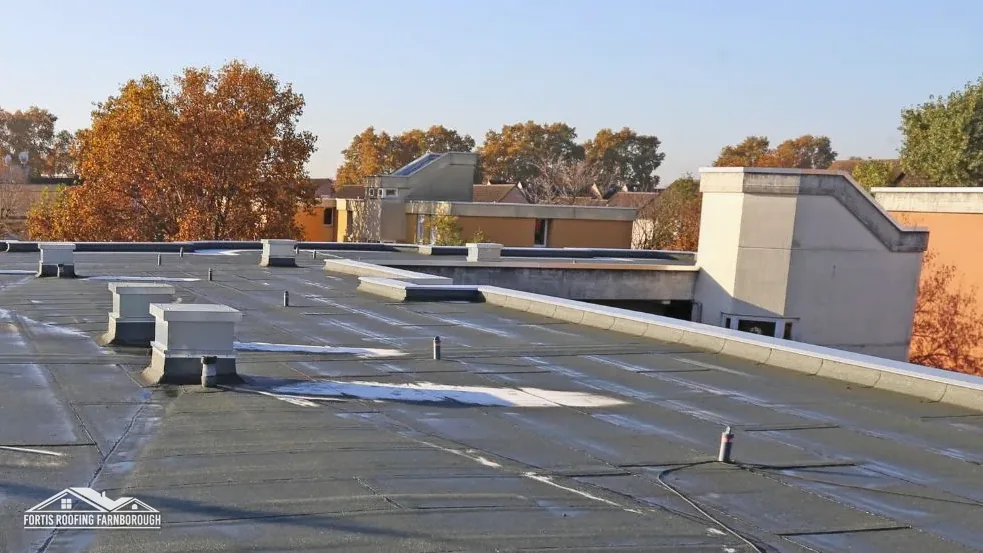
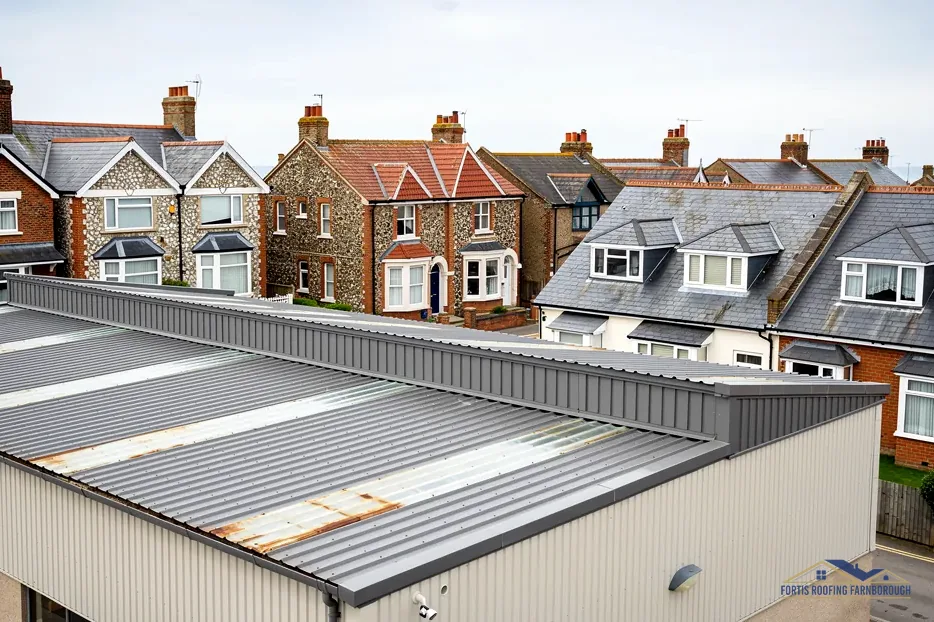
A fragile roof is one that cannot be relied on to carry a person's weight. It may look sound, with the same flat or corrugated surface as its neighbours, and a step onto it can still end in a fall through to the floor below. Falls through roofs and roof lights are among the most serious events in the construction and maintenance of buildings, and they usually involve someone who did not know the roof was fragile.
For an owner or manager of an industrial unit, a warehouse, a farm building or any older commercial property, this is a practical concern. Contractors, plant engineers, cleaners, solar installers and your own staff might all go on the roof. Each of them depends on someone having worked out which parts of it are safe to walk on, and told them.
This guide explains what makes a roof fragile, why asbestos-cement sheeting is always treated as fragile, how roof lights add risk, what an owner should do before anyone goes up, how we approach work on fragile surfaces and what CDM 2015 asks of the client. It is general guidance, and the HSE's own pages are the authority on working at height and on asbestos.
Why fragile roofs catch people out
A fragile roof is dangerous because the danger is hidden. It does not look different from a safe one until it gives way.
Looks can deceive
A sheet that has carried a person once may fail the next time. Age, weathering, corrosion, previous damage and the angle of a person's weight all affect whether a sheet holds. Moss and algae hide cracks, and a roof light painted over or covered in dirt blends in with the surface around it, so what looks like a safe grey stripe can be a panel that gives way.
Common causes
- Old fibre-cement sheets that have become brittle with age and weathering.
- Corroded profiled steel sheets, particularly at fixings and cut edges.
- Roof lights in plastic or glass that have degraded in sunlight.
- Liner panels in built-up systems, which are never meant to bear weight.
- Rotten or thin decking under a covering.
Who is at risk
It is not only roofers. A person sent up to clear a gutter, fix an aerial, service an extraction unit or look for a leak is just as exposed. The risk falls on anyone who goes onto the roof without knowing what it is made of.
Why a short visit is no safer
A fall does not need a long stay. One step off a walkway can be enough. Quick jobs are the ones most often done without planning.
The principle
Treat any roof as fragile until someone competent has shown it is not, and plan every visit around that. Our guide to planned maintenance for commercial roofs shows how access fits into a routine.
Asbestos-cement sheets are always fragile
Many industrial and agricultural roofs built before 2000 were covered in corrugated asbestos-cement sheets. They have a long record, and they present two separate risks.
The HSE's position
In HSE guidance A14, a roof of asbestos-cement sheets goes into the fragile category without exception. A roof that seems solid, is newly painted or has been walked on before is no different. Anyone who goes onto one should assume it will not bear weight, whatever its age.
Why they fail
Asbestos-cement is brittle. Over decades, weathering, moss and thermal movement weaken the sheets, and a point load from a foot can crack them. They are also often installed in long runs with limited support at the purlins, so a person stepping between supports concentrates their weight on a weak span.
The second risk
A broken sheet is not only a fall hazard. Damage releases fibres, and breaking asbestos-cement up substantially changes the category of the work from non-licensed to notifiable non-licensed. If a person falls through or cracks a sheet, there is an asbestos exposure issue as well. Our guide to overcladding or replacing an asbestos-cement roof explains the options.
Buildings from before 2000
Anything built or refurbished before 2000 should be regarded as a possible source of asbestos, the HSE says, until it has been tested. A roof of unknown material on such a building should be treated as both fragile and potentially asbestos-containing until a survey says otherwise.
What to do
Keep people off it, commission an asbestos survey and plan any work with the survey in hand, since the result decides whether the sheets can be handled, overclad or removed.
Roof lights and other weak points
A roof can be sound for most of its area and still contain traps. Roof lights are the best known.
Why roof lights are dangerous
Translucent panels are meant to let daylight in, and many are not designed to carry a person. They fade, crack and become brittle with age. A roof light that is flush with the roof surface, or covered with moss or dirt, can look just like the sheet beside it.
Not only the lights
Other weak points include lining sheets under a built-up system, which may have no strength at all, old skylights and ventilators, repaired patches and the area around plant that has been moved.
Edges and gutters
The edges of a roof carry two risks: falling off, and stepping onto a gutter that is not designed to take weight. A box gutter full of leaves hides what is beneath.
Signs to look for
Fixings that are corroded or missing, sheets that flex underfoot, visible cracks, patches of different material, repaired holes and sagging between purlins are all signs that a surface cannot be trusted.
Treat unknowns as fragile
Where you cannot tell what a surface is, treat it as fragile, and say so in writing to everyone who might go up. That means crawling boards or staging that spread weight, and nets or covers beneath where the work requires it. It also means that nobody walks on the surface without protection.
Marking and warning
Warning signs at the access point and marking on fragile areas, where they are visible, help everyone. Edges get their own treatment in our short answer on roof edge protection.
What a building owner should do
The owner or manager of the building is the person best placed to control who goes on the roof. A few steps reduce the risk a great deal.
Find out what the roof is
Know the type of covering, its age and its condition. Check for any asbestos register or survey. If there is none, and the building dates from before 2000, commission one.
Control access
Lock the roof hatch or fixed ladder, and put a procedure in place so that nobody goes on without permission. A permit-to-work system is a common way to do this. Keep a log of who has been on the roof and why.
Mark the fragile areas
Put clear signs at the access points, and mark roof lights and fragile sections wherever that can be done safely. Update the marking if the roof changes.
Tell contractors
Give anyone who will go on the roof the information you hold: the roof's construction, the survey, the location of roof lights and plant and any previous incidents. It is much better for a contractor to know in advance than to find out the hard way.
Plan the work
For any job, ask how people will reach the work area, how they will be protected from edges and fragile surfaces and what happens in an emergency.
Review regularly
Roofs change with age, so an annual look at the access arrangements and the register keeps them accurate, and a dated note of each check is evidence that the duty is being met.
How we work on a fragile roof
Our approach on a fragile roof starts with the survey and ends with the plan, and nobody steps on the surface until both are done.
Survey from a safe position
The first look comes from ground level, from a platform, from a neighbouring roof or from a camera drone, so nobody steps onto the surface before its type is known. We note the sheet type, the condition, the roof lights and the access.
Find out what is there
If the building dates from before 2000 and the roof material is not known, we ask for an asbestos survey before work begins. Under HSE guidance, careful handling of asbestos-cement is non-licensed, while substantial breakage makes it notifiable. We claim no licence, and we ask that the survey is shared.
Planned access
We agree the route onto the roof and the working area. That usually means scaffold, a mobile platform or staging with edge protection, and crawling boards or covers where we have to cross fragile sheets. Roof lights are protected or covered.
The written plan
For commercial roof work, a plan for the construction phase sets out these arrangements, and we agree it with the client before starting.
The photographs
We photograph the roof and its defects, and share the images with you, so you see the same condition we do. The written price is one total after that survey.
Stopping when needed
If conditions change, or we find something unexpected, work stops until the plan has been revised, and the client is told what was found and why the programme has moved.
CDM duties and who is responsible
Work on a commercial roof is construction work, and CDM 2015 applies. The regulations give the client, who is usually the building owner, responsibilities.
The client's part
A commercial client has to make suitable arrangements so that the project can be done safely. In practice, that means giving contractors the information they need about the building, including whether the roof is fragile and whether asbestos is present, allowing enough time and making sure a construction phase plan exists before work starts.
One contractor or several
Under regulation 5(1), two or more contractors on a project bring in the principal designer and principal contractor roles, and regulation 15(5) makes a lone contractor responsible for drawing up the construction phase plan. The plan should address fragile surfaces, access, edge protection and emergency arrangements.
Responsibility does not move
Hiring a contractor does not pass on the client's duty to provide information. If you know a roof is fragile and do not say so, the consequences can fall on you.
Other trades
The duties apply to every contractor who goes on the roof, from a plant engineer to a window cleaner. A system that controls access covers them all. Our guide to CDM 2015 on commercial roofing jobs sets out the roles in more detail, from client to principal designer.
Further help
The HSE publishes guidance on working at height and on asbestos. Our commercial roofing page lists our related work, including overcladding and planned maintenance.