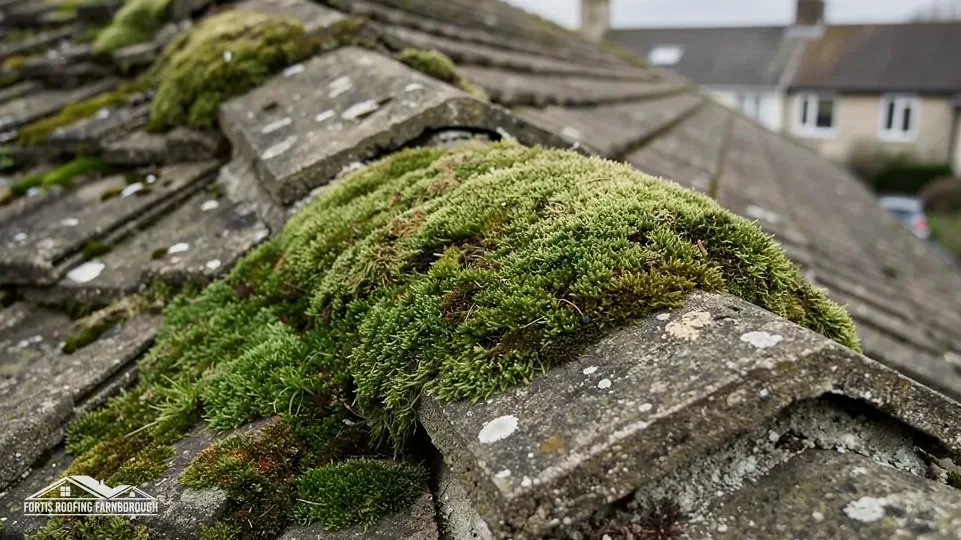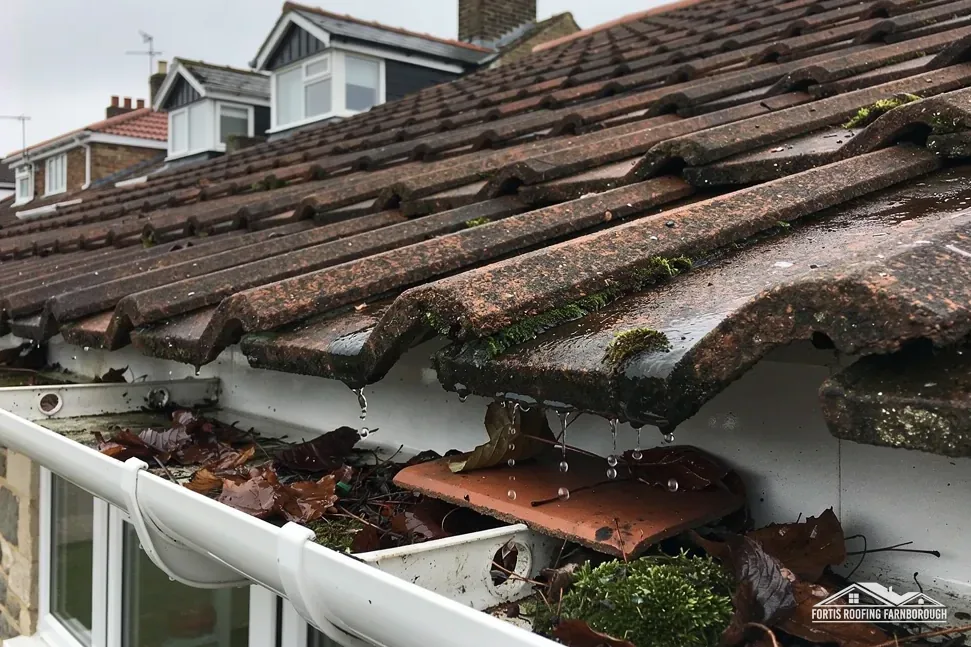
Owners tend to connect moss with the look of a roof. The more expensive trouble often sits lower down, in the gutter. Moss lifts away from tiles in wet weather, drifts down the slope and collects at the eaves, where it mixes with leaves, grit and tile dust into a thick, wet mat. That mat is what stops water getting to the downpipe.
A blocked gutter overflows. Water runs over the front edge and down the face of the fascia, the timber board that carries the gutter, or it spills backwards, soaking the soffit and the wall behind. Fascia and soffit timber stay wet, rot and let in damp. The moss on the roof was only where the story started.
This guide traces that damage route, explains how to spot early signs, how gutters are cleared safely, what to do about falls and sagging, and what national cost guides publish for gutter work, for houses in Farnborough and across the area.
From roof moss to blocked gutter
The route is simple, and it happens in stages. Knowing the stages helps you spot trouble earlier.
Moss moves
Moss that grows on a slope is loosened by frost, wind and heavy rain. Cleaning loosens more. Pieces slide down the slope toward the lowest point, which is the gutter. A single wet winter can drop a good volume into a gutter that looked clear in autumn.
The gutter fills
Moss on its own is light. Wet and mixed with leaves, seed heads and the grit shed from tiles, it forms a dense mat. It sits on the gutter floor and clogs the outlet, the opening where water drops into the downpipe. Once the outlet is covered, the gutter fills like a bath with the plug in.
Plants take root
A mat of old moss and debris holds enough soil-like material for seeds to sprout. Grass, weeds and even small shrubs can grow in a neglected gutter. Their roots push into joints and add weight to brackets.
Why it matters more at the eaves
Roof, gutter, fascia and soffit all meet at the eaves, so water that escapes there has several routes and most of them are wrong. Our guide to roof moss removal methods explains how growth is cleared from the slope without simply moving it into the gutter.
A roof cleaned without the gutters is a job half done, and a gutter cleared without looking at the roof is the same.
Overflow, damp fascias and rot
When water leaves the gutter where it should not, it takes one of three routes. Each does its own damage.
Over the front
Water spills over the lip and runs down the face of the fascia and the wall below. Dark streaks, green algae and peeling paint on the fascia are the usual signs. The timber stays wet, and a board that never dries will rot from the bottom edge up.
Behind the gutter
If the back of the gutter sits below the roof edge or the felt does not lap into it, water can run behind the gutter onto the top of the fascia and the soffit. Wet soffit boards stain, sag and in older properties may crumble. Water can also travel along rafter ends and into the wall plate.
Down the wall
Where the downpipe is blocked at its foot or the outlet is covered, water can pour down the wall. Repeated soaking brings damp inside, shows as staining on the wall and ceiling by the eaves and can wash out the pointing in the brickwork.
In frost
Standing water in a gutter freezes, and ice is heavy and expands. It can pull brackets loose, crack old cast iron and split joints. Met Office averages for South Farnborough put air frosts at around 53 days a year in the 1991 to 2020 period, so freezing weather is a regular feature here.
If the fascia is soft when you press it with a screwdriver, the damage has already moved from the gutter to the timber, and a roofer should look at it.
Spotting trouble from the ground
You can read a lot about gutters from the garden, without a ladder. Look after heavy rain and again in a dry spell.
During rain
Watch the eaves. Water should run along the gutter and out of the downpipe. A waterfall over the front edge, drips from joints and a downpipe that is dry while the gutter overflows are all signs of a blockage.
After rain
Look for stains and algae on the wall below the gutter, damp patches on brickwork, and splashes of dirt or moss on the ground at the base of the wall. A damp patch directly under a joint tells you the seal has gone. Plants poking out of the gutter edge are a certain sign of a build-up.
On a dry day
- Check that the gutter sits in a straight line and does not sag between brackets.
- Look for gaps where the gutter has pulled away from the fascia.
- Check that the downpipe is clear at the bottom, where it meets the drain.
- Note any cracked or rusted sections.
Inside the house
Brown stains on the ceiling near the outside wall, or damp on the wall where the roof meets it, can come from the gutter. It is worth a look before assuming a roof leak.
Do not climb to check. Take a photograph from the ground with a zoom lens or binoculars, and send it to a roofer. A clear picture of the eaves is often enough to say whether clearing, repair or replacement is the question.
Clearing gutters safely and properly
Gutter clearing looks easy and is a common source of falls from ladders. The safe way is as important as the clean one.
Access first
A ladder needs firm, level ground and must not rest on the gutter itself, which can crack or bend. Work should stay within arm's reach with both feet on the rungs. For anything above ground-floor height, a platform or tower is safer than a ladder, and above that, scaffolding. If the work cannot be done from safe access, it should not be done.
The method
Moss and debris are scooped out by hand or with a gutter scoop, bagged and removed, not washed down the downpipe. The gutter is then flushed with water to check the fall and find leaking joints. The downpipe is tested to make sure water runs freely, and the outlet at its foot is checked.
While the access is up
A good clear is the right moment to check the fascia, soffit and brackets. We photograph the inside of the gutter before and after, so the condition is on record. Our guide to gutter cleaning cost covers what the national guides publish.
Joints, brackets and the downpipe
While the gutter is open, we check that each joint is sealed and each bracket is tight to the fascia. A leaking joint under a mossy patch is common, and a loose bracket lets a length sag. The downpipe is checked for blockage from top to bottom, including the shoe at its foot, which is the part that tips water toward the drain.
Disposal
Moss and debris from a roof clean are bagged and taken away with the other site waste. Washed into a drain, they re-block it further down.
If gutters are clear but the roof above is still shedding moss, the cleaning of the slope comes next, and our roof cleaning and moss removal page sets out how that is arranged.
Fall, sagging and when to replace
Sometimes the gutter is blocked because it cannot drain. Water stands in a gutter that sags or has been fixed with the wrong fall, and standing water collects debris and moss faster.
What the fall is
A gutter runs at a slight slope toward the outlet. Brett Martin's guidance for installing a rainwater system gives 1 mm for every 600 mm. That is gentle, and a sagging bracket or a bent run can cancel it out. The British Standard for roof drainage, BS EN 12056-3:2000, is listed as current, though we have not read a fall figure from it. Our guide to gutter fall goes into this.
Signs of a fall problem
Water that stays in the gutter after the rain stops, green slime along one length, and moss growing in a particular spot all point to standing water. Joints that weep are often a result of movement caused by a sag.
Repair or replace
Re-hanging a gutter on new brackets, resealing joints and renewing a short run is repair. Where the whole gutter is cracked, rusted or warped, or the fascia behind has rotted, replacing the system is the better route. MyJobQuote gives around £1,000 to £1,600 for gutter replacement (Oct 2026, typical UK range), and around £800 to cap the fascias and soffits of a three-bedroom semi (Sep 2026).
Materials
uPVC, aluminium, cast iron and concrete gutters each age differently, and the choice depends on the house. A period property in a conservation area may need to keep its existing material. Check with your local planning authority before changing it.
Costs, upkeep and keeping moss away
Gutter clearing is a small cost compared with fascia and soffit repair, and a routine keeps it that way.
What national guides publish
| Source | Job | Range |
|---|---|---|
| Which? (Nov 2025) | Clearing the gutters at the front and back | £75 to £350, ex VAT |
| MyJobQuote (Oct 2026) | Gutter replacement | around £1,000 to £1,600 |
The range for clearing is wide because houses differ: a bungalow with short runs and low eaves is cheaper to clear than a three-storey house with a long gutter and a tall gable. The right access, not the clearing itself, is often what costs the money.
Keeping the cycle in check
- Clear gutters at least once a year, and after heavy leaf fall if trees overhang.
- Trim branches near the roof edge.
- Clean the slope when moss builds up, and clear the gutters straight after.
- Fit gutter guards only after the gutter has been cleared and the fall checked, since a guard over a blocked gutter just hides the problem.
One written total
When gutter work comes with roof work, it all sits in one written total after the survey, with VAT stated and access included. Where two quotes are close, check which one includes access equipment and VAT.
Gutters are part of the roof system, and a roof that sheds water cleanly into a clear gutter lasts longer. Our gutters, soffits and fascias page covers repair and replacement.