Scaffolding is part of any proper roof replacement. It gives a safe working platform at the eaves, edge protection for the people on the roof and a way of catching debris before it reaches the garden. It is also one of the least understood items on a quote, because it looks like a simple line and hides a small administrative process.
Scaffolding kept wholly inside your boundary needs none. If any of it occupies the road, a footway or other highway, section 169 of the Highways Act 1980 says the highway authority must license it. The authority is not always the council whose name is on your council tax bill, and each one publishes its own notice period and fee.
Below: why scaffold is needed, when a licence applies, which council holds the highway role for Rushmoor, Hart, Surrey and Berkshire addresses, the notice and fees each publishes, where Farnborough Airport and CDM fit in, and how scaffold is covered in one written price.
Why a new roof needs scaffold
Working on a roof from ladders alone is not a safe way to replace a covering. A new roof means stripping, carrying materials up and down, and handling heavy tiles for several days.
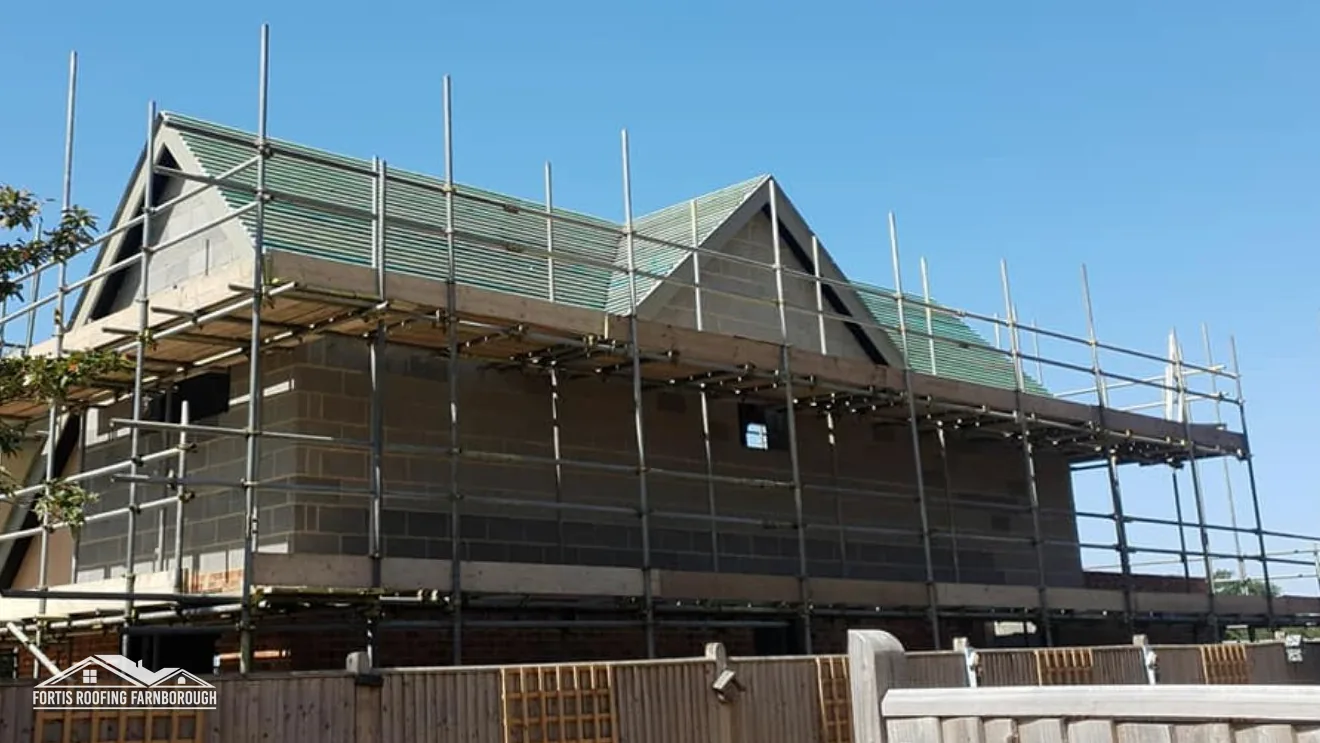
What the scaffold does
- A working platform at eaves level, so people are not standing on the roof edge.
- Edge protection, so that a slip does not become a fall.
- Access to the roof by a stable stair or ladder tower.
- Sheeting or netting where needed, to hold debris and shield the garden.
- A place to stack tiles and battens where they will not slide.
Designed for the job
A scaffold is sized to the house: lift count, board width and ladder tower position all follow from roof height, overhang and ground conditions. A tall gable, a bay, an extension with a lower roof and a sloping garden all change the design.
How long it stays
The scaffold goes up before stripping, stays through the roofing and comes down after final checks and any gutter or fascia work. A job that runs longer than planned, for weather or for repairs found on stripping, may extend the time it stays, and that can affect a licence.
Why we plan it first
The scaffold decides the start date, because a licence takes working days to obtain, and because the access it gives decides how safely the job is done. Our guide to what happens during a new roof shows where it sits in the order of work.
When a licence is needed
The legal test is short. Highways Act 1980, section 169(1), bars anyone from erecting or retaining a scaffold, or any structure that obstructs the highway, on or over it without the highway authority's licence.
What counts as the highway
The carriageway, the pavement and any footway are all highway, and so is the airspace above them. Many houses have a front wall right at the footway edge, so even a tower standing in the garden can carry a platform, hoarding or sheeting that reaches over it.
On your own land
Standing wholly on your own ground, a scaffold needs no licence. Bracknell Forest's page makes that point about private land, and Wokingham's about private roads. The important word is wholly, since a board or hoarding that crosses the boundary brings the highway into play.
Flats, terraces and shared access
A house with no front garden, or a block of flats sharing a forecourt, the scaffold may have to go on the footway or over a shared drive. In that case, the owner of the shared land, such as a freeholder or management company, may have to agree as well as the highway authority.
Private roads and shared drives
A private road is not a public highway, although its owner or management company may set its own rules. Ask the scaffolder to confirm in writing whether your street is adopted and who owns it.
Who deals with it
The licence is something we sort out with the scaffolder, and the start date follows the council's timetable. Where the council says who applies, that is covered in the table of fees below.
Which council is the highway authority
The highway authority is the body that maintains the road, and it is often a county council, not the district or borough. For the area we cover, the position is as follows.
| Address in | Highway authority |
|---|---|
| Rushmoor, Hart, East Hampshire, Basingstoke and Deane | Hampshire County Council |
| Surrey Heath, Waverley, Guildford, Woking, Runnymede, Elmbridge | Surrey County Council (to 31 March 2027) |
| Bracknell Forest | Bracknell Forest Council |
| Wokingham | Wokingham Borough Council |
| Windsor and Maidenhead | RBWM (Royal Borough of Windsor and Maidenhead) |
District councils stay out of it
Rushmoor, Hart and the Surrey district councils issue no scaffold licences, so a call to the wrong council gets redirected.
Surrey from April 2027
Surrey's county and district councils give way on 1 April 2027 to two new unitary bodies, named West Surrey and East Surrey. Until that date the county council is the authority for the Surrey addresses above, and a job that straddles it deserves a check on who then holds the role.
Hampshire stays as it is
The decision to replace Hampshire's councils was withdrawn in September 2026, so Hampshire County Council continues as the highway authority.
When the work runs on
A job that takes longer than the licence period needs the scaffold to stay. Where a council grants no extensions, a fresh application is made, and where it licenses in 4-week or 6-week blocks, the end date is checked against the programme at the start. Bad weather, repairs found on stripping and delays in deliveries are the usual reasons for an overrun.
Not sure whose road it is
The council for your area can tell you, and so can the scaffolder.
What the councils publish on notice and fees
Each council fixes its own fee and notice period. These are the figures the councils themselves publish.
Hampshire County Council
In Hampshire County Council's scheme the scaffolding firm applies on the customer's behalf, and ten clear working days have to pass between application and start. Hampshire County Council charges £211.90 for the first 2 weeks and £72 for each additional 2-week period, and, since no extensions are given, longer jobs need a second application. It also sets a public liability requirement for scaffolders.
Wokingham Borough Council
Wokingham Borough Council has the same arrangement, with the scaffolding company applying for its customer. Its licence is £263 for the first 4 weeks and £163 for every 4-week period after, with at least 10 working days allowed from application to start.
Surrey County Council
Surrey County Council asks for 10 working days' notice and charges £208 for each 28-day period, renewal included, with the application fee non-refundable. An emergency licence can be requested by phone if a structure is unsafe.
Bracknell Forest
Bracknell Forest charges £350 for a residential licence, which includes a £100 application fee that is not refundable, and the licence covers 6 weeks. A new licence is needed once that period ends.
Windsor and Maidenhead
RBWM says permission is needed and can be obtained from the council. RBWM's page lists no fee, and it states maximum fines of £5,000 for breaching a scaffolding licence.
Whatever applies to your street, the cost is part of one written price, so it does not turn up as a surprise.
Airport safeguarding, neighbours and CDM
A few other points can touch a scaffold job, and each is easy if raised early.
Farnborough Airport
According to its own page, Farnborough Airport protects the land around its aerodrome so that mobile or tower cranes and other tall constructions cannot get in the way of operations. It gives a safeguarding email address and no distance, height limit or fee. A crane or tall plant close to the aerodrome should be mentioned to that team before anything is booked.
Neighbours
Tell the neighbours when the scaffold will go up and come down. If it has to cross a boundary, or the work touches a shared wall, chimney or roof edge, a party wall notice may be needed. The Party Wall etc. Act 1996 sets two months' notice for certain works, and party wall questions go to a party wall surveyor, not to building control.
CDM and the homeowner
The Construction (Design and Management) Regulations 2015 treat anyone having construction work done on their own home, outside any business, as a domestic client. Under CDM 2015, several contractors on one project means a principal designer and a principal contractor are named, while a single contractor writes the construction phase plan. A scaffolder and a roofer are usually separate firms, so ask who takes which role.
On-site safety
A scaffold should be inspected before use, and its boards, ties and edge protection checked. If anything looks wrong, stop work and call the scaffolder.
How scaffold sits in your price
Scaffold is one of the items that makes quotes hard to compare, because some include it and some leave it out.
What our price covers
Our written total after the survey already holds the scaffold access the job calls for and, where one applies, the licence. It is paid as part of that figure, and nothing further turns up on the day.
What sets the cost
Scaffold cost follows the size and height of the house, the number of sides needing access and the length of time the scaffold stands. Those factors differ from house to house, so the written quote after the survey settles the figure for your house.
Questions to ask any roofer
- Is scaffold included in the price?
- Is the licence included, and who applies for it?
- How long is the licence for, and what happens if the work overruns?
- Who answers if the scaffold is damaged or blocks the footway?
Insurance and damage
If a scaffold is damaged, or damages something, the question is whose cover responds. Ask the scaffolder to confirm its public liability arrangements in writing, and ask us who is responsible for the scaffold between the day it goes up and the day it comes down. A written answer now avoids an argument later.
Delays
If the licence takes longer than expected, the start moves with it. Wet weather can hold up work, and where a council grants no extensions, an overrun means applying again. Allow some margin when you plan.
Next steps
Our roof replacement service begins with the survey, and our guide to roof replacement cost shows what the national guides publish for the whole job.