Roofs rarely announce that they are finished. They fail in stages: a tile here, a leak there, a stain on a bedroom ceiling that comes and goes with the weather. Each event can be dealt with on its own, and a good many roofs go on for years that way. The skill lies in spotting when the events are no longer separate, and when each repair is only buying a short stretch of time.
Age alone does not settle it. Published lifespans give a rough guide, but a poorly fixed roof can give out early, while a well built and cared-for one can outlast its range by years. What counts is the condition of the covering, the timbers and the underlay, and how those fit together.
This guide sets out the signs worth acting on, from the garden, from the loft and from inside the house. It compares age with typical lifespans, explains how a roofer tells repairs from replacement, and covers what rules apply when the answer is a new roof, for homes in Farnborough and neighbouring towns.
Age against typical lifespans
The first question is how old the roof is. Published ranges give a sense of where it sits in its life, though none is a promise.
| Covering | Typical life |
|---|---|
| Plain concrete tile | 40 to 50 years |
| Double Roman concrete tile | 40 to 50 years |
| Fibre cement tile | 30 to 40 years |
| Clay tile | 60 to 80 years |
| Spanish natural slate | 75 to 100 years |
| Welsh slate | 100+ years |
Other published figures
Marley's own page sets roof tile expectations at about 60 years while stating that this is not a warranty. The BRE minimum life expectancy of 60 years applies to clay tiles only. A guarantee on a product or a job is not the same as a lifespan.
What age tells you
A concrete tile roof past 40 years, a fibre cement roof past 30 or a clay roof past 60 is inside the range where wear becomes likely. It is a reason to look, not a verdict. The tiles may be sound and the problem may lie elsewhere, such as in the underlay or the battens, which often wear out before the covering does.
Insurance and the age of the roof
If you may need to make an insurance claim in future, a dated survey with photographs now is useful evidence of the roof's condition. Insurers commonly exclude wear and tear, so a record of the condition before any event helps.
If you do not know the age
Look for a date on paperwork, a survey from when you bought the house or a planning record for an extension. A roofer can often judge the age range from the tile type and how it has weathered.
What you can see from the garden
Binoculars and daylight tell you a surprising amount from the lawn. Walk round the house and study each slope in turn.
Signs of a covering in decline
- Widespread slipped tiles, in lines or scattered over a slope.
- Cracked, chipped or crumbling tiles, with fragments in the gutter or on the ground.
- A sagging or wavy roofline, where the ridge or the courses dip instead of running straight.
- Bare patches where tiles have gone and have not been replaced.
- Flaking surfaces where the face of the tile has peeled away.
Signs of a roof that is struggling to shed water
Moss packed into the laps, clogged valleys and overflowing gutters all keep a roof damp. Wet roofs age faster, since moisture and frost work on every weak spot. Moss is not itself a sign of failure, but a roof that is covered in it and showing other signs is likely to be tired.
Features to check
Look at the ridge for gaps and crumbling pointing, at the verges for loose edge tiles and at the flashings around chimneys for lifting or gaps. These details wear out sooner than the field of the roof.
If you see one or two of these, a repair may be all that is needed. Several together point toward a bigger decision. Our guide to slipped roof tiles explains how to tell a one-off slip from a pattern.
What the loft shows
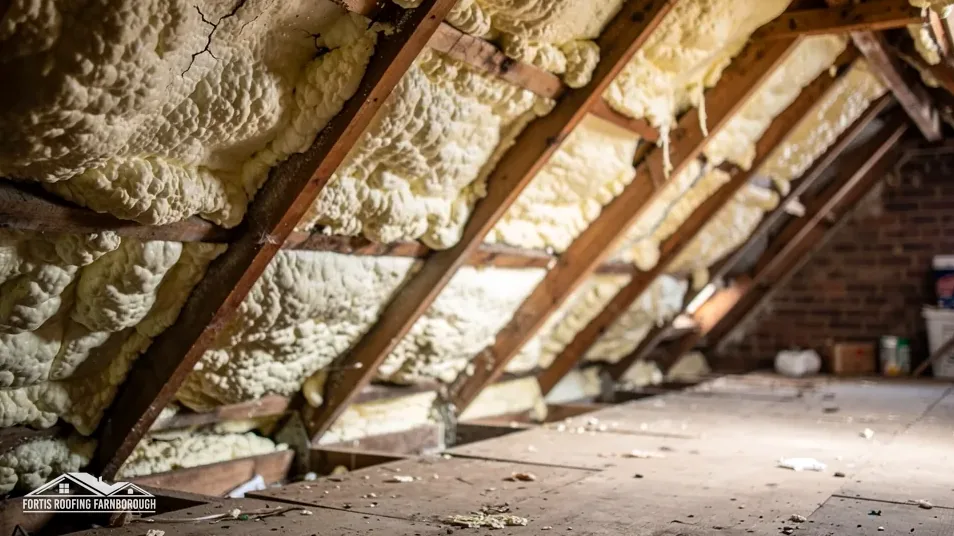
The loft is where the roof's hidden condition shows. Choose a dry day, take a torch, keep your feet on the joists or boarding, and study the rafters and underlay overhead.
Underlay
Underlay is the sheet that sits beneath the battens. Look for old bitumen felt that has gone brittle, torn or dropped away between the rafters. If you can see daylight through the roof, or the underlay hangs in loose pockets, it is no longer doing its job. A failed underlay means that every shower reaches the timber.
Battens and rafters
Dark, damp-looking timber, soft or crumbling battens and rafters with signs of rot or beetle holes all matter. Press gently with a screwdriver where you can safely reach: sound timber resists, rotten timber gives. Our guide to battens that need replacing explains the signs in detail.
Fixings
Rusty nail heads, orange streaks and nails that have worked loose point to fixings that are failing across the slope.
Damp and condensation
Black mould on timber, wet insulation and drops forming on nail tips in cold weather suggest a ventilation problem. That may or may not mean the roof needs replacing, but it may be a reason to correct the underlay and eaves as part of a re-roof.
Daylight and gaps
Daylight at the ridge, round a chimney or at the eaves shows gaps that rain can use. It is worth photographing each one and noting where it is.
Leaks, stains and repeated repairs
Inside the house, the evidence is less direct but often more urgent. A stain or a drip means water has already got through every layer.
Ceiling and wall stains
A brown mark, a patch of peeling paint or a damp smell on an upstairs ceiling or on a wall below the eaves can be a leak from the roof. It can also come from a gutter, a pipe or condensation, so a roofer traces it back before deciding anything.
A leak that returns
One leak, fixed and gone, is a repair. A leak that returns after repair, or moves from one place to another, suggests that the covering or underlay is failing generally. Our guide to finding a roof leak sets out how the source is traced.
The cost of repairs
The average repair comes to about £650 in 2026 according to MyJobQuote (Oct 2026, typical UK range), while Which? gives a range of £75 to £400 ex VAT for a few tiles (Nov 2025). If repairs are being made every year or two, add the bills up. A series of repairs can come to a large share of what a new roof would cost, and each one leaves the rest of the roof ageing.
Repairs on repairs
Patches made with a different tile, sealant used as a cover-up and flashings stuck down with mastic all show a roof that has been patched for some time. They are a reason to stand back and consider the whole.
If you are paying for the same roof to be repaired every year, ask for a survey that compares what each repair buys with what a new covering would.
When repairs stop making sense
The decision between repair and replacement is a matter of evidence and arithmetic. A survey sets out both.
Points that favour repair
- The covering is healthy and the fault is confined to one area.
- The battens and underlay are in good condition.
- The roof is within its typical life range.
- The cause of the fault is clear and can be corrected.
Points that favour replacement
- Failures are spread over several slopes.
- The battens have gone soft or the underlay has perished.
- The covering is cracked, flaking or porous across the roof.
- Repairs have become frequent and costly.
- The roof is at or beyond the end of its typical life.
Partial or full
Sometimes only one slope needs re-covering. That can be a sensible compromise, provided the remaining slopes are healthy and the new tiles match. Our guide to roof replacement cost sets out how the published figures compare.
A short test to apply
Ask three questions of any ageing roof. Is the covering still sound tile by tile? Are the battens and underlay still doing their job? Would the money for the next two repairs, added together, buy a meaningful share of a new roof? Two noes and a yes is the usual pattern that points to replacement.
The cost of waiting
A failing roof can damage what lies below: ceilings, insulation, electrics and furnishings. If the signs are clear, delay may cost more than action. If they are unclear, a survey costs far less than a wrong decision either way.
What the survey gives you
A roofer measures, photographs and marks each defect on a plan, then gives a written view on repair against replacement, with one total price for whichever route you choose.
Rules that apply to a new roof
If the answer is a new roof, a few rules come into play. They are not complicated, but they are easy to miss.
Planning
Swapping the covering of a house normally falls within Class C permitted development. A flat has no such rights. A listed house keeps its Class C right and also needs listed building consent where the work alters its character, and in a conservation area it is worth asking the council about Article 4.
Building Regulations
By the Planning Portal's yardstick, a building control application is not normally needed when less than 25 per cent of the envelope and less than 50 per cent of the roof is touched, and a full re-roof usually exceeds the second limit. A new covering that is 15 per cent or more heavier also needs approval, with a structural check.
What councils say
Bracknell Forest's building control page includes replacing roof coverings in its list of work that may also call for approval, and Basingstoke and Deane's does the same. RBWM names re-tiling or re-felting. None of these councils publishes a percentage or says approval is always required, so we check with building control before a re-roof.
Who to ask
For Farnborough and Aldershot addresses, the Hart and Rushmoor Building Control Partnership can be reached on 01252 398715. Our roof replacement service begins with the survey.