The short answer
Sometimes. A like-for-like swap of an existing roof window can often be done from the loft or room below, because the opening and the rafters are already there. A new opening, a bigger window or a job on a steep or high roof needs the covering opened from outside, and that calls for a roof ladder, a tower or scaffold.
When working from inside makes sense
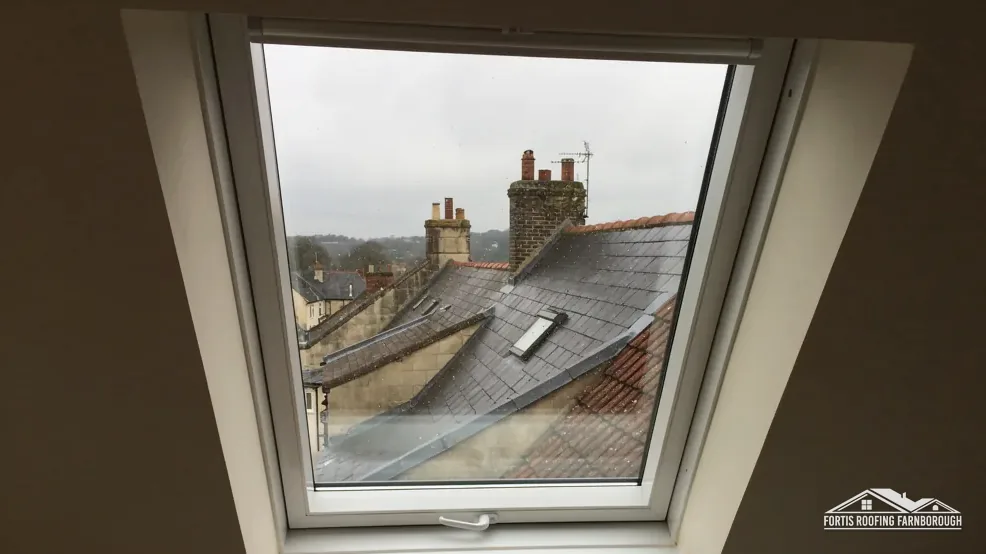
A replacement of a window that is already in the roof is the best candidate. The opening is cut, the rafters are trimmed and the flashing is in place around the old frame. With the replacement the same size, the job is to release the old unit, lift it out and set the new one in the same hole.
Some of that work can be done from below. The lining and the inside fixings come off from the room, and a replacement sash or a new glass unit can be fitted on the existing frame without touching the roof outside. Our answer on replacing just the glass covers that lighter job.
The outside still needs a look. The flashing, the seals and the covering around the frame are on the roof, and they cannot be checked or renewed from a loft. If the old window leaks at the edges, an inside-only swap is a poor choice, because the cause is outside and stays there.
Where the pitch is gentle, the roof is low and a ladder or a hatch gives access to the window, a roofer may do both sides safely. The survey settles it by looking at the window, the slope and the way up.
When a new opening or a higher roof needs scaffold
A new opening cannot be made from inside alone. The covering has to be stripped around the position, the rafters cut and trimmed, and the flashing kit fitted over the tiles or slates. All of that is outside work on the slope. Our answer on cutting rafters for a roof window describes the structural side.
Height and pitch then decide how the roofer gets there. On a low slope, a ladder secured at the ridge can serve. A window high on a three-storey house, a steep pitch or a slope above a conservatory or a porch calls for a scaffold or a tower, because a ladder alone is no safe base for stripping and flashing.
Scaffold that stands out over a road or pavement falls under Highways Act 1980 s169. For Rushmoor and Hart, Hampshire County Council runs the scheme: its page names the scaffold firm as the applicant, asks for ten clear working days' notice, and charges £211.90 for the first 2 weeks and £72 for each further 2 weeks, with no extensions. Private land needs no licence.
Outside Hampshire's area, ask who applies; where the job needs one, the scope records who is applying, which is agreed with the scaffolder.
Safety and what the law expects
Working on a roof is among the riskier jobs in building, and the safe method comes before the neat one. A slope has to be accessed, edges protected where a fall is possible, and the roofer should never be asked to work from a poor foothold to save on access.
The Construction (Design and Management) Regulations 2015 apply to most building work, including a domestic job. In HSE's terms, a domestic client is a householder commissioning work on their own home, not through a business. With several contractors on a project, regulation 5 appoints a principal designer and a principal contractor. With a single contractor, regulation 15(5) requires that firm to prepare a construction phase plan.
In practice, a small window job with a single firm needs a short written plan covering access, edge protection, the weather and how the opening is made safe before everyone leaves. A homeowner does not write it, but should expect to be told what it says.
Anyone tempted to do the work personally faces the same hazards: a fall from a roof or ladder is a serious injury, and a roof window is heavy and awkward to lift.
How we decide at the survey
The survey answers the question. We look at the existing window or the planned position, measure the pitch and the height, photograph the covering and the loft side, and check how we would reach the roof. From that we say whether the job can be done from inside, from a roof ladder or tower, or only from scaffold.
We also ask about the inside. A finished ceiling or a loft room with plaster or boarding means the lining, the insulation and the reveals need to be redone after a new window goes in. The work happens either way, and the plan for dust sheets, floor protection and the order of work is part of the scope.
The covering matters too. A fragile roof, brittle old tiles or a slope with lichen are risky to walk on, and the plan changes accordingly. A slate roof calls for particular care, as our answer on a roof window in a slate roof explains.
You see the photos and the access plan, and a single written price follows. Where an inside-only job will do, we say that and price it as such. See roof windows and skylights for the rest of the work.