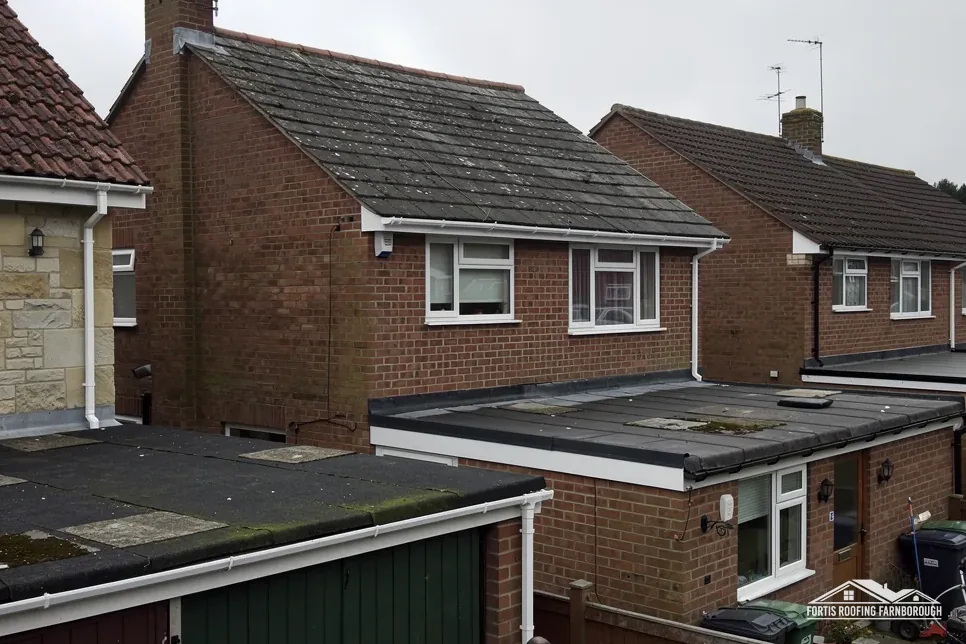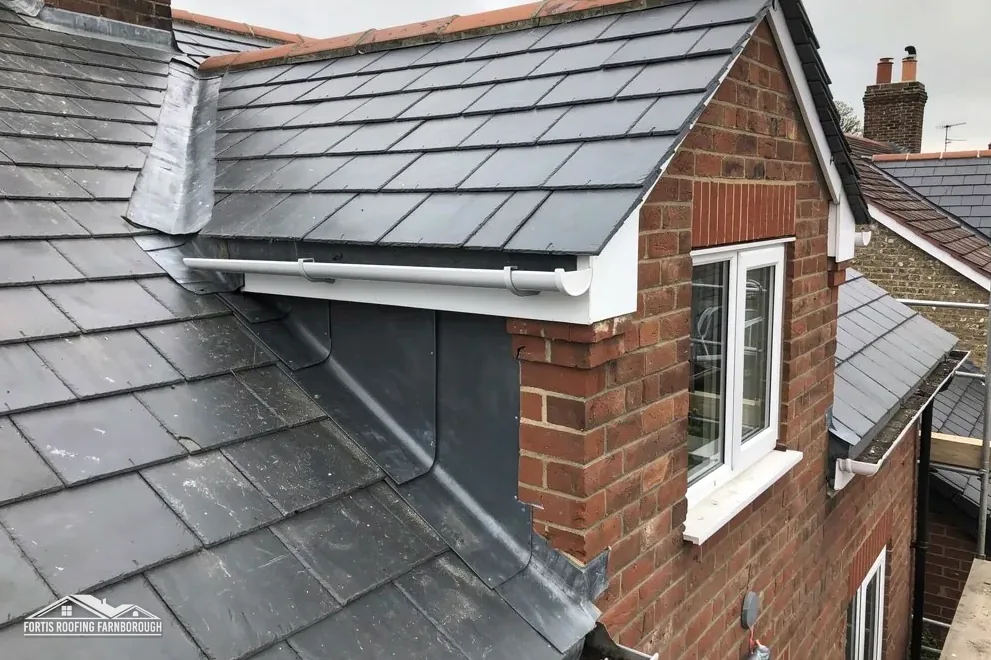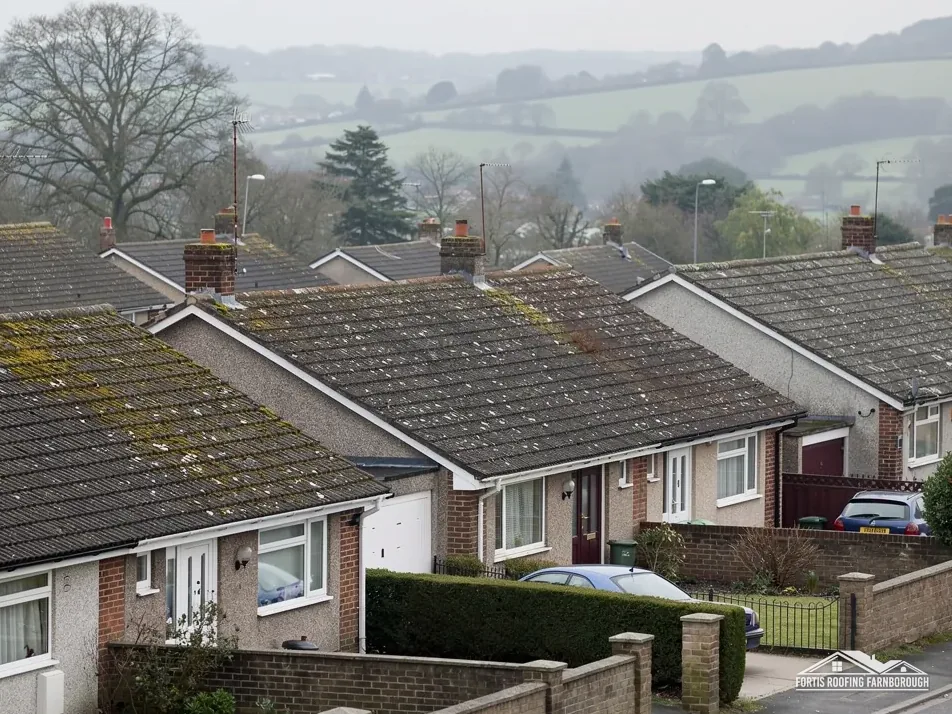
Brookwood Cemetery's edge
In 1854 a company bought 2,000 acres, and 400 acres were laid out as a cemetery by 1911.

Roofs beside Brookwood Cemetery and the canal, at Woking's western edge
Brookwood is a village on the main railway at the western edge of Woking borough, beside the cemetery and the canal. Each roof is photographed and quoted once.
In 1854 a company bought 2,000 acres, and 400 acres were laid out as a cemetery by 1911.

The chapel is listed Grade II and stands within 500 m of the village centre.
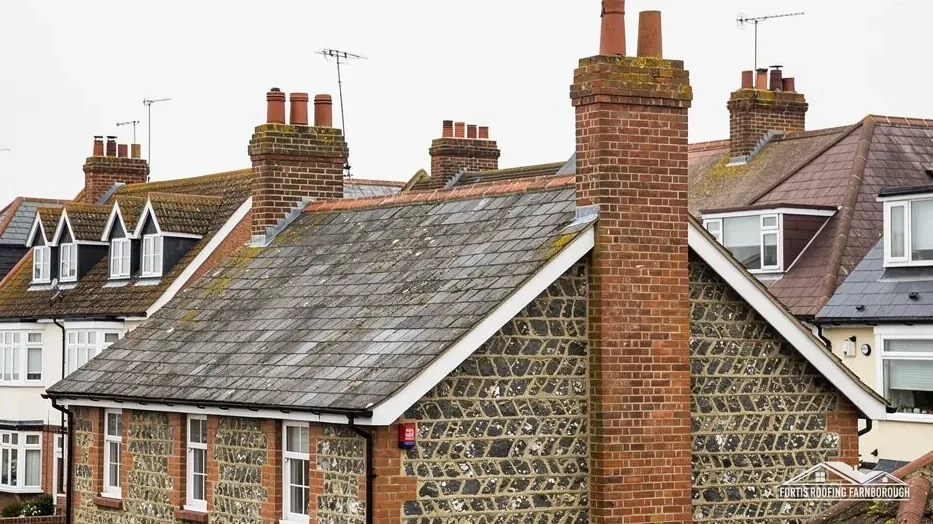
The county asylum opened in 1867, and its 90 ft water tower was a landmark.
Map of Brookwood with Pirbright, Knaphill, Bisley, St John's marked around it.
Map data © OpenStreetMap contributors. Loads only when you ask for it.
Pirbright lies to the south, Knaphill to the north-east, Bisley to the north, St John's to the east, and Worplesdon to the south-east.
About 6.5 road miles east of Farnborough · Woking Borough Council and Surrey County Council.
Brookwood, necropolis and rail
How a cemetery company, a county asylum and a railway station shaped Brookwood, which chapel and which conservation areas touch roof work, and what Woking's own rules and Surrey's licence involve. All figures are sourced.
| No. | Chapter | The figure it turns on |
|---|---|---|
| 01 | A necropolis, an asylum and a 90-foot water tower | 2,000 acres bought in 1854; asylum 1867 |
| 02 | American Military Chapel and Woking's 27 conservation areas | Chapel Grade II; Woking has 27 |
| 03 | Woking's own inspectors, Surrey's licence and the 2027 move | Woking inspects; West Surrey Council 2027 |
Chapter 01 of 03
Brookwood's origins in dated records
Brookwood owes its character to two large institutions. In 1854 a company bought 2,000 acres in Woking and Pirbright, and by 1911 some 400 acres had been laid out as a cemetery planted with rhododendrons and conifers, adjoining Brookwood Station. The Surrey County Asylum at Brookwood opened in 1867 and was much enlarged in 1903, and the county history noted its 90 ft water tower as a conspicuous landmark. The station is on the main line, within Woking parish, and in 1911 there was a Primitive Methodist chapel in the village.
A settlement shaped by a cemetery, an asylum and a railway has an unusual mix of buildings: chapels, lodges, service buildings, workers' houses and the houses that grew up around the station. The 2021 Census counted 1,432 residents in the built-up area, a small place with a very large footprint of non-residential land. The records describe plans and dates, not roof coverings, and we do not guess at the latter.
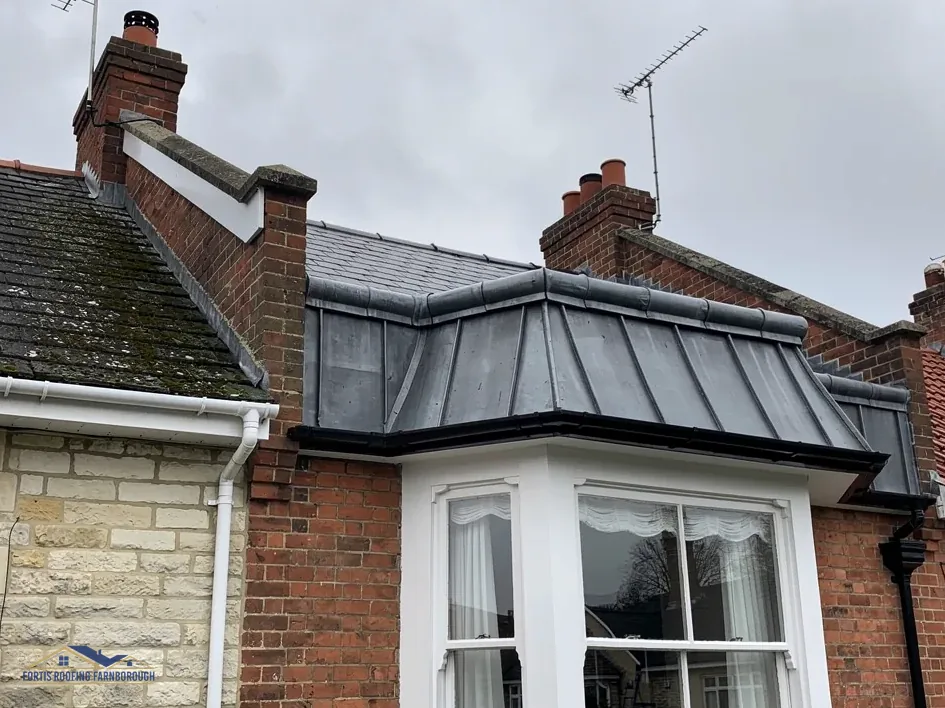
What the history does suggest is that Brookwood's roofs include more than houses. Chapels, lodges and outbuildings have steeper or more complex roofs than most homes, with turrets, bellcotes and long runs of valley. Whatever your building is, the survey takes it as it finds it: we measure the slopes, log each junction, and photograph anything that is unusual, from a lead-lined gutter to a ridge finial. Anything carved, moulded or shaped is recorded at close range on a sketch of the roof, so a matching repair can be specified exactly and checked afterwards.
Our method puts the evidence first. You receive measurements and photographs of every part of your roof before you receive a price, and the report says in plain terms what is sound, what is failing and what a repair would involve. Our pitched roofing page sets out the repairs we make most often, and our flat roofing page covers the flat covers on porches, garages and extensions.
Old buildings near woodland call for one more check. GOV.UK guidance on bats stresses that every species, with its breeding and resting places, has full legal protection, and lists repairing or replacing a roof as one of the things that can affect them. Chapels, lodges and outbuildings among trees are the kind of building where that matters, so we look for signs of roosts from inside the roof space and tell you at once if we find any.
Chapter 02 of 03
| Designation | Detail | For roof work |
|---|---|---|
| American Military Chapel | Grade II, NHLE 1044711, listed 6 January 1984 | Listed building consent |
| Brookwood Cemetery conservation area | Within about 0.75 km of the centre | Check your address with Woking |
| Basingstoke Canal conservation area | Touched by the same area query | Check your address with Woking |
| Woking's conservation areas | 27 across the borough | Check the council's map |

The American Military Chapel received its Grade II listing on 6 January 1984, and it is the one listed building within 500 m of Brookwood's centre. Work that alters the character of a listed building needs listed building consent from Woking Borough Council, and an unlisted house nearby is outside the listing. The Brookwood Cemetery conservation area comes to within about 0.75 km of the centre, with the Basingstoke Canal area caught by the same search.
Woking says there are 27 conservation areas in the borough. Whether an Article 4 direction applies is a question to check with Woking, so we ask Woking's planning team about each address, and we keep the answer with the survey. A short question at the start costs far less than a repair that has to be redone later. That costs nothing, avoids guesswork and means a direction, if one exists, is found before a job and not after it.
A conservation area interests the planners in how a roof looks from the public side. For ordinary repairs it makes no difference: work that follows the existing material raises no question. It starts to matter when a covering changes, when a roof window is added to a front slope, or when a chimney is altered. Our roof windows and skylights page explains the choices for a visible slope.
For the chapel and any other listed or institutional building, the sequence is the same. The roof is measured and photographed before any price is considered. The photographs then serve for a consent application, and the matched repair follows the approved detail. Because chapels have long, steep roofs, access is planned early and scaffold is usually the safe way up.
Trees are part of Brookwood. The cemetery was planted with rhododendrons and conifers, and large trees shade roofs, drop needles and leaves into gutters and encourage moss. None of that is a defect, but it is the reason our survey follows the rainwater from the eaves to the drain, and the reason a clean-out is sometimes all a roof needs. Where overhanging branches threaten the covering, the report says so and leaves the decision on the tree to you.
Chapter 03 of 03
Four facts for a Brookwood roof job
Four things are settled at a Brookwood survey, in this order. The first is whether the job needs inspection. Building control here means Woking Borough Council's in-house service, or a registered approver if you choose a private firm. Re-roofing has Planning Portal limits of 25 per cent of the building envelope and 50 per cent of the roof. Where a new covering weighs at least 15 per cent more, approval is required and a structural engineer or surveyor should look first.
The second is whether scaffold must stand on a public road or footway. If it must, Surrey County Council licenses it at £208 for each 28-day period, and wants 10 working days before the start you want. Its page leaves the applicant unnamed, so the arrangement is made between us and the scaffolder, and you receive the dates in writing. A scaffold wholly on private land is outside the scheme.
The third is access. Brookwood is a village on a main railway, with the canal and heath around it, and deliveries must reach the house without blocking a road. The fourth is timing. West Surrey Council replaces Woking and Surrey County Council on 1 April 2027, and a job that crosses that date needs an answer to the question of who holds each consent. We trace the answer and report it to you well ahead.
At the end of the survey you have a report, a plan and the dates. Nothing is booked until those are clear, and a few days spent on them at the start can save a good deal of trouble later. Whatever the building, a repair is the quote whenever the evidence supports one.
Weather decides when scaffold can be used. Met Office averages for South Farnborough, 1991 to 2020, give 118 wet days a year and about 53 days of air frost, so a 28-day licence is likely to meet both. Spare days are built into the plan, and the roof is kept watertight whenever work stops, even for a single night. Where one scaffold serves a chapel and a neighbouring lodge, we plan the sequence so that neither is left exposed.
The cemetery area extends to about 0.75 km from the centre of the village, and that search also catches the canal area, so it could be. Woking's map shows the boundaries. Every Brookwood address is looked up before we price work that changes a roof's look, and what we find is written into the report you keep.
No. The listing covers the chapel, which needs listed building consent for work that alters its character. A house close by stays outside it; only a listing of its own would bring consent, and a conservation area raises separate planning questions. Your address is settled by Woking's map and the National Heritage List, both of which we consult during the visit.
Woking Borough Council's own building control service, or a registered building control approver if you go private. A few refixed tiles involve neither. The Planning Portal's limits are 25 per cent of the building envelope and 50 per cent of the roof, and the survey measures where yours stands, so you know before any dates are fixed.
Surrey County Council charges £208 per 28-day period and wants at least 10 working days of notice. The page leaves the applicant open, so we settle it with the scaffolder and send you the dates. If the scaffold stands wholly on your own land, no licence is needed, and a ladder or tower often serves for a small repair.
Get your free roof quote
Give us your Brookwood road and what is wrong. We book the survey first, then a single price follows in writing, with the photographs behind it.
10-year workmanship guarantee, in writing.