Upper Gordon Road villas
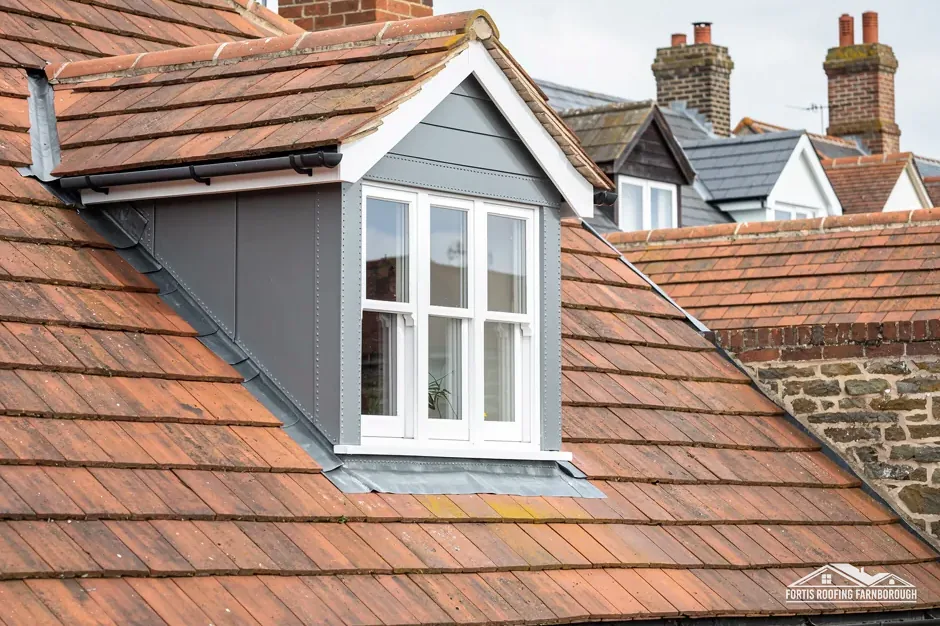
Surrey Heath's appraisal notes red-brick Victorian and Edwardian villas, some with decorative tile-hanging.
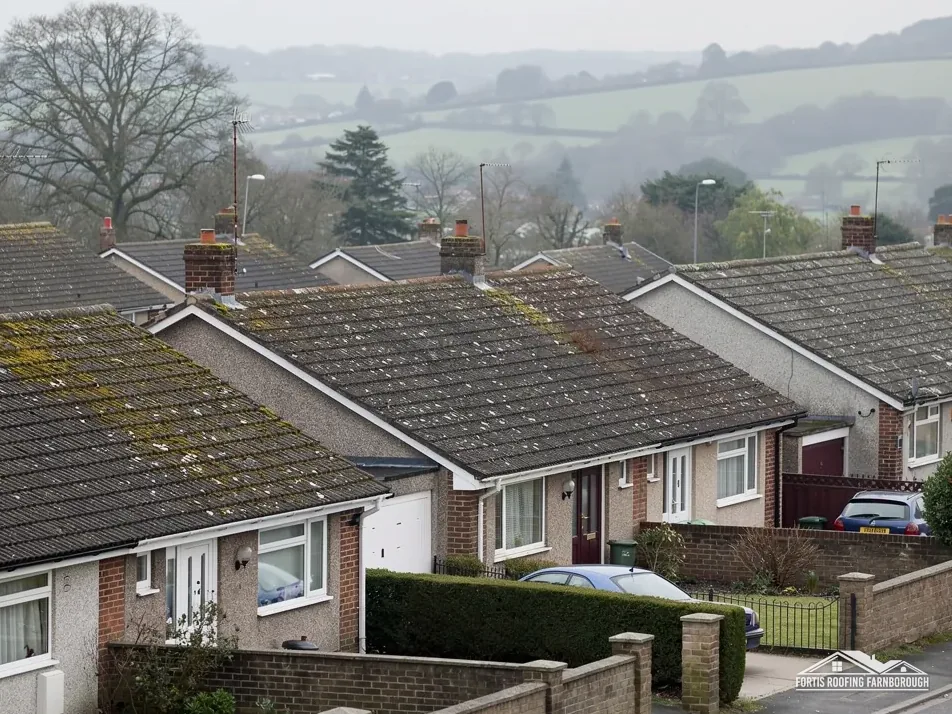
Roofs from the Cambridge Town grid to Upper Gordon Road's villas
Camberley began as Cambridge Town beside the Royal Military College, on heath sold in large plots. Each roof is inspected, photographed and quoted once in writing.
Surrey Heath's appraisal notes red-brick Victorian and Edwardian villas, some with decorative tile-hanging.
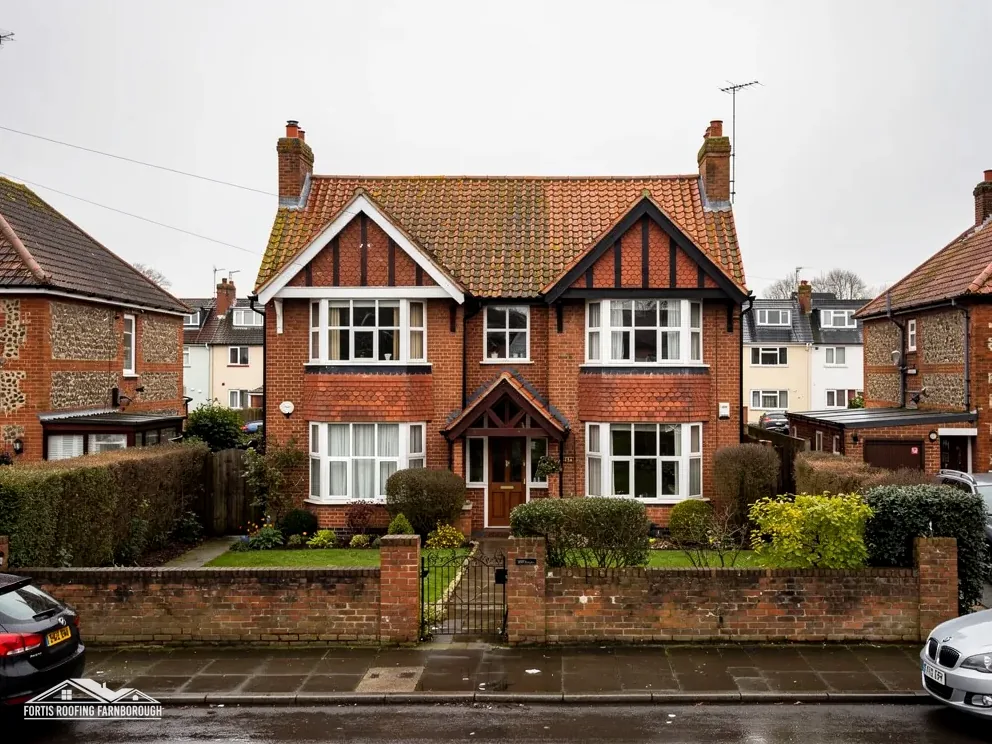
Landowners sold the heath as very large plots, which produced large Victorian houses in wooded grounds.

Fifteen listed buildings stand within 900 m of the centre, including the Memorial Cross.
Map of Camberley with Sandhurst, Blackwater, Hawley, Owlsmoor, Farnborough marked around it.
Map data © OpenStreetMap contributors. Loads only when you ask for it.
Sandhurst lies to the west, Blackwater and Hawley to the south-west, Owlsmoor to the north-west, Frimley to the south, and Heatherside to the south-east.
About 3.5 road miles north of Farnborough · Surrey Heath Borough Council and Surrey County Council.
Camberley, college and villas
How a military college shaped Camberley's grid and its large plots, what Surrey Heath's appraisal records about the Upper Gordon Road villas, and which listings, inspectors and scaffold terms apply to a job here.

| No. | Chapter | The figure it turns on |
|---|---|---|
| 01 | From York Town to Cambridge Town to Camberley | College 1812; Staff College 1862; rail 1878 |
| 02 | Plain clay tile, tile-hanging and 7-hectare plots | Semis of 1897-98; plots of about 7 hectares |
| 03 | Listings, SHBCC and scaffold in Surrey Heath's main town | 15 listed buildings; two conservation areas |
Chapter 01 of 03
Camberley's early dates from the published record
The Victoria County History of 1911 says York Town grew up near the Royal Military College after its move to Sandhurst in 1812, and that the extension built after the Staff College opened in 1862 was first called Cambridge Town, then renamed Camberley for postal convenience. Surrey Heath's town centre masterplan describes the centre as a place planned to serve the college, with a regular grid structure that shows the influence of military planning. A rail link to London followed in 1878, and the 2021 Census counted 36,783 people in the built-up area.
A town laid out on a grid by planners has long straight streets, and a long straight street tends to have many houses of similar age and layout. That is helpful to a roofer only up to a point. Within a street the roofs have been repaired at different times by different owners, and the evidence differs from house to house. We therefore treat a neighbour's roof as a clue and never as a substitute for looking at yours.
Camberley is Surrey Heath's main town, with 36,783 people counted at the 2021 Census, and the range of buildings that house and serve them is wide: villas, terraces, flats above shops, offices and outbuildings. Each has a different covering and different weak points. We climb the roof with a tape and a camera, follow the ridge and every valley, probe a few fixings on each slope and record what we find in a report organised slope by slope.
Our pitched roofing page explains how tiled and slated roofs are repaired, and our flat roofing page explains the coverings found on shops, extensions and garages. If a repair is enough, that is the quote, and the pictures demonstrate it.
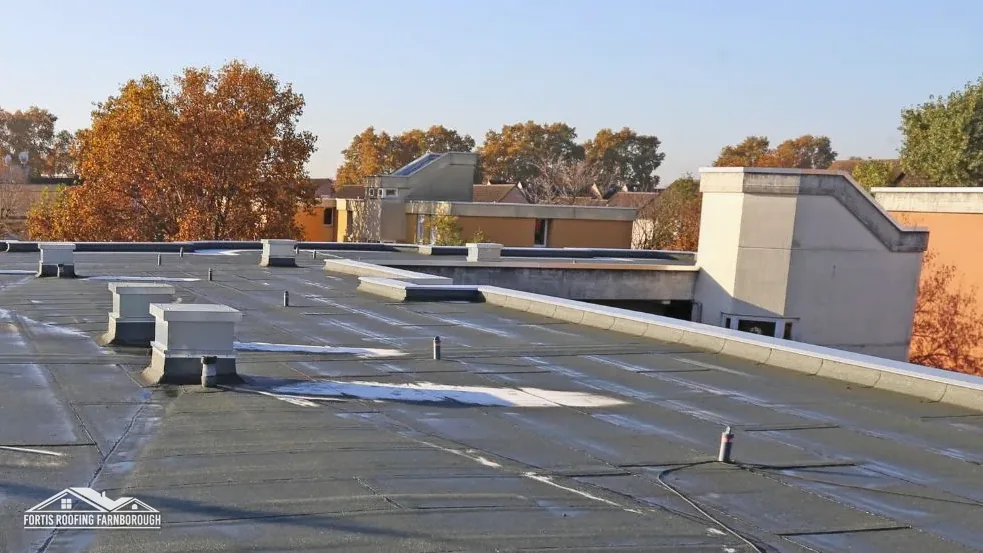
Shops and offices in a town centre often have flat roofs hidden behind parapets, and those are the roofs most easily forgotten. On them we look at drainage first: outlets, gutters behind the parapet, upstands where the roof meets a wall, and any ponding after rain. Where access is awkward the report notes it and explains how the roof was reached, so the evidence is credible to whoever reads it.
Chapter 02 of 03
| Feature | Surrey Heath's record | What we record on a repair |
|---|---|---|
| Houses | Red-brick Victorian and Edwardian villas | Brickwork, eaves and chimneys photographed |
| Semi-detached houses | Built 1897-98 with plain dark clay tile roofs | Tile colour, size and texture |
| Wall finish | Decorative tile-hanging | Hanging tiles beside roof junctions |
| Plots | Heath sold in plots of often around 7 hectares | Large houses with long roof runs |
| Conservation area | Upper Gordon Road to Church Hill, October 1989 | Check your address with Surrey Heath |

Surrey Heath's appraisal notes a high proportion of red-brick Victorian and Edwardian villas around Upper Gordon Road, among them semi-detached houses of 1897-98 with plain dark clay tile roofs and decorative tile-hanging. That is a description of specific houses in a named area, and we use it that way. The council's character document adds that 19th-century landowners sold the heath as very large building plots, often around 7 hectares, which produced large Victorian houses in wooded grounds.
For a roof of plain clay tiles, a repair is a matching exercise. Plain tiles are small and laid in overlapping courses, so a few failed tiles can be replaced without disturbing the rest, but only if the replacements match in colour, size, thickness and camber. We photograph the existing tiles, keep every sound one for re-use, and hold a sample against the roof before ordering. A mismatched patch shows from the road and weathers differently from its neighbours.
Old plain-tile roofs hang each tile by a pair of nibs on a batten, with a nail or two to hold it. Where the nails have rusted or the nibs have snapped, tiles slip. We test each course by hand, count the tiles that need replacing and put the number in the report. A count is better than an estimate, and it is what makes a repair price precise.
Tile-hanging is part of the same job. Hanging tiles on a wall meet the roof at a junction, and that junction, with its flashings and any lead soakers, is a common source of damp. We examine it from the roof and from the loft, and our chimney repairs page explains the stacks that often sit nearby.
Large plots mean large houses, with long roof runs, several chimneys, perhaps a conservatory or an annexe. A big roof calls for careful measurement, and a big roof calls for honest advice about whether to repair it in stages or in one go. We set out both options with the photographs behind them. Surrey Heath designated the Upper Gordon Road to Church Hill conservation area in October 1989, first as Upper Gordon Road and Upper Park Road. The boundary is checked for every address, with the result noted in the report.
Chapter 03 of 03
Four facts for a Camberley roof job
Camberley has two of Surrey Heath's nine conservation areas: Upper Gordon Road to Church Hill, and the former Staff College on London Road, which the national dataset names Royal Military Academy. Fifteen listed buildings stand within 900 m of the centre, including the Camberley Memorial Cross, the entrance lodges to the Royal Military Academy and a lamp post near the Staff College, all Grade II. Work that alters the character of any of them needs listed building consent, which is one reason we record details before touching anything near a listed boundary. The Church of St Tarcisius is also Grade II. Being a Roman Catholic church in use, it sits under the ecclesiastical exemption, so its roof follows the Catholic Church's own consents, not listed building consent.
Surrey Heath's building control is provided by the Surrey Heath Building Control Consultancy, SHBCC, with a registered building control approver as the private route. A few tiles refixed need neither. Two Planning Portal limits govern re-roofing: 25 per cent of the building envelope and 50 per cent of the roof. A covering that weighs 15 per cent more than the old adds approval and a structural check. For a flat roof, Approved Document L treats replacing the waterproof membrane as renovation, which brings insulation standards into the job.
Surrey County Council is the licensing body for scaffold on Camberley's roads. Its fee is £208 per 28-day period and it wants 10 working days between application and start, which matters on a main road where space is tight. The council leaves the applicant unnamed, so we sort out the licence with the scaffolder and put the dates in writing. On 1 April 2027 West Surrey Council replaces the county and Surrey Heath, and we say who to contact if a job crosses that date.
Surrey Heath's appraisal notes decorative tile-hanging on houses there, so on your own house we photograph what is on the walls, keep sound tiles for re-use and hold samples against them before ordering. If your house is inside the conservation area, Surrey Heath's planning team is asked before any different material is considered.
No. It is listed Grade II but in use as a Roman Catholic church, so the ecclesiastical exemption applies and roof work follows the Catholic Church's own approval system. Listed building consent is the route for other listed buildings such as the Memorial Cross or the entrance lodges, and a neighbouring unlisted house falls outside all of them.
Surrey Heath has nine conservation areas, and two are in Camberley: Upper Gordon Road to Church Hill, and the former Staff College on London Road. Surrey Heath's map shows the lines. We check each Camberley address before quoting for a new covering, ridge or stack, and what we find is recorded in your report.
Surrey County Council charges £208 per 28-day period for scaffold on its roads and wants at least 10 working days of notice. Who makes the application is left open there, so we agree the licence with our scaffolder and the dates reach you in writing. Scaffold wholly inside your boundary falls outside the scheme.
Get your free roof quote
Give us your Camberley road and the fault you can see. We arrange the survey, then quote once in writing.
10-year workmanship guarantee, in writing.