Houses of the railway boom
The county history of 1911 says the railway had transformed the parish within about sixty years.

Roofs in a railway town of terraces, flats and Maybury churches
Woking was remade by the railway after 1838, and its roofs range from terraces to a Grade I mosque. We survey each building on what we find up the ladder.
The county history of 1911 says the railway had transformed the parish within about sixty years.
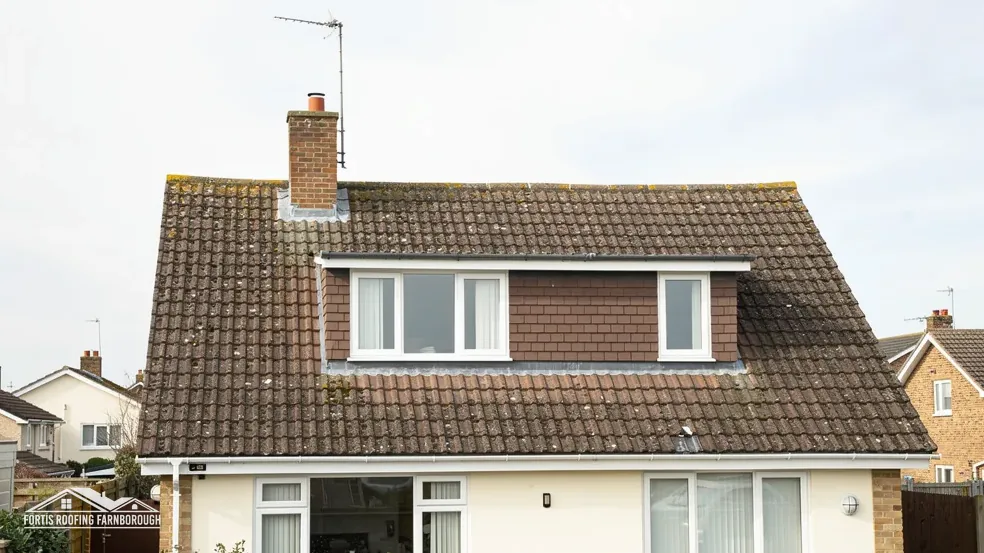
Christ Church was built in red brick in 1889, and St Paul's, Maybury Hill, in 1895 with Bath stone windows and quoins.
Woking has 75,666 residents, and its flats have no permitted development rights.
Map of Woking with Horsell, Old Woking, St John's, Mayford marked around it.
Map data © OpenStreetMap contributors. Loads only when you ask for it.
Woking is a railway town on the Bagshot sand heaths of north-west Surrey, beside the Basingstoke Canal, with Farnborough 14.4 road miles west of it.
About 14.4 road miles east of Farnborough · Woking Borough Council and Surrey County Council.
Woking, rails, churches and mosque
Which bodies decide a Woking roof job, how the railway of 1838 and its branch of 1845 built the town, and what the Grade I mosque, Christ Church and the town's conservation areas mean for repairs.
| No. | Chapter | The figure it turns on |
|---|---|---|
| 01 | Woking Borough Council and Surrey's highways | Woking inspects, Surrey licenses poles |
| 02 | The railway that remade a parish | Main line opened in 1838 |
| 03 | A Grade I mosque, Christ Church and conservation areas | Shah Jahan Mosque, Grade I |
Chapter 01 of 03
| Question | Answered by |
|---|---|
| Does the work need planning permission? | Woking Borough Council |
| Does it need building control? | Woking Borough Council's own service |
| May scaffold stand on the pavement? | Surrey County Council, until 31 March 2027 |
| What is the population? | 75,666 in the built-up area (Census 2021) |
| How far from Farnborough? | 14.4 road miles east, measured from the A325 |
At the 2021 Census Woking counted 75,666 people. Planning and an in-house building control team are the work of Woking Borough Council, while Surrey County Council keeps the highway licences until 31 March 2027; from 1 April that year both roles pass to West Surrey Council. Farnborough is 14.4 road miles to the west, taking the A325 as our starting line.
Under the planning order a flat is not a dwellinghouse, which leaves it with no permitted development rights, and anything beyond a straight like-for-like repair may call for planning permission. That matters in a town with many blocks. A house is different, since a plain re-covering is normally permitted. Whether you own a flat or a house, we check your position before the survey and tell you.
Woking's own guidance gives no re-roofing percentage. We steer by the Planning Portal instead, whose limits are 25 per cent of the envelope and 50 per cent of the roof, with a heavier covering as an independent test. Under both, no application is usual; a covering 15 per cent heavier calls for one.
Before choosing a roofer, ask each what the price assumes about scaffold, VAT and carting away the old covering. In a town the third is not trivial: tiles and slates are heavy, and a skip or a lorry on a street needs space to stand. A figure that skips those details will grow once work begins, so ours states them in one total.
Surrey's licence is the thing to know if scaffold must stand on a public footway: £208 per 28-day period until April 2027, the same on renewal, with applications wanted 10 working days ahead and processed within 10 days. A block of flats or a terrace facing the street usually has no choice but to use the footway, so the licence is part of the plan. Nothing on the council's page names the sender of the form, so we ask the scaffolder and agree the answer before booking.
Commercial buildings and blocks bring their own questions about access, signage and pedestrian routes, and we raise those at the first call. A town-centre roof also needs a safe route up, for ladders, materials and waste, and we plan that with the managing agent or owner.
Chapter 02 of 03
Woking's railway-era dates
The 1911 county history said that in about sixty years the Woking parish had been entirely transformed by the railway. The main line opened in 1838, and the branch to Guildford from Woking Junction followed in 1845. By 1911 what little open land was left about Woking Heath was being covered rapidly with houses. In other words, Woking is a town whose building stock arrived in waves, each set off by the trains.
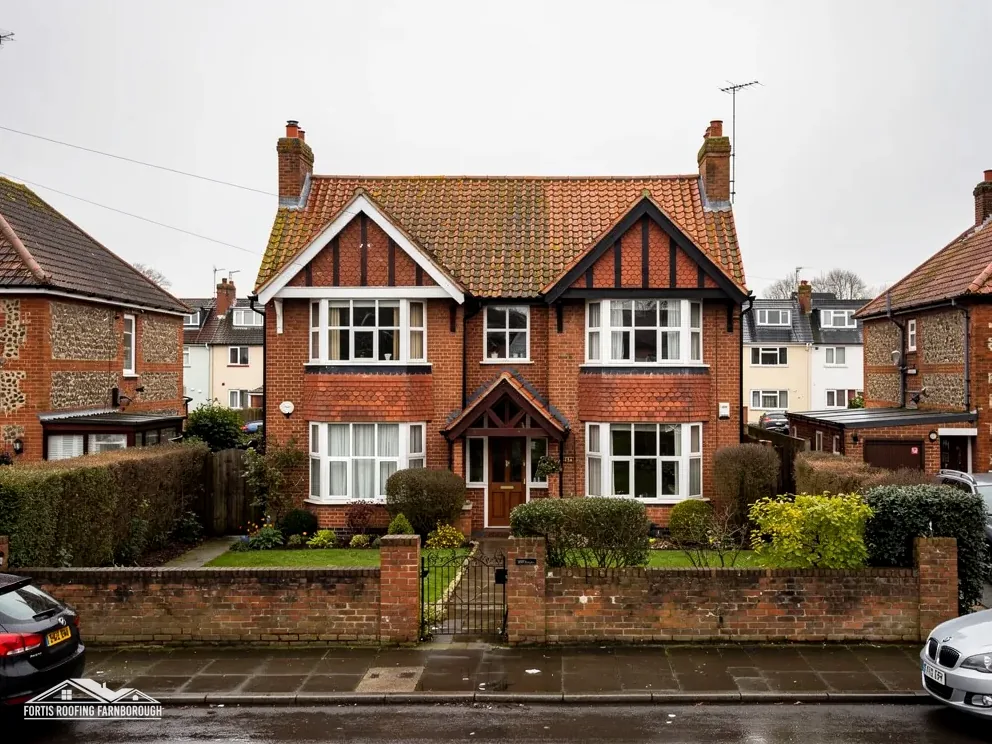
The same history records the Mosque at Maybury, built in 1889 beside buildings that opened in 1865 as a Dramatic College and became the Oriental Institute in 1886. Christ Church was built in red brick in 1889, and St Paul's, Maybury Hill, in red brick with Bath stone windows and quoins in 1895. So a Woking roof can be a Victorian church roof, a late-Victorian terrace or a recent block, all within a short walk.
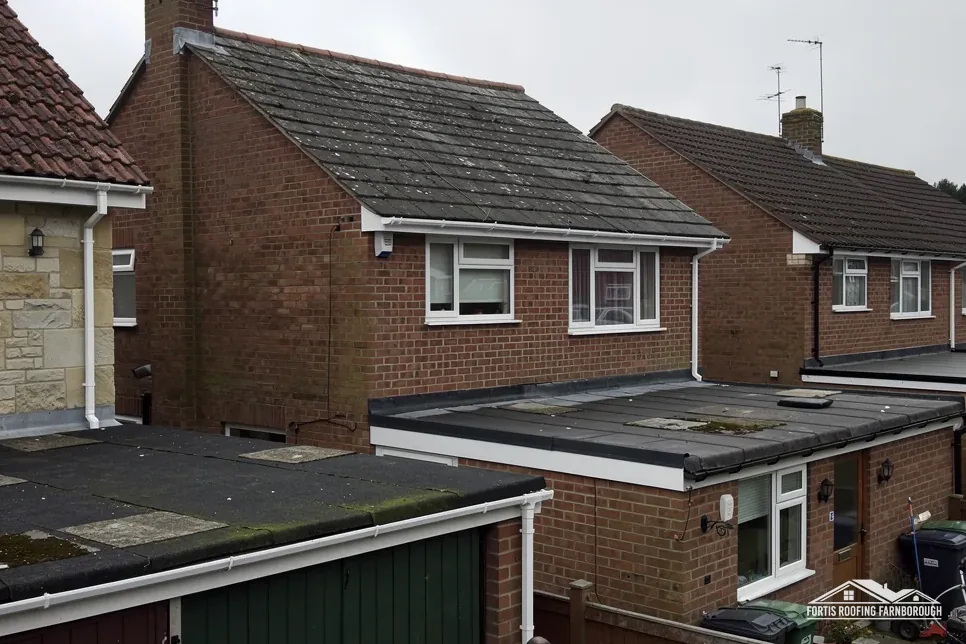
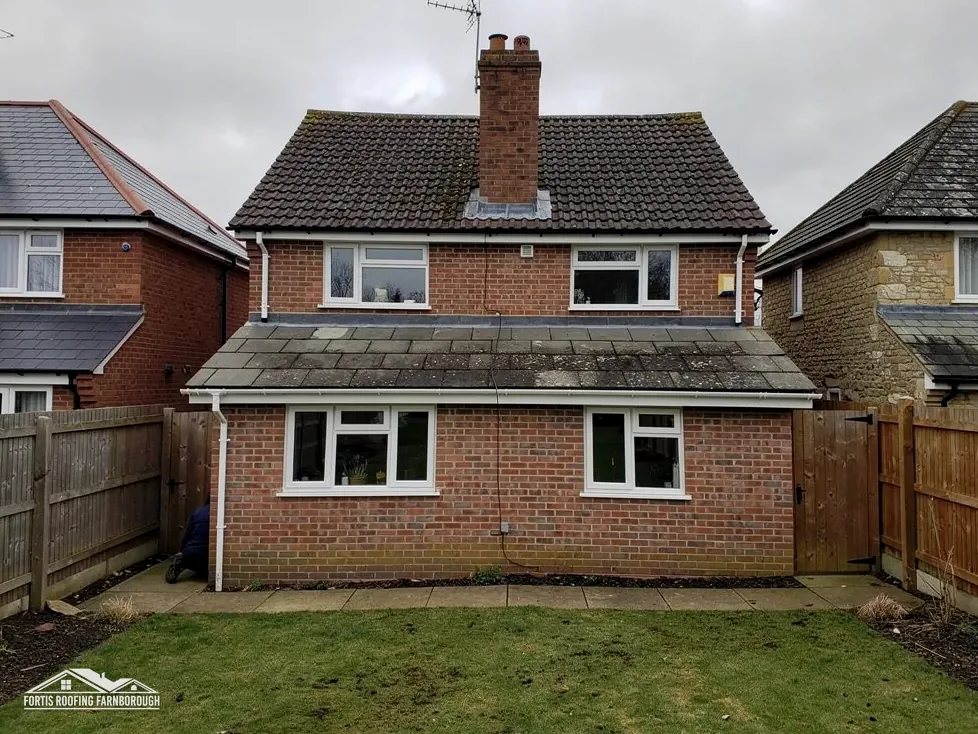
For a roofer, the lesson of a railway town is variety, and variety rules out shortcuts. A Victorian terrace may have a slate or tile roof that is a century old, with lead valleys and soakers that are failing. A 1930s semi has hips and ridges of mortar that have weathered. A modern block may have a flat roof with an outlet that has silted up. We survey each for its own faults and photograph them.
The Dramatic College of 1865 and the Oriental Institute that followed it were extensive buildings, in the county history's word. A large institutional roof has a lot of lead and a lot of joints, and an owner or agent needs a clear schedule of defects with photographs, which is what we write after a survey.
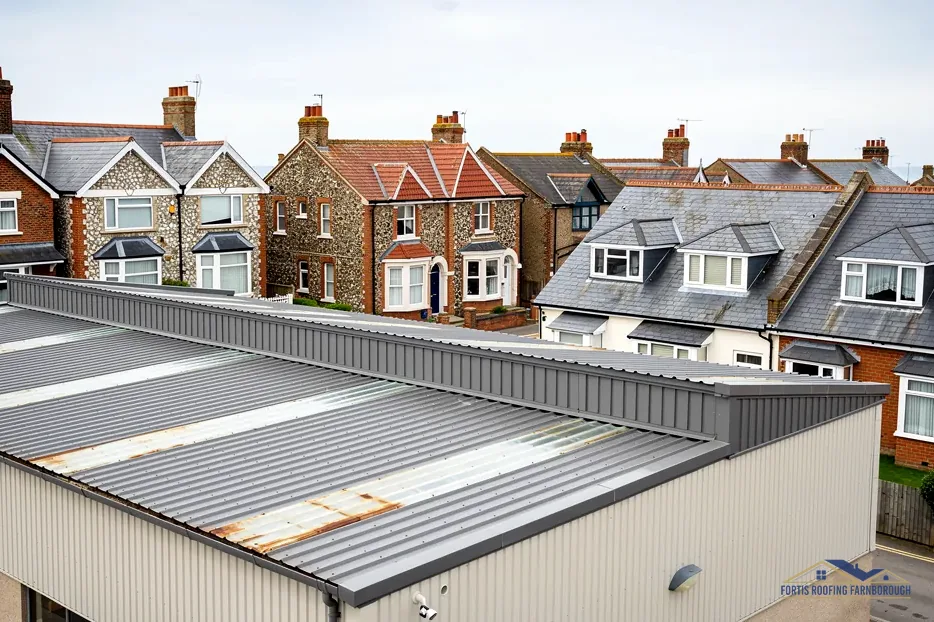
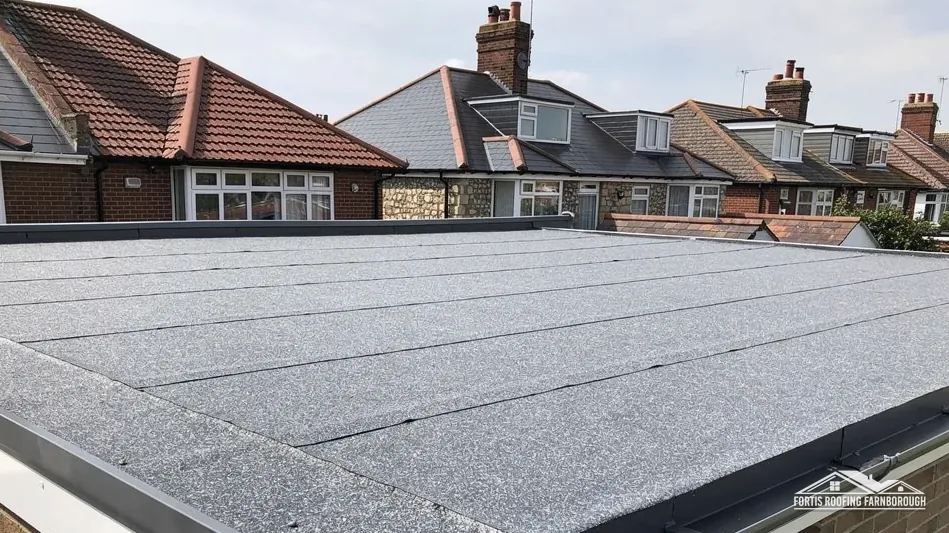
Flat roofs are especially common in a town centre, over shops, extensions and garages. They need a close look at the membrane, the upstands and the outlets, and BS 6229:2025 sets a minimum finished fall of 1:80 for flexible-membrane roofs. We measure fall with a level, not by eye. Our flat roofing page explains how those roofs are checked and renewed.
Whatever a building's date, we name its covering from the roof itself, and the price comes afterwards.
Chapter 03 of 03
| Designation | In Woking | For roof work |
|---|---|---|
| Grade I listed | Shah Jahan Mosque (NHLE 1264438) | Listed building consent |
| Grade II listed | Christ Church (NHLE 1236299), a Church of England church | Faculty system |
| Conservation areas | Woking Town Centre; Ashwood Road and Heathside Park Road; The Hockering | Check Woking's map |
| Conservation area | Basingstoke Canal | Check Woking's map |
Woking has a remarkable listed building for a Surrey town: the Shah Jahan Mosque, listed Grade I. Its faith has no ecclesiastical exemption, so Woking Borough Council's listed building consent applies wherever work would affect its special character, and to its entrance gate piers, which are listed Grade II. Christ Church is a Grade II listed Anglican church, and for its roof the faculty system stands in for the council's consent.
The national dataset names conservation areas at Woking Town Centre, Ashwood Road and Heathside Park Road, The Hockering and the Basingstoke Canal, with Wheatsheaf, Horsell, close by. Woking says it has 27 conservation areas across the borough, so many addresses are inside one. We check the council's map for yours before the survey. Inside a conservation area, repair is normal, and the point to watch is any change of appearance.
Whether an Article 4 direction reaches your street is a question for Woking Borough Council, and we put it to them before quoting for anything that changes how the roof looks.
Seven listed buildings stand within 900 m of the town's centre, among them Ramwick Cottage. A roofer in a town like this meets listed buildings often, and the routine is constant: photographs, measurements and a clear description of what is proposed, in the form the council expects.
A house or block that is unlisted and outside the areas is simply a repair job, with whatever approvals the work calls for. Our commercial roofing page explains how shop, office and block roofs are surveyed and renewed, which suits Woking's town-centre buildings.
Woking's canal-side and town-centre conservation areas have different needs. Near the Basingstoke Canal the roofs are seen across water and along a towpath, so ridge lines and chimney stacks form part of the view. In the town centre the roofs are seen from above, by neighbours in taller buildings, and a patchwork repair shows. We keep both audiences in mind when we match a repair.
Two listed places
St Paul's, with its Bath stone windows and quoins, is a reminder that stone details meet roofs at lead flashings, and those flashings are where a church roof most often leaks. We photograph abutments, parapets and gutters close up, because a record is the first thing any consent route asks for.
If you are unsure whether your building is listed or in an area, send the address. The national list and the council's map answer both questions before we visit.
Standing water for more than a day or two points to too little fall or a blocked outlet, and often to a membrane that is starting to fail. BS 6229:2025 sets a minimum finished fall of 1:80. A level, a hose test on the outlets and close photographs of the surface let us advise between repair and renewal.
Because a flat has no permitted development rights, planning permission is needed for works other than like-for-like repairs, or ones that alter the building's look. If you are a leaseholder, your freeholder or managing agent is normally responsible for the roof as well. We can survey and report, then you decide who acts.
Surrey County Council charges £208 for each 28-day period on public highway, until April 2027, and renewal costs the same. It asks for 10 working days of notice and processes applications within 10 days. Surrey's page leaves the applicant unnamed, so the scaffolder is the one to ask. A scaffold kept on private land stays outside the licence.
The Grade I mosque belongs to a faith with no ecclesiastical exemption, so listed building consent from Woking Borough Council covers work that would affect its character. That consent route also applies to its Grade II entrance gate piers. Anyone commissioning work should start from a careful photographic record of the roof as it stands.
Get your free roof quote
Tell us your Woking street and the problem you have seen, indoors or out, and a surveyor will call.
10-year workmanship guarantee, in writing.