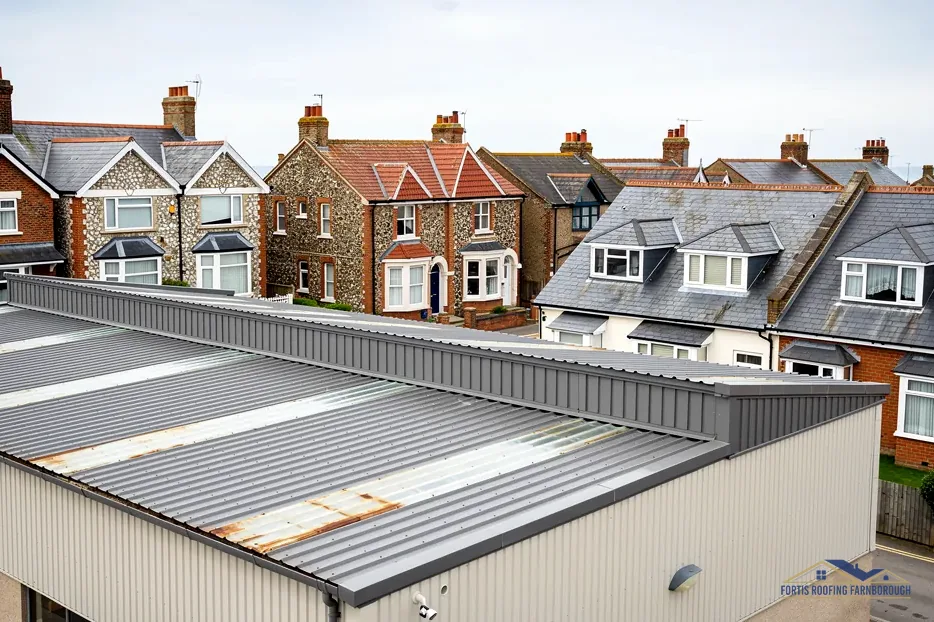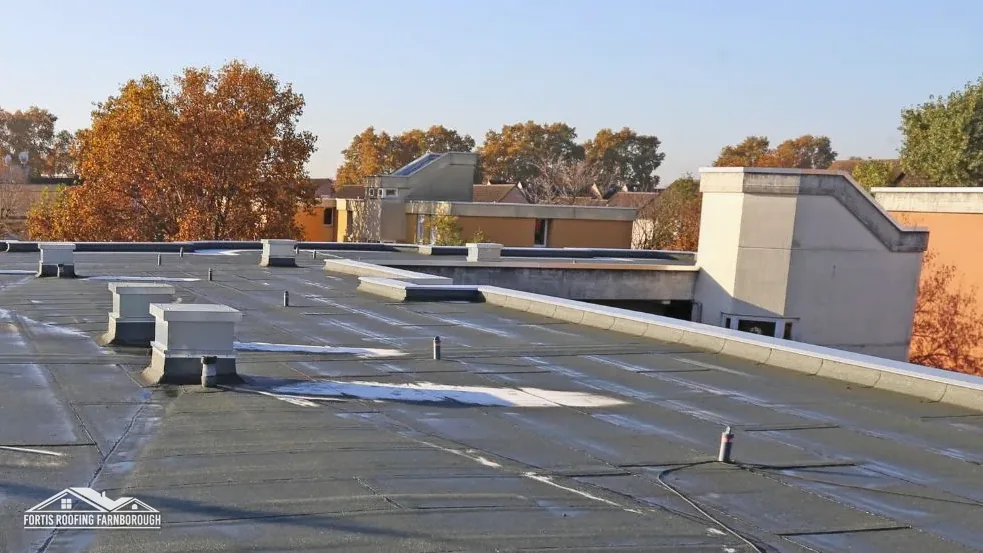
Commercial roofs are rarely looked at until water comes through, and by then the question is no longer whether to act but how fast. A flat roof over a stockroom, a profiled metal roof on a warehouse or a parapet gutter above a shop can go for years without anyone checking it, and then fail on a wet weekend with stock below. By that point, the repair is urgent, the roof is hard to reach and the bill is larger than it needed to be.
Planned maintenance reverses the pattern. A roofer visits on a regular schedule, checks the covering, the drainage and the details, clears what has built up, deals with small faults and reports in writing with photographs. The owner learns about problems while they are small, and the file of dated reports shows how the roof has aged.
This guide explains how often a commercial roof should be looked at, what a visit covers, why gutters and outlets get so much attention, what a photo report should contain, how safe access is arranged and what a plan means for the owner under CDM 2015. It does not give prices, because the cost of a plan depends on the roof, and a figure from a general guide would mislead. Instead, it shows what to look for when you compare proposals.
What a maintenance visit covers
A visit is a systematic inspection of every part of the roof, followed by the work that can be done on the spot.
The covering
The inspector walks the roof where it is safe, or uses a camera drone or ladder access where it is not, and looks for splits, blisters, lifted laps, punctures, worn areas and signs of ponding. On a metal or fibre-cement roof, the focus moves to fixings, sheet laps, corrosion at cut edges and cracks.
The edges and details
Parapets, copings, upstands, flashings, roof lights, vents, pipes and cable penetrations are checked one by one, with a photograph of each, because a detail that has opened by a few millimetres can let in a surprising volume of water. These details fail before the main surface does, and they are where leaks so often begin.
Drainage
Outlets, gutters, downpipes and overflows are checked, cleared and tested. This is the single most valuable part of a visit, and the next section explains why.
Plant and equipment
Air-conditioning units, extract fans, solar panels and aerials stand on the roof or pass through it. Their bases, fixings and cable routes are checked, and any damage to the covering around them is recorded.
Small repairs
Minor faults, such as a loose flashing, a failed sealant joint or a split in a seam, are dealt with on the day where the access allows, so the owner is not billed for a second visit to do a ten-minute job. Larger defects are reported with a recommendation.
Record and recommendation
The visit ends with a report. Planned maintenance puts the report at its centre, because the record is what lets an owner plan and budget.
How often should a commercial roof be inspected
There is no single legal interval for roof inspections, and the right rhythm depends on the roof. A few principles guide it.
A sensible baseline
For most commercial roofs, two planned visits a year work well: one in spring, after the winter, and one in autumn, before leaf fall and the wet months. The autumn visit is the one that prevents blocked gutters from becoming a winter problem.
After severe weather
A roof should also be looked at after any major storm, hail or heavy snow, and after work by other trades on or near the roof. A plant engineer who has been on the roof can damage a membrane without knowing it.
Older and higher-risk roofs
An ageing roof, a roof with a history of leaks, a roof over a sensitive use such as a data room or food store and a roof with many penetrations each deserve more frequent attention. An asbestos-cement roof, which is always fragile, needs particular care about who goes on it.
New roofs
A newly completed roof benefits from an early check, to catch settlement or workmanship issues while the contractor is still engaged, and again after its first full winter.
Adjusting the plan
The first year of reports shows what the roof needs. If every visit finds blocked outlets under a tree, a mid-season clear is worth adding. If the roof is stable, the rhythm can stay as it is. Our answer on commercial roof condition surveys explains the one-off alternative.
Gutters, outlets and the water path
Drainage is the heart of commercial roof maintenance. Water that cannot leave a roof will find another way out, and it is usually through the building.
Why outlets block
Leaves, moss, silt, bird droppings, litter and fragments of membrane or insulation collect at outlets and in gutters. A blocked outlet causes ponding, and ponding adds load, speeds ageing and can overload a roof that was not designed to carry standing water.
Falls and ponding
BS 6229:2025 keeps a minimum finished fall of 1:80 for general areas and internal gutters on flexible-membrane roofs. A roof that holds water after heavy rain has a fault: either the outlet is blocked or the falls have been lost through movement. Maintenance records show which, and whether it is getting worse.
Gutters and downpipes
Brett Martin gives a guide of 1 mm of fall for every 600 mm of rainwater gutter. Joints leak, brackets loosen and gutters sag. Parapet and valley gutters carry the most water and give the most serious leaks when they fail. Our answer on commercial gutter lining covers a repair option.
Overflows
An overflow outlet gives warning of a blocked main outlet. It should be kept clear, and any discharge noted as a sign that the main drain is struggling.
Testing
Where safe, water is run to check that outlets drain freely, and the result is photographed, so a slow outlet is found before it blocks.
Cost of neglect
A cleared outlet is a small job. A flooded stockroom is not.
Photo reports and records that help later
A maintenance plan is only as useful as the record it leaves. The report is the product, and a good one is easy to read.
What a report contains
- The date, the roof or section inspected, the weather and who attended.
- Photographs of each part checked, and close-ups of every defect, with a note of where it is.
- A plan or sketch marking the locations.
- A short description of each finding, in plain words.
- What was done on the day, such as cleaning an outlet or re-sealing a joint.
- Recommendations, in order of urgency, with notes on what happens if each is left.
Why photographs matter
A picture of a split seam in March, compared with one in September, shows how fast it is growing. A report that says only 'roof in fair condition' tells you nothing.
A running history
Over several years, the reports become a history of the roof, with dates of repairs and the condition at each visit. That helps in budgeting, in negotiations with a landlord or tenant and in discussions with insurers, since a record of maintenance shows the roof has been cared for.
Warranty and lease
A new roof's warranty may require evidence of regular maintenance, and a lease may place maintenance duties on the tenant. The reports supply the evidence in each case.
Who keeps it
The owner or managing agent should hold the file, and the contractor should keep a copy, so that nothing is lost when a manager leaves or a contract changes hands. Our approach on commercial roofs is to survey, photograph and explain, so the report follows the same pattern.
Safe access and the owner's duties
Maintenance means people on roofs, and roofs are dangerous. Planning access is part of the service, and it brings duties for the owner.
Fragile surfaces
HSE guidance A14 treats asbestos-cement roofing as fragile in every case. Roof lights and old or corroded sheets can also be fragile. Any plan needs to identify these and set out how people will avoid them, using crawling boards, covers, barriers or alternative access.
Edges and access routes
Where there is no parapet, edge protection or restraint systems are needed. Permanent access, such as a fixed ladder with a safety cage, a walkway or a hatch with guard rails, reduces risk on every visit. Our guide on fragile roof safety sets out the issues.
CDM 2015 and maintenance
Maintenance and repair are construction work under CDM 2015. A single roofing contractor writes the construction phase plan alone. When several contractors share the project, the client has to name a principal designer along with a principal contractor. A planned maintenance contract usually has a single roofing contractor, so a short plan for the work is the norm.
Other trades on the roof
Plant engineers, solar installers and aerial riggers all use the roof. The owner should control who goes up, require them to report any damage and keep a log of access. A permit-to-work system is common.
Information for contractors
Give any contractor the previous reports, any asbestos register, the layout of fragile areas and the access arrangements before they set foot on the roof, and keep a signed record that they received them.
What to look for in a maintenance proposal
When you compare proposals, the headline fee tells you little. The scope behind it matters more.
Scope
- How many visits a year, and what triggers extra ones?
- Which parts of the roof are inspected, and how?
- What cleaning is included, such as outlets, gutters and moss?
- What small repairs are done on the day, and what is the limit?
- How are larger defects reported, and how is a quote for them given?
Reporting
Do you receive a written report with photographs after each visit? Is it dated and mapped to the roof? Can you see a sample?
Access and safety
What access will be used, and who supplies it? Is a plan prepared for the work, and will the contractor identify fragile areas?
Response
What happens if a leak occurs between visits? Stopping water getting in comes first, and the contract should say how a call is handled.
How the price is set
The cost of a plan depends on the roof's size, type, access and condition, and the number of visits. After a survey, we give one total written price for a plan we agree. Prices are good and fair, and we explain what is in them. Our commercial roofing page lists the related work we do.
Starting point
The first step is usually a baseline survey, which sets the condition of the roof and shapes the plan, with a photograph of every part to compare against later visits.