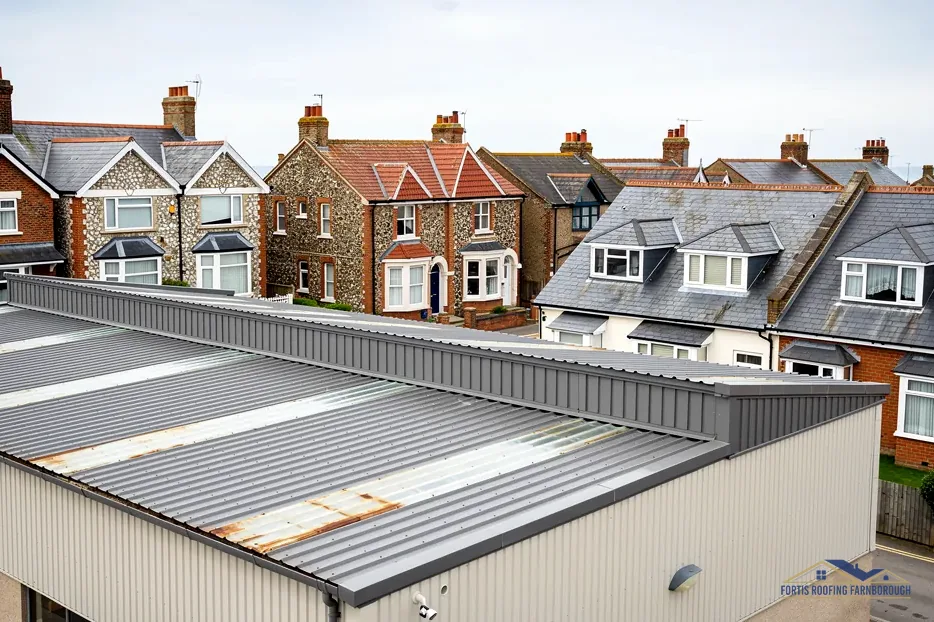
The short answer
Fibre cement roof sheets are corrugated cement boards used on industrial units, garages and farm buildings. Sheets made before asbestos was banned often contain it, and HSE's presumption is that anything built or refurbished before 2000 holds asbestos until a survey clears it. Roofs of this kind are classed as fragile in every case, so walking on one needs proper access.
What the sheets are and why age matters
Fibre cement roofing is made by mixing cement with reinforcing fibres and forming it into sheets, often with a corrugated profile. The sheets are light, cheap and durable, and for decades they covered garages, sheds, warehouses, schools and farm buildings.
The fibres in older sheets were asbestos, and that is the heart of the matter. Asbestos cement was a standard roofing product, and many roofs of that type are still in service. Modern sheets use other reinforcing fibres and carry no such risk, but nobody can tell the two apart by looking.
HSE's presumption is therefore based on age. A property constructed or refurbished before 2000 counts as asbestos-bearing until a survey clears it. A sheet roof on a 1980s unit is handled as asbestos cement from the outset, and only a survey and laboratory test can show otherwise.
Asbestos cement is not dangerous while it is intact and undisturbed. The risk arises when it is broken, drilled, cut, abraded or weathered to the point of shedding material, because that can release fibres. Our answer on asbestos surveys before roof work explains how identification is done.
HomeBuilding gives fibre cement tiles a typical life of "30-40 years", so older roofs are often past that range.
Why these roofs are fragile
Fibre cement sheets are brittle. They support their own weight across the purlins, but a person's weight concentrated on a small area can crack the sheet, and it then gives way. HSE classes roofs of asbestos cement as fragile in every case.
Weathering makes it worse. Over decades the surface roughens, moss and lichen grow, and the sheet becomes less strong, while the moss hides the surface and makes it slippery. A roof that looks solid from the ground may not carry anyone.
Rooflights are the other hazard. Plastic rooflights set into a sheet roof can be covered by dirt or paint, and they look like the sheets around them. A person who steps onto one can fall through to the floor below.
These facts shape every job. Anyone working on a fibre cement roof needs access that spreads load and prevents falls: crawling boards or staging, edge protection, a harness on a secure anchor, and a mobile platform or tower from below where possible. Our guide to fragile roof safety sets out the controls.
Do not climb on one to look at a leak or to clear moss. A fall through a fragile roof can be fatal, which is why access comes first.
Three routes for the owner
Once the roof is identified, the owner has three broad options, and the survey informs the choice.
Repair suits a roof in generally good order with a few damaged sheets or leaking laps. Individual sheets can be replaced, and seals and fixings renewed. If the sheets contain asbestos, handling them follows the asbestos rules, and breaking them up is notifiable work.
Overcladding fits a new sheet system over the old, leaving the asbestos undisturbed. It avoids removal, and the building can stay in use, but the structure must carry the extra weight and the old sheets must stay in good enough condition to support the new fixings. Our guide to an overclad asbestos roof covers the details and its limits.
Replacement strips the old roof and fits a new one. It gives a clean, fully renewed building, but removal of asbestos cement is controlled work, with costs for removal and waste.
Whichever route suits, the work is planned before it starts, with a survey, a method that takes account of the fragility and a clear view of who is responsible for the asbestos register.
You receive photographs of what we found and a written price for the option you choose. The commercial roofing hub lists related work.
Handling rules in brief
The rules for working with asbestos cement are set by HSE and they turn on method and condition.
On HSE's list, asbestos cement items, with roof sheeting and gutters as examples, fall into non-licensed work provided they are handled gently and lifted off unbroken. Weathered cement in otherwise sound condition is included.
Where sheets will be badly damaged or crushed during the job, the work moves into a further group, notifiable non-licensed work. Duties then include telling the authorities, medical surveillance for workers and health records kept for 40 years.
Insulating board containing asbestos, which can turn up in external soffits, is a separate material with a stricter regime. Work on it that will go beyond a short spell is licensable, and since it looks like harmless board, it is checked first.
The waste from any of this travels under a consignment note, double-wrapped and labelled. The route for waste is set out in our notes on asbestos waste disposal.
These rules are summarised for the owner's benefit. The duty holder for the building should take advice from a specialist before any work that could disturb a sheet.