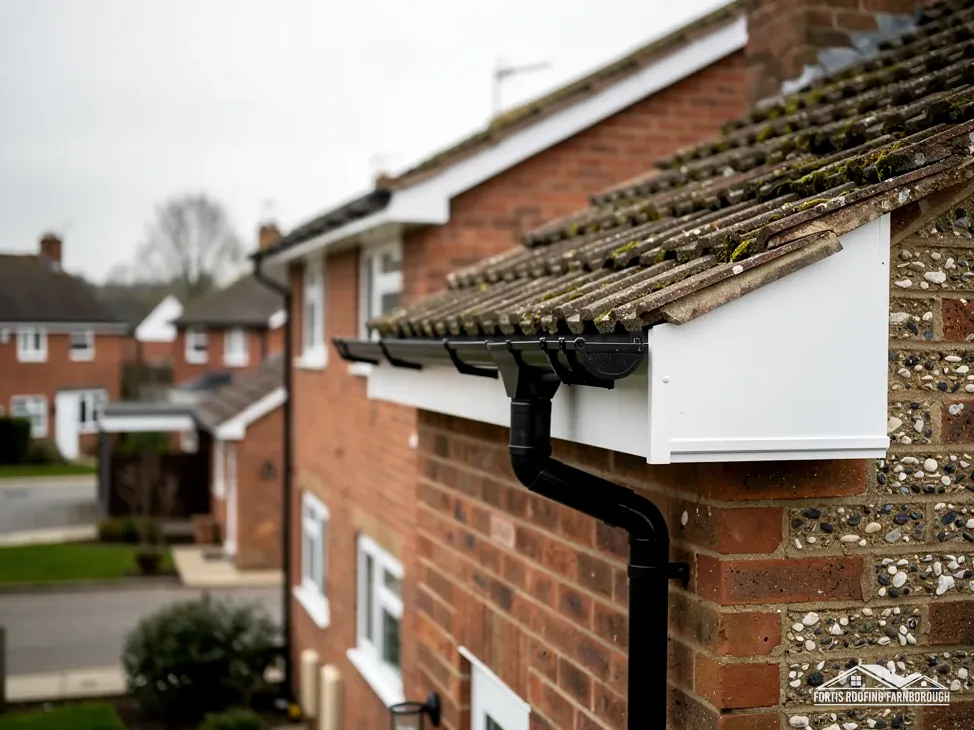
Fascia capping, also called over-cladding, means fitting new plastic covers over the existing fascia and soffit boards, rather than removing them. It leaves the old timber in place and wraps it in uPVC, so the front of the roof edge looks new and the paint-and-repaint cycle ends. Full replacement strips the old boards off and fixes new ones, usually in uPVC, to the rafter ends.
Both routes give a clean white or coloured finish, and from the ground the result can look much the same. The difference is what happens to the timber behind. Capping covers it, rot or not, and a board that was sound when it was capped will stay that way. A board that was already decaying will carry on, out of sight, and take the new cover and the gutter with it when the fixings go.
This guide sets out how each route works, what capping hides, how long uPVC fascia is said to last, the one published capping figure, the cases where capping is reasonable and the reasons a full replacement is usually the sounder buy. It is general information, and the right answer comes from looking at the boards.
What capping and replacement each involve
The two jobs look similar from the street but differ in almost everything the roofer does.
Capping
Capping fits plastic covers over the existing fascia, soffit and sometimes bargeboard. The old gutters come off, the covers are cut and fixed to the old timber with pins or screws, and the gutters go back. The existing boards stay where they are. It is quick because nothing is stripped, and it leaves the roof edge as it was behind the new surface.
Full replacement
Replacement removes the old fascia and soffit boards. With the boards gone, the rafter feet, the lower edge of the felt and the wall plate are all open to inspection and repair. New boards go on, an eaves protection tray is fitted, ventilation is provided and the gutters are re-hung. It takes longer and costs more, but the work is done on sound timber, with the roof edge understood and protected.
The part you cannot see
In both cases the outcome you see is a new uPVC finish. What differs is the condition of everything behind it. Replacement puts you in a position to find out. Capping leaves you guessing, or hoping.
Our guide to the eaves protection system explains why the roof edge is worth checking when it is open. Capping rules that check out, because nothing is open.
Our survey looks at the boards from a ladder, prods the timber at spots we can reach safely, and photographs the condition, so the choice between routes rests on evidence.
What capping can hide
The strongest argument against capping over old boards is that you cannot see through it. A plastic cover is opaque, and what is under it is wood that has been damp in the past, and may still be.
Rot behind the cover
Fascias rot because water runs behind them, from failed eaves felt, overflowing gutters or leaking joints. If a board is already soft, a plastic skin does not dry it out, and it may keep it damp. Rot spreads along the board and into the rafter ends. You will not see it until the cover moves, stains or the gutter sags.
Failed fixings
New covers are fixed into old timber. If the timber is soft, the fixings pull out, and the cover begins to lift or the gutter drops. The brackets that carry the gutter are fixed through the cover into the board beneath, and if that board is decayed, they have nothing to hold.
Pests and moisture
Birds and insects can use gaps in soffits and eaves. A capped soffit may still have holes behind the cover, and our answer on birds nesting in soffits explains the legal position on nests, which turns on the word intentionally in the Wildlife and Countryside Act 1981.
Underlay and rafters
The roofer cannot check the end of the underlay, the rafter feet or the wall plate through a cover. The cause of the original rot, if any, remains, and it carries on working while the new surface looks perfect. A gutter that overflows onto a capped board will, in time, find its way behind the cover too.
A fascia that is cosmetically tired but structurally sound is the one case where capping over it is a fair choice. The survey tells us whether yours is that case.
How long uPVC fascia lasts
Published lifespans for uPVC fascia come mostly from suppliers, who are interested parties, so they should be read as a rough guide rather than a measure. Plastic Centre, a retailer, puts the life of uPVC fascia boards at between 20 and 40 years. We name the source because it sells the product.
| Source | Typical life | Note |
|---|---|---|
| Plastic Centre (retailer) | 20 to 40 years | An interested party |
What the range hides
A range of 20 to 40 years is wide, and it describes the plastic, not the timber it hangs from. A capped fascia is only as long-lived as the board under it. If that board lasts 15 years, a plastic cover with a 30-year life will be removed after 15.
What affects it
- Sun: ultraviolet light turns white plastic yellow and brittle over time, especially on south and west faces.
- Fixings: screws and pins that pull out, or heads that corrode, let boards bow.
- Movement: plastic expands and contracts with heat, so joints and fixings need to allow for it.
- The structure beneath: a sound, dry rafter end and a clear eaves detail are what the boards depend on.
Our answer on how long uPVC fascias last goes through those factors in more detail, including the signs of a board that is close to finished. Treat any lifespan as typical, never as a promise.
What the national guide says about capping cost
MyJobQuote's page on capping fascias and soffits, updated September 2026, gives a figure of around £800 for a three-bedroom semi-detached house. It is a national guide's typical figure for one house type, and it says nothing about what Fortis Roofing Farnborough would charge for yours.
| Source | Typical figure | House type | Page date |
|---|---|---|---|
| MyJobQuote | Around £800 | Three-bedroom semi | September 2026 |
What it does and does not include
A capping figure describes covering existing boards. It does not describe stripping them, repairing rafter ends, fitting an eaves tray or opening up and renewing rotten timber. So it cannot be set beside a full replacement quote and read as a saving.
What moves the price
- The length of fascia and soffit, and whether bargeboards are included.
- The number of storeys, which governs access and scaffold.
- Whether the gutters come down and go back, or are renewed.
- The condition of the timber, which decides how much needs repair.
- The profile and finish of the new boards.
Access and scaffold
A tower or scaffold is usually needed for the eaves of a two-storey house, and the quote should say whether it is included. Scaffold that overhangs the pavement brings Highways Act 1980 section 169 into play, with a licence and notice period.
The quote that follows our survey is one total for the route that suits the boards.
When capping is reasonable
Capping is not always the wrong choice. There are cases where it is sensible, and pushing replacement every time would not be fair to you.
The conditions for capping
- The timber is dry, firm and well fixed along the whole length, confirmed by probing, not just looking.
- The roof edge has no history of leaks, overflow or stains.
- The eaves felt and rafter ends are known to be sound, perhaps from a recent look in the loft.
- The gutters are being renewed or re-hung in any case, with correct brackets and fall.
- The aim is a better finish, not the cure of a fault.
When it is a poor idea
If any of the boards are soft, stained, split or loose, capping is a poor choice, because it covers a problem that will return. If the gutters have been leaking onto the timber for years, the timber has probably taken harm. If you are not sure, the decision between the two routes is best made once a few boards have been checked at close range.
A staged approach
Sometimes a roof edge is sound at the front and bad at the back, or sound on one elevation and rotten on another. Replacing the failed runs and capping the sound ones is possible, though a mix of finishes needs care so that the two match.
We would rather tell you capping will do than sell you a replacement you do not need. Doing the smaller job when the smaller job will serve is how we approach every survey.
Why full replacement is usually the sounder buy
For most roof edges that have a history of wear, replacement gives better value over time, even though it costs more at the start.
You see what you are fixing
With the old boards off, the rafter ends, the felt, the wall plate and the back of the soffit are all visible. Rot is cut out and treated, underlay is repaired and an eaves protection tray is fitted. Doing it once, properly, avoids a second visit.
The gutter gets a firm fixing
New boards, fixed to sound timber, give the gutter brackets a firm hold. That matters because a gutter full of water is heavy, and brackets in soft timber pull out. See our guide to soffit and over-fascia ventilation for the airflow that a new soffit can supply.
Ventilation can be put in
A new soffit board can include vents, and a new fascia can carry an over-fascia vent. Capping an old, unvented soffit leaves a loft without the air it may need.
The finish lasts as long as the structure
New uPVC on new fixings and sound timber is limited by the plastic's typical 20 to 40 years, as one retailer states, not by the age of the wood behind. A cap on old timber is limited by the timber.
The cost over time
Any saving from capping disappears if replacement follows in a few years, because you pay for both. Replacing now usually means one job. For a full range of work, see our gutters, soffits and fascias page.