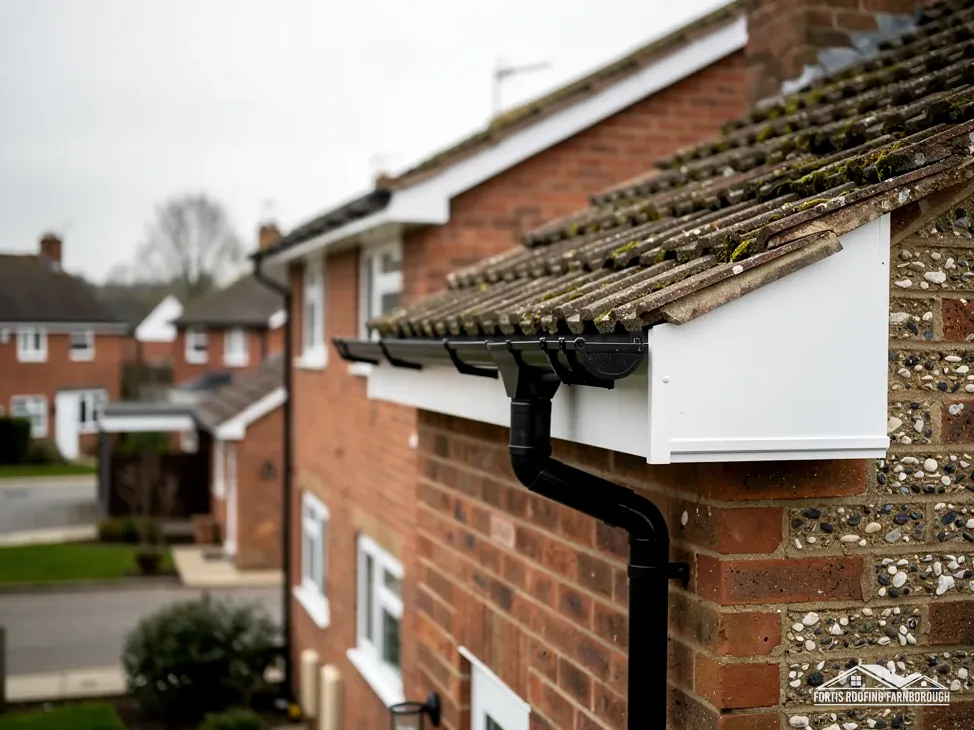
An eaves protection tray is a shaped strip, usually plastic, fixed along the bottom edge of the roof so that the underlay runs onto it and into the gutter. Its job is to carry any water that gets past the tiles down and over the top of the fascia board, instead of letting it soak into the fascia, the rafter ends and the soffit behind. It costs little as a part and can mark the difference between a fascia that lasts and one that rots again.
The best moment to fit one is when the fascia and gutters are being replaced. The old boards are off, the rafter ends are exposed and the felt can be seen, so the tray can be fixed correctly in one go. Fitting a new fascia without one leaves the underlay's weakest point where it was, and the new timber or plastic board starts taking water from day one.
This guide explains how water reaches the eaves, what an eaves tray does, what rotten eaves felt looks like, how the ventilation gap at the eaves must be kept clear and why a fascia replacement is the time to deal with all of it. It is general information, and each roof edge needs a look.
How water reaches the eaves
Rain does not simply fall on the tiles and run off. Some of it is driven up and sideways by wind, some creeps through small gaps between tiles, and some melts off snow and runs back under the laps. All of it ends up on the underlay beneath the tiles, which is built to carry it down to the gutter.
The underlay's route
The underlay is a sheet laid across the rafters under the battens. Water that lands on it runs down the slope towards the eaves. At the bottom edge it should run over the fascia board and into the gutter. If it stops short, or sags, or tears, the water has another route: behind the fascia, onto the rafter feet and into the soffit.
Why the fascia takes the damage
The fascia board sits across the ends of the rafters, and it carries the gutter. If water runs behind it, the top edge and the rafter ends stay wet. Timber that stays damp rots, and plastic boards fixed to rotten rafters or battens lose their grip. A gutter hung on a decayed board sags and leaks, which sends more water back to the same place.
What this looks like from outside
- Dark, flaking or soft paint on the top edge of a timber fascia.
- Gutters that sag in the middle or pull away from the wall.
- Stains on the soffit below, or on the wall under the eaves.
- Moss or green growth on the fascia and soffit.
Our answer on rotten fascia boards explains how to tell sound timber from rot. The cause is often at the roof edge, not in the board itself.
What an eaves protection tray does
An eaves protection system fixes the weak link. It is a long, shaped strip that sits on the top of the fascia and on the rafter ends, and it forms a continuous slope from the underlay into the gutter.
How it works
The tray is fixed so that its upper edge sits under the underlay, and its lower edge reaches beyond the fascia into the gutter. Water running down the underlay lands on the tray and slides over the fascia into the gutter. It cannot run behind the board, because the tray is in the way and slopes outward.
What it protects
- The top edge of the fascia, which stays dry.
- The rafter ends and the wall plate, where rot can start unseen.
- The soffit and its fixings.
- The back of the gutter and its brackets.
What it does not replace
A tray does not replace sound underlay, nor does it cure a leak higher up the roof. It deals with the specific problem at the eaves. If the underlay above is torn or perished, that needs its own repair. And it is not a ventilation system, though many trays include a vent section, which is covered later in this guide.
Different forms
Trays come as a plain tray, a tray with a built-in ventilation strip, or a combined unit that also supports the bottom row of tiles. Which suits depends on the roof pitch, the tile type and whether the soffit is ventilated.
On a survey we measure the fascia depth and the overhang, and we note the existing underlay's finish at the eaves, so the tray chosen fits the roof you have.
Why a fascia change should include one
Replacing a fascia without checking the eaves is half a job. The new board will hang where the old one did, and the underlay will still end wherever it ended before. If it ended short, the same water takes the same route.
The access argument
When the old fascia comes off, the rafter ends, the edge of the underlay and the bottom of the tiles are all open to see and reach. That is the one point at which fitting a tray is quick. Once a new fascia and gutter are up, getting the tray in means taking them down again.
What happens without it
A new fascia with an unprotected edge can start taking water straight away. If the underlay stops at the back of the board, water runs behind it. In a few seasons, the top edge of a timber board darkens again and a plastic board shows staining and movement. The cost of doing it twice is far more than the cost of the tray.
What a good fascia job includes
- Inspect the rafter ends and treat or replace any rotten timber.
- Check the underlay at the eaves and repair or replace it where it is torn or short.
- Fit an eaves protection tray under the underlay and over the fascia.
- Fix the new fascia, and soffit if needed, with a ventilation path kept open.
- Hang the gutter with brackets at the right spacing and a fall to the outlet.
Our guide on fascia capping and full replacement explains why a cap over old boards cannot do this work. A cap hides the board, but cannot reach the underlay behind it.
Rotten eaves felt and what it looks like
Old roofs often have bitumen felt as underlay, laid decades ago. Felt ages, and the eaves is where its decline shows first, because it carries the most water and gets the most sun and frost.
Signs of failed eaves felt
- Felt that has gone brittle and cracked, or turned to crumbs at the edge.
- A sag in the felt where it hangs into the gutter, collecting water in a pocket.
- Felt that stops at the back of the fascia, or never reached it.
- Dark, wet timber beneath, with a smell of damp.
- Rust on nails and black staining on rafters.
Why it matters
Felt that sags forms a trough, and water standing in the trough soaks the timber. Felt that is too short sends water behind the board. In both cases the wood below is wetted again and again, and decay is only a matter of time. A fascia replaced over bad felt does not stay sound.
How it is put right
The bottom courses of tiles are lifted at the eaves. The old felt is cut back to sound material and a strip of new underlay is lapped under the existing felt above, so water runs outward. An eaves tray is fixed at the bottom, and the tiles are relaid. It is a small job compared with a re-roof, and it can be done as part of the fascia work.
When it is a bigger problem
If the felt is perished across the whole roof, the underlay is spent, and the question of re-covering arises. See our guide to repairing or replacing a roof.
Keeping the ventilation gap open
An eaves tray sits where a roof also needs to breathe, so the two have to work together. A loft that cannot vent gathers condensation, and the damp attacks the same timber the tray is trying to protect.
What the guidance says
Marley's guidance for a cold roof with an HR underlay, a high-resistance, non-breathable type, is an eaves opening of 10 mm on pitches above 15 degrees and 25 mm on pitches of 15 degrees or less. Where a breather (LR) underlay sits above a well-sealed ceiling, Marley points to the incidental gap of 3 mm that ordinary eaves construction leaves, subject to third-party certification. BS 5250:2021, listed as current but under review, is the standard behind this.
Why trays and vents work together
Many trays include a vent strip so that the eaves ventilation is kept open while the tray carries the water. Where the soffit is solid, an over-fascia vent or a soffit vent can supply the air. Our guide to soffit and over-fascia ventilation sets out the options.
Insulation at the edge
Loft insulation packed tight into the eaves can close the gap, which leaves the tray's vent doing nothing. A baffle holds the insulation back and keeps the air path open. We check that on the survey from inside the loft.
Why it is worth getting right
A roof that is dry outside and damp inside still rots. The tray keeps rain off the timber, the vent carries moisture away and the insulation baffle protects the gap. Doing all three in one visit is more reliable than doing them one at a time.
The detail depends on your underlay and your pitch, so we measure them before choosing the parts.
What to ask for and what to expect
A fascia and gutter job is often quoted as a single item, so it helps to know what a sound one contains and to ask the right questions.
Questions to ask
- Will an eaves protection tray be fitted, and where does the underlay end?
- Are the rafter ends and the underlay at the eaves being checked, and repaired where needed?
- How will the eaves ventilation be kept open, and is there a vent in the tray, soffit or fascia?
- Are the brackets spaced to carry a gutter full of water?
- Is the new gutter set with a fall to the outlet?
- Who removes the old boards and gutters?
What the survey gives you
We photograph the existing eaves, including the rafter ends, the felt edge and the gutter fall, and we measure the fascia. The photographs show what is rotten, what is sound and what a tray would fix. That evidence is what turns a general quote into a precise one.
Access and scaffold
Eaves work on a two-storey house needs safe access, usually scaffold or a tower. If the scaffold overhangs a pavement or road, Highways Act 1980 section 169 requires a licence, with notice. We agree with the scaffolder who applies, and tell you before work starts.
The quote
The written quote is one total price after the survey. It names the fascia, the tray, any soffit work and the gutter. See our gutters, soffits and fascias page for the full range of work.